


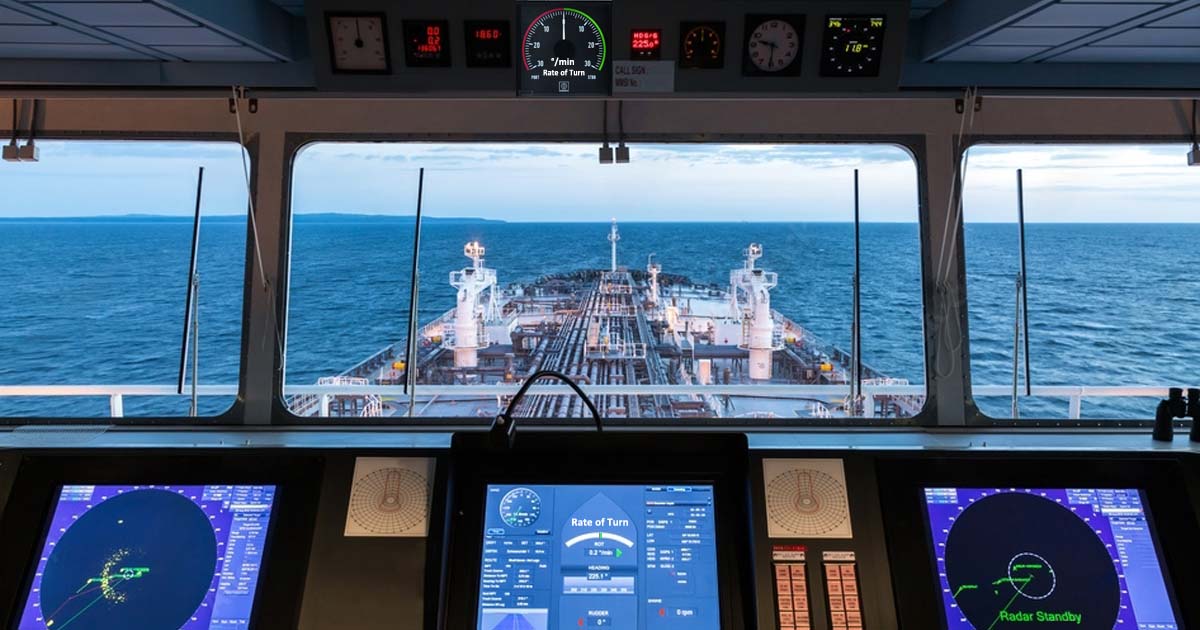
The Rate of Turn Indicator (ROTI) is a critical navigational instrument used to monitor a ship’s turning motion in real-time.
It displays the rate at which a vessel is turning to port (red) or starboard (green), measured in degrees per minute.
This tool enhances situational awareness, especially during channeling, tight maneuvers, and low visibility conditions.
Whether you’re a cadet learning helm watch or a seasoned AB steering in narrow straits, understanding ROTI helps you anticipate, correct, and control ship movements effectively.
🔍 What Is a Rate of Turn Indicator?
A Rate of Turn Indicator is an onboard device that displays the angular velocity of a ship’s heading change. It shows:
- Left (Port) Turns – Pointer swings to the red-colored side.
- Right (Starboard) Turns – Pointer swings to the green-colored side.
- Zero Movement – Pointer remains at center when the vessel is moving straight.
The color coding aligns with the navigation side lights convention to avoid confusion on the bridge.
📍 Where Can You Find the ROTI on the Bridge?
ROTI is installed prominently across various ship systems. Common placements include:
- Above the helmsman’s station on the bridge ceiling, near the speed indicator, rpm gauge, clock, and course repeater.
- Conning display, directly in front of the steering wheel.
- ECDIS overlays, showing predicted track lines that incorporate the vessel’s rate of turn and current speed.
🧭 This redundancy ensures visibility from multiple positions, including the master’s chair and OOW stations.

⚖️ Regulations on Rate of Turn Indicator
📘 SOLAS Requirements
Under SOLAS Chapter V, Regulation 19 Paragraph 2.9.1, ROTI is mandatory on:
“All ships of 50,000 gross tonnage and upwards shall, in addition to meeting the requirements of paragraph 2.8, have a rate-of-turn indicator or other means to determine and display the rate of turn.”
While the regulation mandates it for ships ≥50,000 GT, many smaller vessels still carry it for safety and redundancy.
🌐 IMO Performance Standards
IMO Resolution A.526(13) sets performance standards for ROTIs, including:
- Scale length
- Sensitivity
- Linear range
- Accuracy tolerance
- Design & operational requirements
Compliance ensures all ROTIs provide reliable, standardized output regardless of manufacturer or bridge setup.
📐 Rate of Turn Formula (With Example)
If your vessel’s ROTI fails or is unavailable, you can calculate the Rate of Turn (ROT) manually using this formula:
🧮 ROT (°/min) = (57.3 × V) / (R × 60)Where:
- V = Ship’s speed (knots)
- R = Radius of turn (nautical miles)
- 57.3 = Converts radians to degrees
- 60 = Converts per second to per minute
🔎 Example:
If a ship moves at 12.5 knots and turns with a 1.0 NM radius:
ROT = (57.3 × 12.5) / (1 × 60) = 11.94°/min
This formula is useful for wheel-over point calculations, especially in manual navigation or training scenarios.

⚓ Real-Life Use Cases of the Rate of Turn Indicator (ROTI)
As a helmsman, I found the ROTI to be one of the most useful bridge instruments, especially in challenging conditions where visual cues were minimal.
Here’s how we used it to enhance steering accuracy, course stability, and turn prediction.
🔄 Common Scenarios Where ROTI Is Essential
- Restricted Visibility – ROTI helps track turn progress when there’s fog, rain, or zero visibility.
- Nighttime Steering – When no lights or visual bearings are available, ROTI guides course adjustments.
- Managing Vessel Swing – Avoids over-turning by monitoring rate and applying timely rudder correction.
- Steady Course Maintenance – Helps keep the vessel on a straight track even in crosswinds or current.
- Bad Weather – During rough seas or strong winds, ROTI gives feedback to maintain helm control.
- No Fixed Reference Points – Useful when landmarks or stars are obscured by glare or clouds.
- Channeling and Narrow Waters – Establishes mental benchmarks for safe turning angles.
- Helm Orders Verification – Confirms if the ship is responding after rudder is applied.
⚠️ Pro Tip: Inexperienced helmsmen often over-rely on visual cues. By incorporating ROTI readings into your decision-making, you reduce guesswork- especially during sudden helm orders or sharp maneuvers.
🧭 Limitations and Cross-Checks
While the Rate of Turn Indicator is reliable, it isn’t foolproof. Mechanical or sensor failures can result in inaccurate readings.
🧠 Best Practice: Use Visual Cross-Checking
If you suspect an error, observe the ship’s mast movement against fixed objects on the horizon.
This traditional method acts as a natural rate-of-turn indicator.
“Trust the equipment- but verify with the sea.”
Also, cross-reference the ROTI with tools like:
- Gyro compass repeater
- ECDIS turn predictor
- AIS vector trails
- Radar overlays
This redundancy builds confidence in your helm decisions and prevents navigational surprises.
❓ Frequently Asked Questions (FAQs)
✅ What does a Rate of Turn Indicator measure?
It measures how fast a ship is turning in degrees per minute, either to port (left/red) or starboard (right/green).
✅ Is ROTI mandatory on all ships?
No. SOLAS requires it on ships 50,000 GT and above, but many smaller vessels install it voluntarily for safety.
✅ Can I calculate the Rate of Turn manually?
Yes. Use the formula:
ROT (°/min) = (57.3 × Speed in knots) / (Turn radius in NM × 60)✅ Where is the ROTI located on the ship?
Typically above the helmsman’s station, on the conning display, or integrated into ECDIS and bridge navigation systems.
✅ Can the ROTI fail or give wrong readings?
Yes. That’s why visual observation and cross-checking with other navigation tools is always advised.
🧭 Final Thoughts: Mastering the Turn
Understanding the Rate of Turn Indicator goes beyond just knowing its display- it’s about developing situational awareness, anticipation, and control in real-time maneuvers.
🧑✈️ Whether steering during heavy traffic, foggy night shifts, or coastal approaches, the ROTI is your silent partner in precision navigation.
📢 Call to Action
Want more real-world tips like this?
Subscribe to CaptainsMode.com for expert insights on shipboard operations, bridge equipment, and seamanship essentials.
✅ Bookmark this guide and share it with your deckmates who are learning helm work. It could save them from oversteering or missing a crucial turn.
May the winds be in your favor.


Leave a Reply