

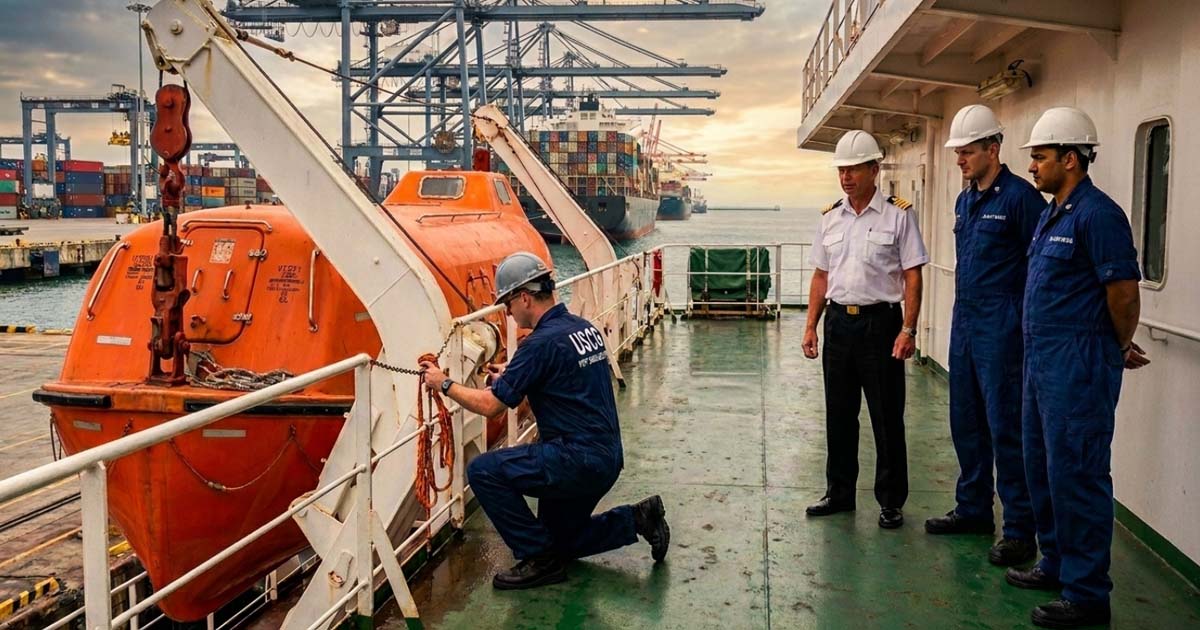
In 2025, the U.S. Coast Guard’s Port State Control program issued 78 vessel detentions across 8,999 SOLAS safety exams.
Two deficiency categories accounted for 41% of every detention: Safety Management System (SMS) failures (22%) and fire safety deficiencies (19%).
At the individual-deficiency level (not just detentions), Ballast Water Management Systems were the single most frequently cited defect, appearing 77 times.
This article ranks every major detainable deficiency category, highlighting what inspectors are actually finding on board.
Quick Answer: What Are the Most Common Detainable Deficiencies?
According to the 2025 USCG Port State Control Annual Report, the leading detainable deficiencies were:
| Rank | Category | Total Deficiencies |
| 1 | Safety Management Systems | 62 |
| 2 | Fire Safety | 53 |
| 3 | Ship Certificates & Documentation | 14 |
| 4 | Lifesaving Appliances | 13 |
| 5 | Working and Living Conditions | 13 |
These categories account for a large portion of vessel detentions and remain consistent with findings from previous PSC campaigns worldwide.
Why Do PSC Deficiencies Matter? 🚨
A detainable deficiency means that a vessel’s condition, equipment, documentation, or operational readiness is considered unsafe or substantially non-compliant with international regulations.
The U.S. Coast Guard defines a detention as intervention on a foreign vessel when its condition or crew does not substantially meet applicable international conventions, creating risks to:
- The vessel
- The crew
- Port facilities
- Navigation safety
- The marine environment
Detentions can lead to:
- ❌ Operational delays
- ❌ Charter party disputes
- ❌ Commercial losses
- ❌ Increased PSC targeting
- ❌ Reputational damage
- ❌ Flag State scrutiny
USCG statistics currently show a detention ratio of 0.86%.
1. Safety Management Systems — The #1 Cause of Detention 📋
SMS-related detainable deficiencies actually declined in 2025, dropping from 65 to 51 cases year-over-year, yet the category still tops the list. The breakdown of those 62 detention-linked SMS deficiencies:
| SMS Sub-Category | Share |
| Maintenance of ship & equipment | 55% |
| Shipboard operations | 13% |
| Company responsibility & authority | 8% |
| Emergency preparedness | 8% |
| Other (ISM) | 6% |
| Safety & environmental policy | 3% |
| Reports of non-conformities | 3% |
| Master’s responsibility | 3% |
Real PSC Findings
The pattern PSCOs describe is consistent: an SMS deficiency rarely shows up as a standalone paperwork failure.
More often, the inspector finds a cluster of unrelated technical or operational defects during a single exam, and that cluster becomes the evidence that the SMS isn’t functioning in practice — not just that one piece of equipment failed.
In one documented 2025 case, a PSCO found unauthorized flammable cargo aboard a vessel whose SMS had no requirement for the master or crew to verify dangerous goods compliance before loading — an SMS gap that produced a cargo-safety detention.
Why this matters: A string of three or four unrelated minor findings in one exam is not bad luck. It is, in the Coast Guard’s own framework, the evidence base for an SMS detention.
How Ships Can Avoid SMS Deficiencies
Masters should:
- Conduct realistic drills
- Review corrective actions monthly
- Ensure procedures match actual practice
- Monitor overdue maintenance items
Companies should:
- Strengthen internal audits
- Address recurring deficiencies immediately
- Analyze trends fleetwide
- Verify implementation rather than documentation alone
2. Fire Safety Deficiencies 🔥
Fire safety has led all operational deficiency categories for five consecutive years, with 53 detainable deficiencies in 2025:
| Leading Fire Safety Findings | Share |
| Oil accumulation in engine room | 28% |
| Fire detection & alarm systems | 26% |
| Fixed fire extinguishing installations | 13% |
| Fire doors / openings in fire-resisting divisions | 9% |
| Fire drills / crew performance | 9% |
| Remote means of control | 8% |
| All other | 6% |
Oil accumulation — oil-soaked lagging, active fuel leaks, excess oil in the bilge, and combustible material stored loose in the engine room — remains the single most common fire safety finding, though it eased slightly from 18 cases in 2024 to 15 in 2025.
Fire detection failures typically involved non-functioning smoke detectors or unworkable test equipment; in one case, an entire cargo-hold fire detection system was found completely disconnected, triggering detention.
Fire door deficiencies were dominated by holes, warping, and gaskets worn past the point of providing a proper seal.
Several ships were detained because cargo hold smoke detection systems were disconnected.
Relevant Regulations
- SOLAS Chapter II-2
- ISM Code
- FSS Code
Best Practices
- ✅ Weekly machinery space inspections
- ✅ Eliminate oil leaks immediately
- ✅ Test detectors regularly
- ✅ Keep escape routes clear
- ✅ Inspect fire doors during rounds
3. Ship Certificates and Documentation 📑
Ship certificate deficiencies produced 14 detainable findings in 2025, accounting for 5% of all detentions.
The count is relatively low, but the consequences are disproportionate — a single expired certificate can prevent a vessel from departing port regardless of her physical condition.
Frequent Findings
- Expired statutory certificates
- Expired endorsements
- Missing records
- Invalid Safe Manning Documents
- STCW non-compliance
- Security certification issues
Documentation deficiencies continue to cause unnecessary detentions despite being among the easiest deficiencies to prevent.
Critical Certificates PSC Inspectors Verify
| Certificate | Convention | Share |
| Safety Management Certificate | ISM | 36% |
| Cargo Ship Safety Construction | SOLAS | 29% |
| Load Line Certificate | Load Line Convention | 7% |
| ISSC | ISPS | 14% |
| Minimum Safe Manning Document | SOLAS | 14% |
Prevention Measures
Create:
- A certificate tracker
- Monthly expiry review meetings
- Digital reminders
- Internal PSC checklists
4. Lifesaving Appliances Deficiencies ⚓
Detainable deficiencies in the lifesaving appliances category fell meaningfully in 2025, from 20 findings the prior year down to 13.
However, rescue boats and lifeboats still dominated every sub-category, and the nature of the deficiencies is serious: these are pieces of equipment that exist specifically for when everything else has gone wrong.
Common Findings
- Rescue boats unable to start
- Lifeboat engines defective
- Launching systems not operational
- Expired provisions
- Poor maintenance
- Damaged equipment
This is worth examining in context. Lifeboats and rescue boats are among the most infrequently used pieces of equipment on any vessel — which is precisely why they accumulate neglect.
Weekly inspections and monthly drills are required under SOLAS, but what PSCOs consistently find is that maintenance records exist on paper while the actual equipment sits in a degraded state.
Applicable Regulations
- SOLAS Chapter III
- LSA Code
- MSC.402(96)
5. Working and Living Conditions 🏠
Working and living conditions generated 13 detainable deficiencies in 2025.
The USCG’s own report marks this as the first time the category has produced enough findings to be recognized in the detention overview.
That’s a notable threshold as previous years saw scattered findings that didn’t collectively reach the level warranting specific mention.
Findings included:
- Unsafe electrical installations
- Defective accommodations
- Improper cargo stowage
- Habitability concerns
These deficiencies may also overlap with requirements under the Maritime Labour Convention (MLC 2006).
The Paris MoU’s 2024 data similarly identified health, medical care, and welfare under MLC Title IV as responsible for 10.4% of all recorded deficiencies across European and North Atlantic ports, signaling that this area of enforcement is growing globally, not just in the U.S.
What PSC Inspectors Look for During Examinations 🔍
The Coast Guard evaluates multiple risk indicators before deciding inspection scope.
These include:
- Flag State performance
- Classification society records
- Previous detentions
- Casualty history
- Deficiency trends
- Vessel age
- Ship type
- Security records
- QUALSHIP 21 participation
Ships with poor compliance histories are more likely to receive expanded examinations.
Lessons Learned for Seafarers ⚓
The recurring nature of PSC deficiencies shows that most detentions are preventable.
A simple principle applies:
A deficiency rarely appears overnight. Most detentions result from unresolved issues that have accumulated over time.
Shipboard teams should prioritize:
Masters
- SMS implementation
- PSC preparation
- Drill quality
- Corrective action follow-up
Chief Engineers
- Oil leak elimination
- Fire safety readiness
- Machinery maintenance
- Alarm testing
Chief Officers
- Lifesaving appliances
- Documentation control
- Cargo safety
- Security procedures
Companies
- Trend analysis
- Fleet benchmarking
- Internal audits
- Root cause investigations
Frequently Asked Questions
What is the single most common detainable deficiency category in 2025?
Safety Management System failures, responsible for 22% of all detentions, followed by fire safety deficiencies at 19%.
What’s the difference between a “deficiency” and a “detainable deficiency”?
A deficiency is any finding that falls short of a convention requirement. A detainable deficiency is severe enough — alone or in combination — to prevent the ship from proceeding to sea until corrected.
What is the USCG detention ratio in 2025?
The detention ratio was 0.86%, with 78 detentions from 8,999 PSC examinations.
Why are fire safety deficiencies so common?
Fire hazards develop gradually through poor housekeeping, inadequate maintenance, oil leaks, defective alarms, and ineffective inspections. Fire safety has remained the leading operational deficiency category for five consecutive years.
Which convention governs Safety Management Systems?
The International Safety Management (ISM) Code, adopted under SOLAS Chapter IX.
Are most PSC detentions preventable?
Yes. The majority of deficiencies identified by PSC inspectors involve maintenance, documentation, operational readiness, and procedural implementation that can be corrected before arrival in port.
Conclusion ⚓
The 2025 USCG PSC Annual Report sends a clear message to the industry: vessels are still being detained for familiar and avoidable reasons.
Safety Management Systems, fire safety, certificates, lifesaving appliances, and living conditions remain the areas most likely to attract PSC attention.
For shipowners and crews alike, the best PSC strategy is not preparing for the inspection itself, but maintaining a culture where compliance becomes routine, deficiencies are corrected early, and the Safety Management System functions exactly as intended.
May the winds be in your favor.
Leave a Reply