


The global maritime industry powers over 80% of international trade, but fewer young people are choosing a career at sea.
Many parents- especially those who are seafarers themselves, face a tough decision:
Should they encourage their children to pursue the same path or steer them toward opportunities ashore?
This article analyzes insights from a comprehensive seafarer survey: The CaptainsMode Seafarer Survey, revealing the realities of life at sea, the motivations behind choosing this career, and the concerns shaping decisions for the next generation.
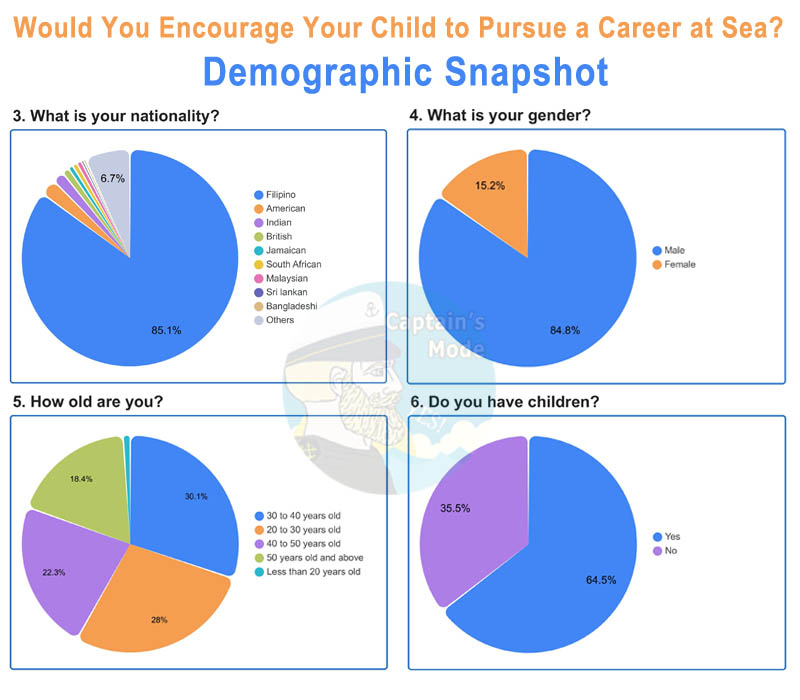
1. Who Are Today’s Seafarers? A Demographic Snapshot 🌍
The survey paints a clear picture of the modern maritime workforce:
| Category | Key Insights |
|---|---|
| Dominant Nationality | 85.1% of respondents are Filipino seafarers, reaffirming the Philippines as the world’s top supplier of maritime labor. Other represented nationalities include Americans, Indians, Jamaicans, Malaysians, Sri Lankans, and British. |
| Gender Representation | The industry remains male-dominated– 84.8% male vs. 15.2% female, but female participation is steadily increasing, especially on passenger ships and tankers. |
| Age Distribution | Most seafarers fall within 30–40 years old (30.1%), followed by 20–30 years old (28%), 40–50 years old (22.3%), and 50+ years old (18.4%). This shows a healthy mix of mid-career professionals and seasoned veterans. |
| Family Life | 64.5% of seafarers have children. Among them, 34% have kids aged 10–20, and 30.9% have children under 10– a major factor influencing career decisions. |
Key Insight: The modern seafarer workforce is Filipino-heavy, family-driven, and mid-career oriented. For parents, family life significantly influences whether they’d recommend a maritime career to their children.
2. The Allure of the High Seas: Why Seafarers Choose This Career 🌟
Despite the risks, many seafarers continue to recommend life at sea.
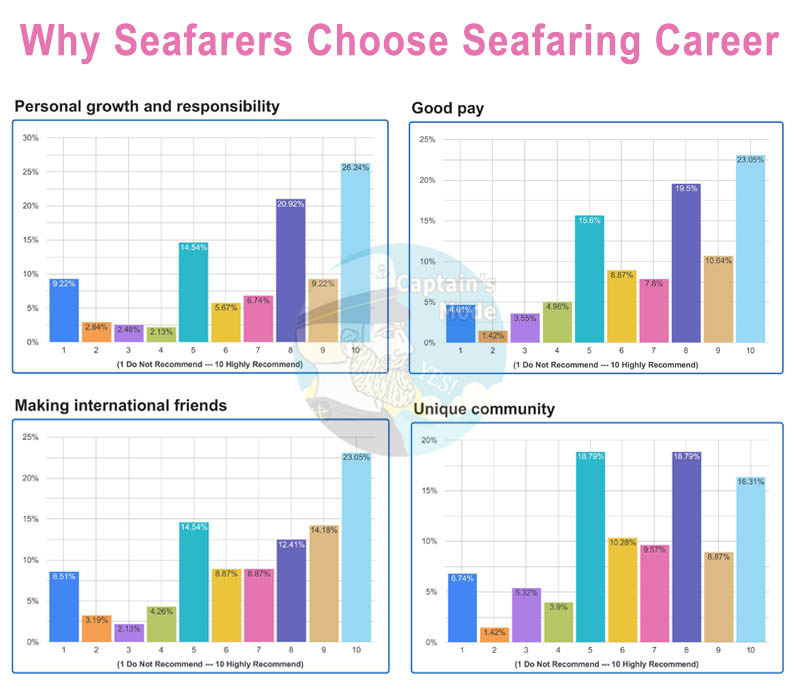
The survey highlights key motivators and how they shape career perceptions:
| Motivator | % Highly Recommend (8-10/10) | Key Takeaway |
|---|---|---|
| Skill Development | 61% | Surprisingly, many seafarers encourage their children to pursue a career at sea because it provides high-value technical and practical skills that last a lifetime. |
| Good Pay & Benefits | 53.19% | Competitive salaries remain a major driver. Many believe the financial rewards justify time away from home. |
| Global Friendships | 49.64% | Working with multinational crews fosters strong cross-cultural bonds and networking opportunities. |
| Unique Community Life | 43.97% | Living and working together builds close-knit teamwork and a sense of belonging. |
| Adventure & Travel | 37.94% | While some enjoy exploring ports worldwide, others feel limited by tight schedules and short layovers. |
| Internet at Sea | 29.08% | Connectivity has improved, but access remains inconsistent- impacting morale and family communication. |
3. Navigating the Storm: The Harsh Realities of Life at Sea ⛈️
While the rewards of a maritime career are appealing, the survey highlights significant challenges that heavily influence whether parents want their children to follow the same path.
A. Mental Health & Well-being Struggles 🧠
Seafaring demands long hours, isolation, and extended periods away from loved ones– factors that directly affect mental health:
| Challenge | Strong Impact (8-10/10) | Key Insight |
|---|---|---|
| Family Disconnection | 43.97% | Limited communication affects family bonds, especially for those with young children. |
| Isolation & Loneliness | 40.43% | Being far from family and support networks causes emotional fatigue and low morale. |
| Redundant training taking up vacation time | 40.42% | Repetitive trainings are highly frustrating. Instead of resting or spending time with family, they often have to attend courses, which affects recovery and work-life balance. |
| Health and medical risks | 43.26% | Limited access to proper healthcare, delayed emergency responses, and high-risk working conditions increase physical and mental vulnerabilities. |
| Stress, Anxiety & Depression | 39.36% | Prolonged contracts and high-pressure environments increase psychological strain. |
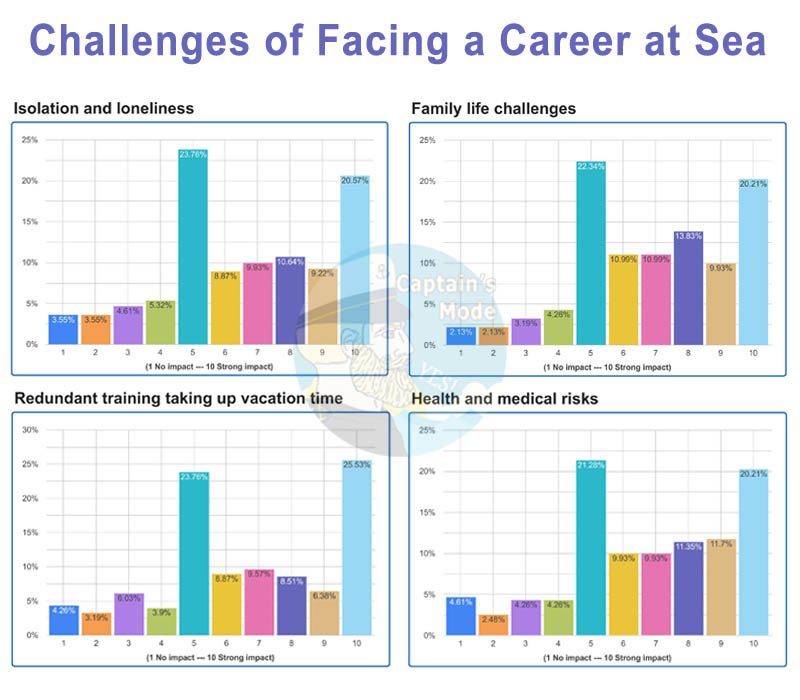
Takeaway: Mental health support is critical for seafarers. Many parents hesitate to recommend this career because they fear the emotional toll on their children.
B. Safety, Health, and Operational Risks ⚠️
Life at sea isn’t just physically demanding – it’s inherently dangerous:
- Safety Hazards 🚨 → 21.28% rated safety concerns as a major impact (10/10). Unsafe working conditions, rough seas, machinery accidents, and extreme weather remain daily risks.
- Piracy & Geopolitical Tensions 🏴☠️ → 14.54% reported piracy concerns, while 15.96% highlighted geopolitical instability in areas like the Red Sea, Black Sea, and Gulf of Guinea.
- Exposure to Fatigue 😴 → Long hours, watchkeeping duties, and insufficient rest lead to operational mistakes and higher accident rates.
Key Insight: These living and working challenges significantly affect how seafarers view the future viability of maritime careers for the next generation.
4. The Parent’s Dilemma: Should Their Children Follow the Same Path? 👨👩👧👦
A core focus of the survey was how seafarers with children feel about passing down the profession.
Here’s what they said:
| Parental Attitude | % of Seafarers | Meaning |
|---|---|---|
| Actively Encourage | 28.4% | Strong belief in the financial rewards and career opportunities at sea. |
| Passively Encourage | 15.2% | Parents are open but cautious, leaving the decision to their children. |
| Neutral | 30.5% | Recognize both pros and cons, preferring children to choose independently. |
| Discourage + Actively Discourage | 25.9% | Driven by safety, mental health, and family separation concerns. |
Why Parents Say “Yes” ✅
- Competitive salaries and global career opportunities 🌎
- Valuable technical and lifelong skills 🛠️
- A sense of pride and tradition in seafaring families ⚓️
Why Parents Say “No” ❌
- Long family separations and emotional strain 💔
- Unstable contracts and unpredictable schedules ⏳
- Mental health challenges 😵💫
- Safety risks are still high
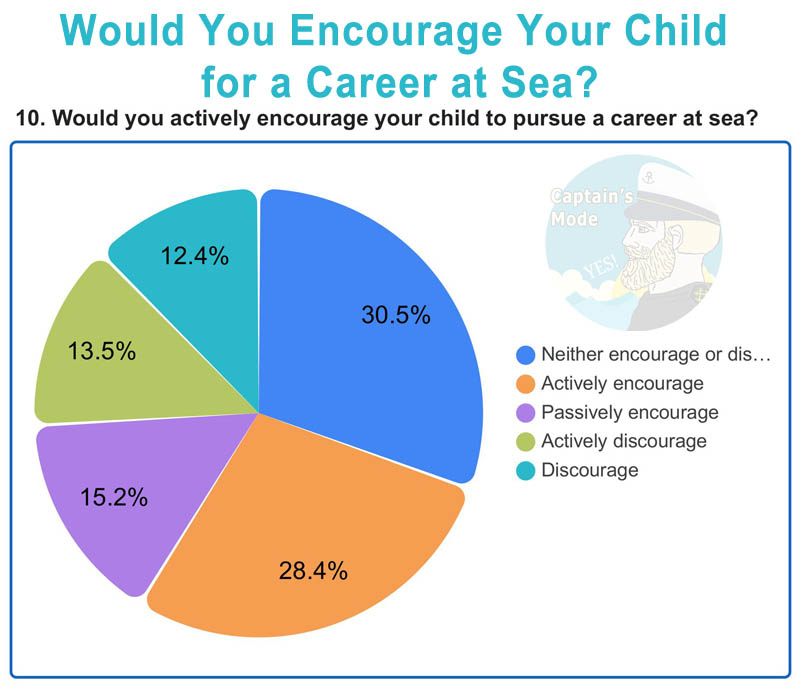
Insight: While nearly 43.6% of seafarers would encourage their kids to pursue a maritime career, a quarter would discourage it. This split reveals a deep generational shift – parents value the pay but fear the hazards.
5. Key Takeaways for Parents, Cadets, and the Maritime Industry 📌
The survey paints a balanced picture of modern seafaring: rewarding yet demanding, profitable yet challenging.
Here are the main insights:
- Filipino Seafarers Dominate the Workforce 🇵🇭 — With 85.1% representation, Filipino families carry a major stake in the maritime industry.
- Skill Development Leads the Way 🧭 — At 61%, skill development is the top driver for why many seafarers would encourage their children to pursue a maritime career, which many would find surprising.
- Financial Incentives Drive Interest 💰 — Good pay remains a major motivator at 53.19%, followed by international camaraderie and unique shipboard life.
- Mental Health & Lifestyle Challenges Persist 😔 — Stress, isolation, and family separation make retention and recruitment difficult. The survey is in parallel with National Library of Medicine’s study Factors Impacting Seafarers’ Mental Health and Career Intentions.
- Parents Are Divided ⚖️ — While 43.6% encourage their children to pursue the profession, 26% actively discourage it, citing emotional, safety, and stability concerns.
- Digital Connectivity Matters 🌐 — Seafarers increasingly demand reliable internet onboard to stay connected with families. Internet today is a deciding factor for many younger cadets.
Bottom Line: If your child is considering a maritime career, they need to weigh the benefits against the realities of life at sea.
6. Practical Advice for Parents & Aspiring Cadets 🧭
Before encouraging your child to chart a course toward seafaring, consider these expert-backed recommendations:
A. For Parents 👨👩👧👦
- Start the Conversation Early — Talk openly about both opportunities and challenges.
- Support Mental Wellness — Understand the emotional toll and explore available support systems for maritime families.
- Explore All Career Paths — Maritime isn’t limited to seafaring; shore-based roles like marine surveying, port operations, and shipping management exist.
B. For Aspiring Cadets 🎓
- Understand the Lifestyle — Be prepared for long contracts and time away from home.
- Focus on Skills That Matter — Prioritize STCW courses, technical certifications, and leadership skills.
- Research Employers Carefully — Look for companies offering mental health programs, family-friendly contracts, and better onboard living conditions.
- Plan a Long-Term Career Map — Consider pathways to transition from shipboard roles to shore-based maritime careers.
7. Future Outlook: Building a Sustainable Maritime Workforce 🌊
If the industry wants to attract the next generation, companies, regulators, and training institutions must address the following:
- Mental Health & Well-being 🧠 → Invest in onboard counseling, better rotations, and family-friendly policies.
- Work-Life Balance ⚓ → Reduce redundant training during vacation periods and improve rest schedules.
- Internet Connectivity 🌐 → Make reliable onboard internet a standard, not a privilege.
- Career Development Opportunities 🎓 → Provide clearer promotion pathways, skill-building programs, and shore-based transition support.
By tackling these issues head-on, the maritime sector can retain talent and ensure its future sustainability.
Get the survey result here: Would You Encourage Your Children to Pursue a Career at Sea?
8. Frequently Asked Question FAQ ❓
Q1. Should I encourage my child to pursue a maritime career?
It depends on their interests and resilience. A seafaring career offers good pay and global opportunities, but comes with long absences, safety risks, and lifestyle challenges.
Q2. What motivates most seafarers to join the industry?
Top motivators include competitive salaries, skill-building opportunities, and global travel. Many also value the unique camaraderie among multinational crews.
Q3. Why do some parents discourage their children from becoming seafarers?
Key reasons include family separation, mental health struggles, safety concerns, unstable contracts, and demanding schedules.
Q4. Are there alternatives to working onboard ships?
Yes. Aside from shipboard roles, seafarers can pursue shore-based careers in port operations, logistics, marine surveying, and shipping management.
Q5. Is the maritime industry improving working conditions for future seafarers?
Yes, slowly. Many companies are now prioritizing mental health support, better rotations, and digital connectivity to make careers at sea more sustainable.
🌊 Ready to Help the Next Generation Navigate Their Maritime Journey?
If you’re a parent, cadet, or maritime professional, understanding the realities of a career at sea can make all the difference.
✅ Explore our Career Guides for aspiring seafarers
✅ Read our Minimum STCW Courses Per Rank before starting cadetship
✅ Join the CaptainsMode Community and connect with thousands of seafarers worldwide!
📌 Your insights matter! Share your thoughts in the comments below- would you encourage your child to become a seafarer?
May the winds be in your favor.
Leave a Reply