



The Black Sea is one of the world’s most intriguing inland seas, with mysterious origins, strategic shipping importance, and unique oceanographic traits.
For seafarers navigating this region or curious about maritime geography, understanding the Black Sea is essential knowledge.

Why Is It Called the “Black Sea”?
Etymology & Myth
The Greeks initially called it Pontos Axeinos or “Inhospitable Sea,” later changing it to Eúxeinos Póntos– the “Hospitable Sea”, after colonization.
The term “Black” may also relate to cardinal directions from ancient Persian culture and the Achaemenid Empire, where black denotes the north.
Strategic Maritime Relevance
- Enclosed sea with only one navigational outlet: The Bosporus Strait
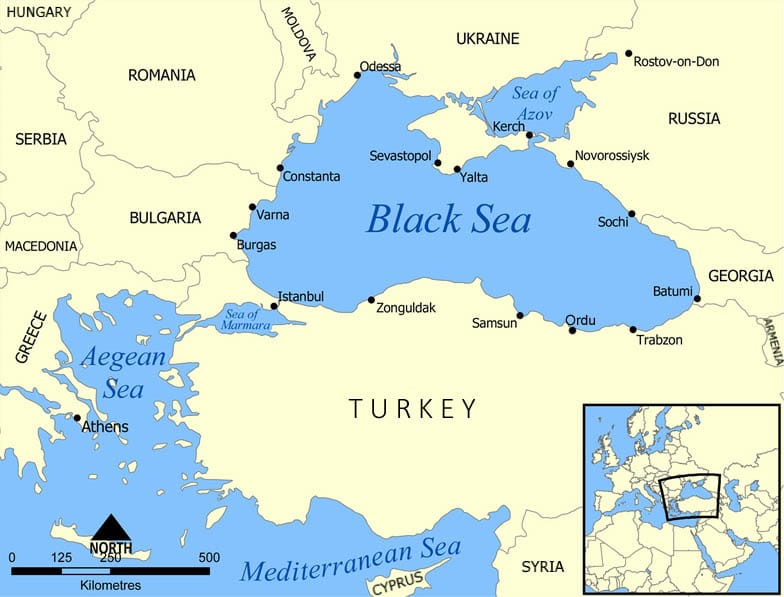
- Critical for access to Russia, Ukraine, Romania, Bulgaria, and Georgia
- Subject to military closures during conflicts (e.g., under the Montreux Convention)
- Special Navigation Rules in Narrow Straits must be followed when passing.
Unique Physical Characteristics
Largest Meromictic Basin
- Upper oxygen-rich layers do not mix with deeper waters
- 90% of deep waters are anoxic (devoid of oxygen)
- Rich in Hydrogen Sulfide (H₂S)– the world’s largest deposits
No Tides, But Currents Exist
- Surface and deep currents operate in opposite directions
- Absence of traditional tidal behavior
- Two-way undersea currents in Bosporus and Kerch Straits

Fascinating Maritime Facts
- Second Largest Sea in Europe – 168,500 square miles.
- Landlocked Sea – Entry/exit only via Bosporus → Marmara → Dardanelles → Aegean → Mediterranean.
- Hitler’s Lost Fleet – German U-boats secretly transported into the Black Sea, sunk and rediscovered.
- Freshwater Origins – Salinity is 50% lower than ocean water; theorized to be a freshwater lake during the Ice Age.
- Toxic Threat – H₂S layer could trigger a mass extinction if disturbed by a seismic event.
- No Black Sea Bass – Despite the name, this fish is only found off the U.S. Atlantic coast.
Countries Bordering the Black Sea
- Turkey, Bulgaria, Romania, Ukraine, Russia, Georgia
- Each has access limitations, shipping policies, and exclusive economic zones (EEZs)
What Seafarers Should Know
- Navigation via Bosporus may require local pilotage
- Expect fog, seasonal storms, and poor visibility
- Military conflicts can shut down commercial shipping lanes
- H₂S below 200m = no marine life → risk for deep-sea recovery
FAQs
Why does the Black Sea have no tides?
Due to its enclosed nature and small size, gravitational tidal effects are minimal. Most level changes are due to atmospheric pressure or seasonal inflows.
Why is the Black Sea anoxic?
The sea’s stratified water layers prevent oxygen-rich surface water from mixing with deep layers, creating a toxic environment below 200m.
Conclusion
The Black Sea is a historically rich, geologically unique, and geopolitically critical body of water.
For modern seafarers, knowing its facts, myths, and hidden dangers enhances both safety and maritime awareness.
May the winds be in your favor.
Leave a Reply