


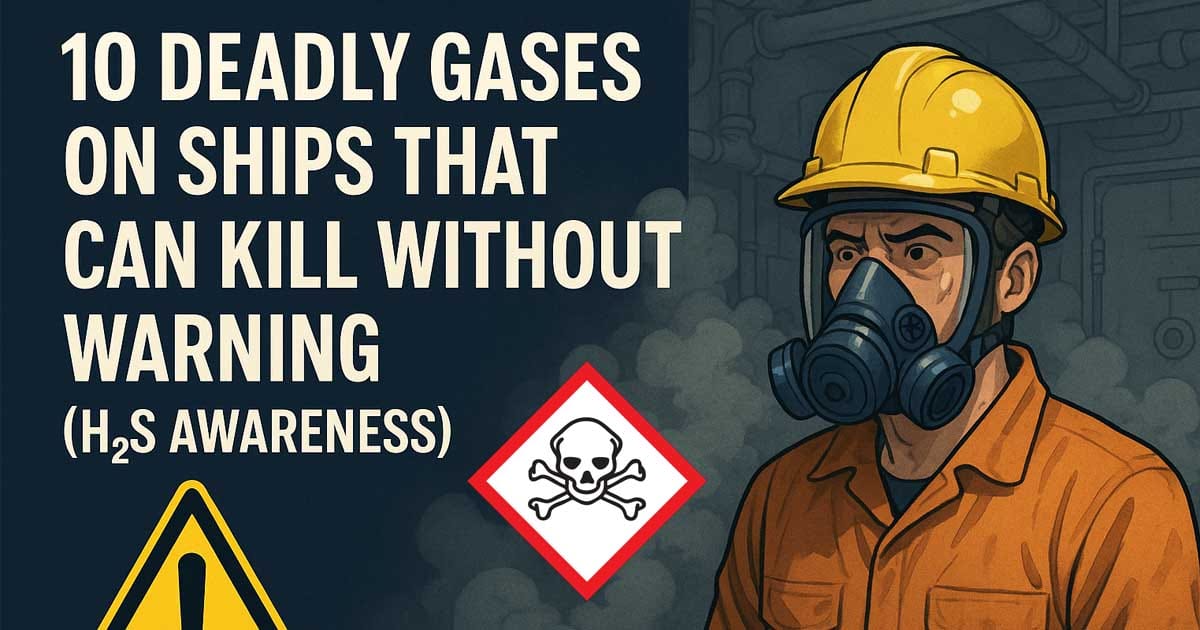
Toxic gases are among the deadliest, silent threats on board merchant vessels.
Unlike fatigue or depression, which build over time, dangerous gases can incapacitate or kill within seconds- often without warning.
You may be working inside what looks like a normal paint locker, tank, or pump room… but invisible killers could be lurking.
And it’s still a hard truth today: confined space fatalities remain a leading cause of death among seafarers, with over 50% of these involving would-be rescuers who entered without proper protection (IACS report).
💀 No smell. No sound. No warning. Just collapse. That’s the danger of these gases.
In this article, we’ll expose the 10 most dangerous gases at sea, explain where they’re found, why they’re lethal, and how to stay alive by applying best practices from ISGOTT, STCW, and industry accident reports.
☣️ Why Are These Gases So Dangerous On Ships?
Maritime environments amplify the risks posed by hazardous gases due to the following:
- Invisible & Odorless – Most gases cannot be seen or smelled, especially in confined spaces.
- Rapid Incapacitation – A single breath can cause collapse before you realize what happened.
- Asphyxiant Properties – They displace oxygen, silently suffocating victims.
- Multiple Entry Routes – Some gases can be absorbed through skin contact.
- Limited Detection – Requires calibrated gas detectors (portable and fixed).
- Flammability – Many are highly explosive in the presence of sparks or open flames.
- Enclosed Space Presence – Poor ventilation traps and concentrates gases.
- Rescue Challenges – Difficult or delayed rescue operations due to toxic or oxygen-deficient atmospheres.
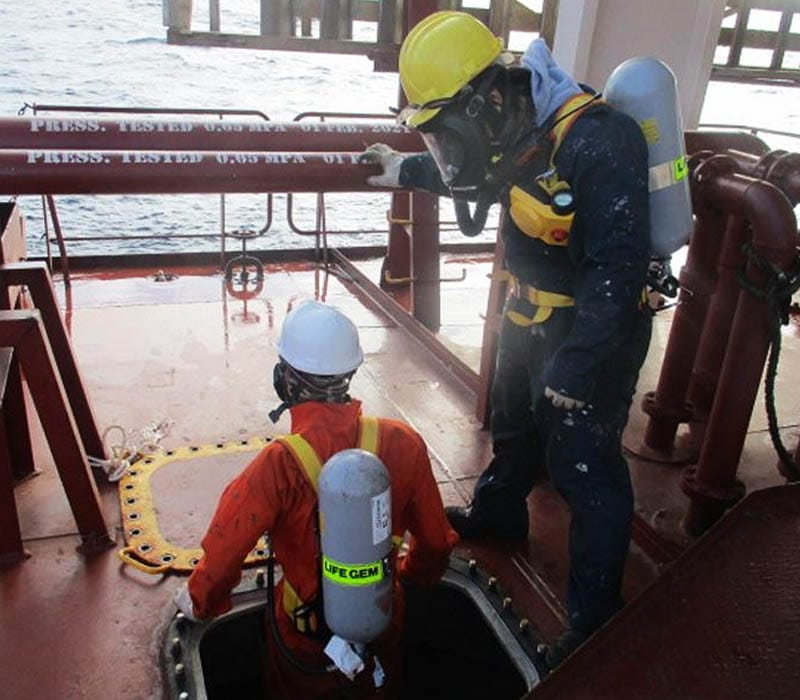
🧪 Top 10 Dangerous Gases Found on Ships
🔐 Always test the atmosphere before entry. Never assume a space is safe just because it “looks” empty.
1. Hydrogen Sulphide (H₂S) – The Silent Killer
- Where Found: Crude oil tanks, slop tanks, sewage systems, sludge tanks, adjacent spaces.
- TLV: 10 ppm (Threshold Limit Value, Occupational Safety and Health Administration (OSHA) guidance)
- Why It’s Dangerous: H₂S numbs your sense of smell. At higher concentrations, a single breath can cause collapse or death in seconds.
- Smell: Rotten eggs at low concentrations only. Beyond that, your nose can’t detect it.
- Safety Tip: Use calibrated H₂S detectors and ventilate enclosed spaces. Always conduct full gas testing before entry.
- Real Case: Multiple rig workers died from H₂S exposure on a jack-up rig. (IMHF Gdynia Report)
⚠️ Remember: If you “stop smelling” H₂S, it’s not gone. Your sense of smell is and you’re in extreme danger.
2. Carbon Monoxide (CO)
- Where Found: Engine exhausts, boiler uptakes, internal combustion engines, cargo fires.
- TLV: 25 ppm
- Why It’s Dangerous: CO binds to hemoglobin very much faster than oxygen, leading to internal suffocation even in open-air spaces.
- Smell: None (odorless, tasteless, invisible).
- Safety Tip: Ensure proper exhaust ventilation in engine rooms. Use CO gas monitors when working near combustion sources.
- Real Case: One crew member died and two were airlifted after CO poisoning on a fishing vessel. (The Shipowners’ Club)
3. Methane (CH₄)
- Where Found: LNG carriers, coal cargo holds, sewage systems, ballast tanks, fuel storage.
- TLV: Not directly toxic but asphyxiant at high concentrations
- Why It’s Dangerous: Displaces oxygen and can form explosive atmospheres with air.
- Smell: Odorless and colorless (in industrial settings, odorants are added but not on ships).
- Safety Tip: Test oxygen and explosive limits (LEL/UEL) before entry. Use explosion-proof tools.
- Real Case: Methane buildup from coal cargo caused an explosion aboard the “Great Aspiration.” (MAIB Report)
4. Phosphine (PH₃)
- Where Found: Fumigated grain cargoes, pest control chemicals
- TLV: 0.3 ppm
- Why It’s Dangerous: Highly toxic even in small traces. Can ignite spontaneously in air.
- Smell: Garlic or decaying fish, but often undetectable.
- Safety Tip: Check documentation for cargo fumigation. Use multi-gas detectors pre-entry.
- Real Case: A crew member aboard MV Jupiter died from residual phosphine in cargo hold. (BMA Safety Report)
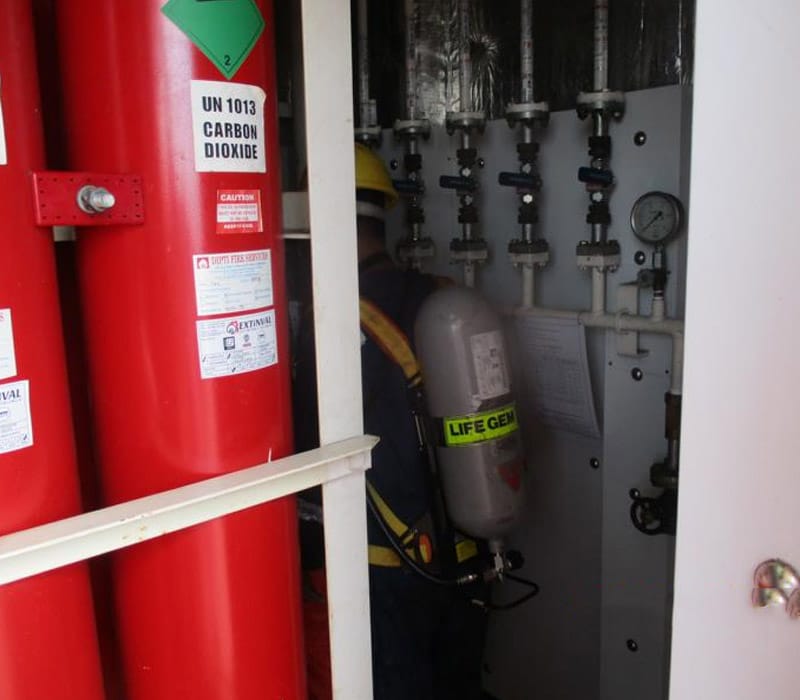
5. Carbon Dioxide (CO₂)
- Where Found: Fixed fire suppression systems, engine room extinguishers, fermentation tanks
- TLV: 5,000 ppm
- Why It’s Dangerous: Asphyxiant- displaces oxygen rapidly and is heavier than air, pooling in low-lying spaces.
- Smell: Odorless, colorless
- Safety Tip: Evacuate area before discharging CO₂ system. Never enter a space immediately after release.
- Real Case: 10 crew died and 19 were injured in a CO₂ leak aboard a Chinese cargo vessel. (Safety4Sea)
6. Chlorine (Cl₂)
- Where Found: Cargoes, disinfectants, water treatment chemicals
- TLV: 0.5 ppm
- Why It’s Dangerous: Highly toxic and corrosive. Chlorine is heavier than air and causes severe respiratory and eye irritation. Fatal in high concentrations.
- Smell: Sharp, pungent odor (like bleach), yellow-green gas
- Safety Tip: Always review MSDS and IMDG Code documentation before handling chlorine-based cargo or chemicals.
- Real Case: Chlorine gas leak in a Jordanian port killed 13 and injured over 250. (France24)
7. Nitrogen (N₂)
- Where Found: Tankers (inert gas systems), nitrogen generator outlets, controlled-atmosphere cargo spaces
- TLV: Not toxic, but displaces oxygen (asphyxiant)
- Why It’s Dangerous: Rapidly reduces O₂ levels below survivable thresholds. Victims may collapse instantly without warning.
- Smell: Odorless, colorless
- Safety Tip: Follow IMO and ISGOTT guidelines for confined space entry. Always test O₂ levels and wear SCBA when required.
- Real Case: Crew fatality aboard Stolt Helluland due to undetected nitrogen exposure. (Cayman Islands MA Report)
8. Ammonia (NH₃)
- Where Found: Refrigeration systems, ammonia-based fuel systems, ammonia carriers
- TLV: 25 ppm
- Why It’s Dangerous: Strong irritant and corrosive gas. Can cause burns to lungs and skin, and fatal exposure is possible in confined spaces.
- Smell: Sharp, pungent odor (like urine or cleaning fluid)
- Safety Tip: Regularly inspect refrigeration units and wear chemical PPE. Monitor with ammonia-specific gas detectors.
- Real Case: One dead and three injured after ammonia leak onboard a gas carrier. (Safety4Sea Report)
9. Sulfur Dioxide (SO₂)
- Where Found: Exhaust gases from high-sulfur fuels, coal cargo emissions, some gas cargoes
- TLV: 2 ppm
- Why It’s Dangerous: Causes severe respiratory distress and chemical burns. Long exposure can cause pulmonary edema.
- Smell: Pungent, suffocating odor (similar to burnt matches)
- Safety Tip: Monitor emissions during bunkering or in cargo holds with sulfur-rich cargoes. Always ventilate thoroughly.
- Real Case: Crew exposed to SO₂ emitted from coal cargo leading to fatalities. (Skuld Case Study)
10. Benzene (C₆H₆)
- Where Found: Cargo and slop tanks, pump rooms, fuel and lubricant storage areas, chemical tankers
- TLV: 1 ppm (carcinogen)
- Why It’s Dangerous: Long-term exposure causes leukemia and other cancers. Short-term exposure at high levels can cause dizziness, unconsciousness, or death.
- Smell: Sweet, aromatic
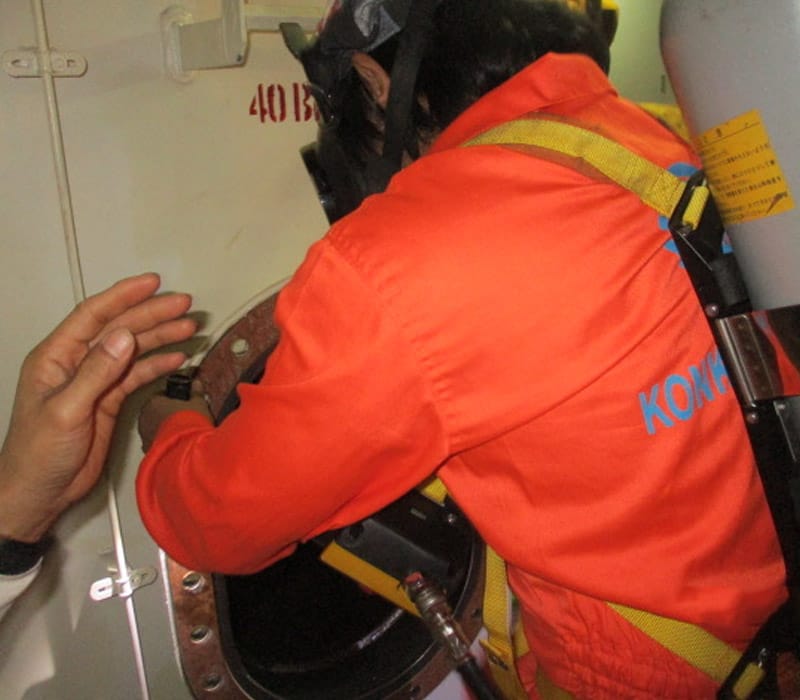
- Safety Tip: Always wear chemical masks or full PPE when tank cleaning or sampling. Use forced ventilation and inert gas systems.
- Real Case: Three crew members died from acute benzene poisoning aboard a chemical tanker. (NCBI-NIH Report)
🧯 How to Protect Yourself from Toxic Gases at Sea
Staying safe requires more than just knowledge, it demands action and compliance. Here’s how to reduce the risk:
✅ Safety Checklist for Seafarers
- 🔸 Always test enclosed spaces for O₂, toxic gases, and flammables before entry.
- 🔸 Never enter confined spaces alone– follow enclosed space entry procedures per ISGOTT, SOLAS, and Code of Safe Working Practices for Merchant Seafarers (COSWP).
- 🔸 Use calibrated gas detectors– multi-gas monitors should be worn on-person.
- 🔸 Wear appropriate PPE– including SCBAs when needed.
- 🔸 Ventilate thoroughly before entry or maintenance work.
- 🔸 Know the MSDS of every chemical and cargo.
- 🔸 Follow STCW training and onboard safety drills regularly.
- 🔸 Have emergency rescue gear ready, such as tripods, retrieval lines, and resuscitation equipment.
🧠 Seafarer Tip: If you smell something unusual, feel dizzy, or sense a drop in air quality, get out immediately and raise the alarm.
📢 Final Thoughts: Awareness Saves Lives 🚨
These gases don’t give second chances.
Whether you’re a deck cadet, AB, oiler, or chief engineer, understanding the risks and using proper procedures is the only way to survive.
💬 If you’re unsure about a space or a substance, ask. test. wait. Your life is worth the delay.
May the winds be in your favor.
Leave a Reply