

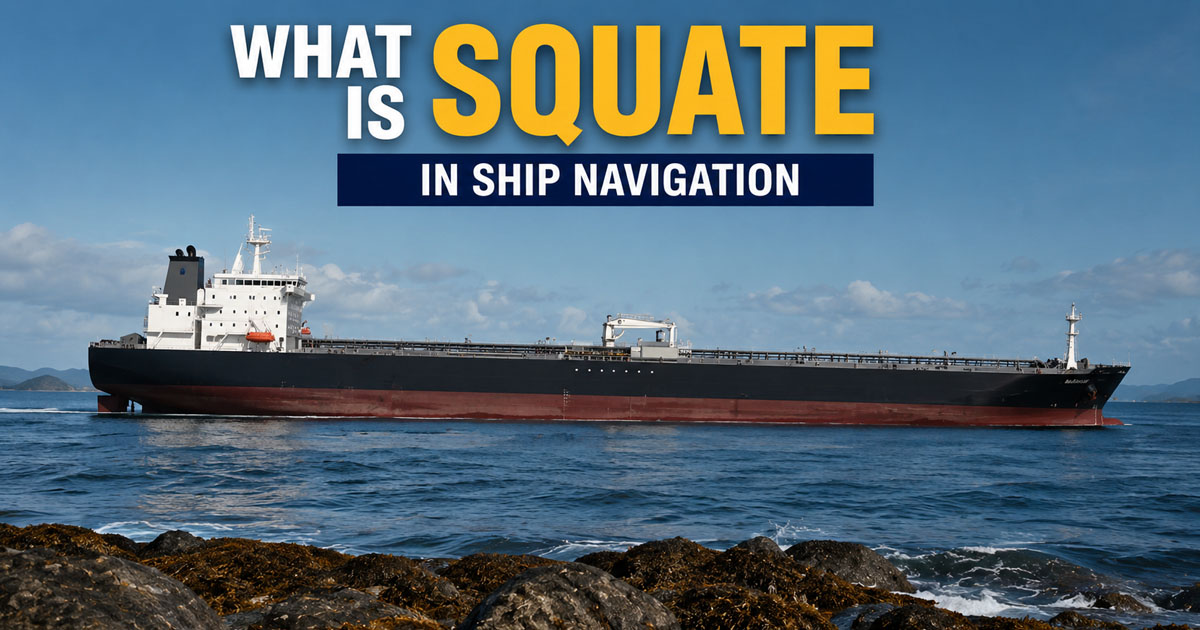
Squat is the increase in a ship’s draft caused by hydrodynamic sinkage as speed increases in shallow or restricted water.
Squat can double in shallow water compared to open water, and it directly affects Under Keel Clearance (UKC) — the safety margin between a ship’s keel and the seabed.
The basic formula for squat:
| Water Condition | Formula |
| Open water | S = (Cb × V²) / 100 |
| Shallow / Confined waters | S = 2 × (Cb × V²) / 100 |
Where S = sinkage (meters), Cb = block coefficient, V = ship’s speed (knots).
🚢 What Is Squat, Exactly?
When a vessel gets underway, it doesn’t sit at the same draft it had alongside. As speed increases, the ship’s hull generates a pressure field that causes it to sink deeper into the water and change trim. This phenomenon is known as squat.
Squat happens because a moving hull displaces water faster than it can flow back underneath and around the vessel, especially in confined depths.
The water accelerates past the hull, pressure drops (per Bernoulli’s principle), and the vessel is drawn down. The sinkage increases roughly with the square of the ship’s speed — meaning a small increase in speed produces a disproportionately large increase in squat.
Key fact: Squat is not the same everywhere. In shallow water, the restricted flow beneath the hull amplifies the effect — squat in shallow water can be roughly double what the same ship experiences in open, deep water at the same speed.
📐 The Squat Formula
| Water Condition | Formula |
| Open (deep) waters | S = (Cb × V²) / 100 |
| Shallow / Confined waters | S = 2 × (Cb × V²) / 100 |
Where:
- S = sinkage (meters)
- Cb = block coefficient (a measure of hull fullness — higher for tankers and bulkers, lower for container ships)
- V = ship’s speed (knots)
Worked example: A tanker with a block coefficient (Cb = 0.8147), transiting at 12.5 knots in shallow water:
S = 2 × (0.8147 × 12.5²) / 100
S = 2 × (0.8147 × 156.25) / 100
S = 2.55 meters
That’s over two and a half meters of additional draft the officer of the watch must account for — on top of static draft — before checking under keel clearance.
💡 Practitioner Note: Squat Calculation for an Algeciras Approach
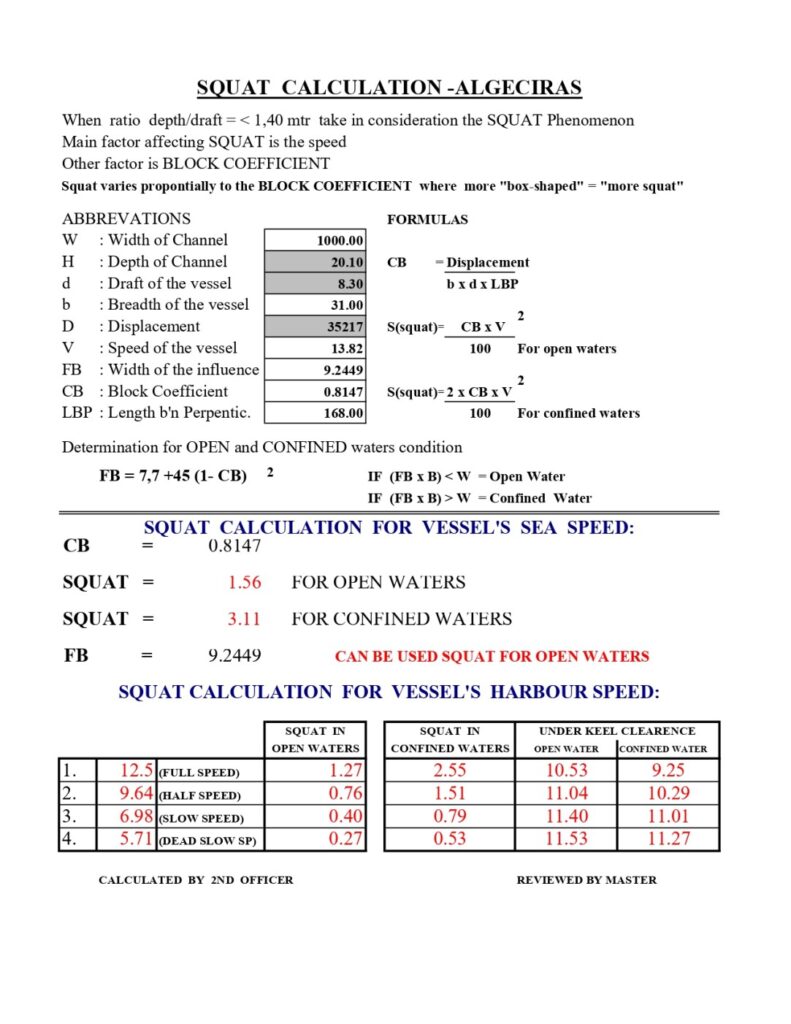
This is a real bridge-team squat calculation, worked by the 2nd Officer and reviewed by the Master ahead of an approach into Algeciras — the kind of routine passage-planning task every deck officer needs to be fluent in.
Vessel and channel particulars:
| Parameter | Value |
|---|---|
| Draft (d) | 27.2 ft (8.30 m) |
| Breadth (b) | 101.7 ft (31.00 m) |
| Length BP | 551.2 ft (168.00 m) |
| Block coefficient (CB) | 0.8147 |
| Channel depth (H) | 65.9 ft (20.10 m) |
| Channel width (W) | 3,280.8 ft (1,000.00 m) |
| Static clearance (H − d) | 38.7 ft (11.80 m) |
With a depth/draft ratio under 1.40, squat had to be factored into the approach — consistent with the shallow-water threshold covered earlier in this article.
Determining open vs. confined water: the vessel’s passage-planning tool first calculates the width of influence (FB) to check whether the channel counts as “open” or “confined” for this hull:
FB = 7.7 + 45(1 − CB)²
For this vessel, FB = 9.2449. Since FB × breadth (9.2449 × 31 m ≈ 287 m) is less than the channel width (1000 m), the channel was classified as open water for squat purposes — even though it’s a controlled approach, the geometry doesn’t create a confined-water effect.
Squat at different engine speeds, calculated using the same formula shown earlier in this article:
| Speed | Knots | Squat — Open Water | Squat — Confined Water | UKC — Open Water | UKC — Confined Water |
|---|---|---|---|---|---|
| Full sea speed | 12.5 | 4.2 ft (1.27 m) | 8.4 ft (2.55 m) | 34.5 ft (10.53 m) | 30.3 ft (9.25 m) |
| Half speed | 9.64 | 2.5 ft (0.76 m) | 5.0 ft (1.51 m) | 36.2 ft (11.04 m) | 33.8 ft (10.29 m) |
| Slow speed | 6.98 | 1.3 ft (0.40 m) | 2.6 ft (0.79 m) | 37.4 ft (11.40 m) | 36.1 ft (11.01 m) |
| Dead slow speed | 5.71 | 0.9 ft (0.27 m) | 1.7 ft (0.53 m) | 37.8 ft (11.53 m) | 37.0 ft (11.27 m) |
💡 Practitioner Note 2: A VLCC at Corpus Christi
VLCC particulars:
| Parameter | Value |
|---|---|
| Draft, fully laden (d) | 66.0 ft (20.1 m) |
| Breadth (b) | 196.9 ft (60.0 m) |
| Length BP | 1,082.7 ft (330.0 m) |
| Block coefficient (CB) | 0.83 |
| Approx. displacement | ~330,000 t |
Post-deepening: 75 ft (22.9 m) main channel / 77 ft (23.5 m) Gulf extension.
The Port of Corpus Christi is planned to dredge its channel to allow fully laden VLCCs navigate without lightering.
Once dredging completes, static clearance opens up to 9.1 ft (2.8 m) in the main channel and 11.1 ft (3.4 m) in the Gulf extension — enough to work with, but still tight enough that speed control matters.
Checking the width-of-influence formula (FB = 7.7 + 45(1 − 0.83)² ≈ 9.0) against this vessel’s beam shows FB × breadth (≈1,772 ft / 540 m) exceeds the channel width (530 ft / 161.5 m) — so this channel classifies as confined water, meaning the doubled squat formula applies:
| Transit Speed | Knots | Squat (Confined) | UKC — Main Channel (75 ft) | UKC — Gulf Extension (77 ft) |
|---|---|---|---|---|
| Harbor full | 10.0 | 5.4 ft (1.66 m) | 3.6 ft (1.10 m) | 5.6 ft (1.71 m) |
| Half speed | 7.5 | 3.1 ft (0.93 m) | 6.0 ft (1.83 m) | 8.0 ft (2.44 m) |
| Slow speed | 5.5 | 1.6 ft (0.50 m) | 7.4 ft (2.26 m) | 9.4 ft (2.87 m) |
| Dead slow | 4.0 | 0.9 ft (0.27 m) | 8.2 ft (2.49 m) | 10.2 ft (3.10 m) |
Even after the deepening project completes, a fully laden VLCC transiting at harbor full speed would leave only 3.6 ft (1.10 m) of UKC in the main channel — below the 10% of draft benchmark (6.6 ft / 2.0 m) covered earlier in this article.
Slowing to slow or dead-slow speed restores a comfortable margin.
This is why pilots reduce VLCCs to minimal steerageway speed in tight channel sections, regardless of how deep the channel has been dredged.
🌊 Shallow Water vs. Restricted Water: Know the Difference
These two terms are often used interchangeably by newer officers, but they describe different — and sometimes overlapping — hazards.
| Term | Definition |
| Shallow Water | Water depth-to-draft ratio of 1.5:1 or less — the point at which squat effects intensify sharply and must be factored into passage planning. |
| Restricted Water | Narrow channels, canals, waterways with vertical or overhanging banks, or areas with piers and breakwaters that meaningfully change a ship’s maneuvering characteristics. |
Most restricted waters are also shallow, and many include significant tidal streams and currents — compounding the squat and maneuvering challenge.
In restricted waters, the ship also has less sea room to correct for bank effect, interaction with passing traffic, or a squat-induced grounding risk.
⚙️ Main Factors Governing Squat
Squat isn’t determined by speed alone. Five factors govern how much a given vessel will squat:
- Ship’s speed — squat increases with the square of speed
- Hull design — fuller hull forms (higher Cb) generate more squat than fine hull forms
- Ship’s cross-section and water-plane area — larger underwater cross-section relative to channel cross-section increases squat
- Ratio of draft to depth of water — the shallower the margin, the greater the effect
- Blockage factor — how much of a channel’s cross-section the ship’s hull occupies when transiting a narrow channel or canal
⚠️ Operationally Significant Thresholds
As a practical guide, officers generally treat squat as operationally critical when:
- Channel width is less than roughly five times the ship’s beam, and
- Static under-keel clearance is already tight relative to draft (commonly under 20%)
These are practitioner heuristics used for quick risk-screening during passage planning, not fixed regulatory thresholds — the actual squat figure should always be calculated for the specific vessel, speed, and depth using the formula above.
On full-form vessels such as tankers, squat trims the vessel by the head — forward draft increases more than aft draft, which matters when the forward UKC margin is already the tightest.
📏 Under Keel Clearance (UKC): The Safety Margin That Matters
Under Keel Clearance (UKC) is the vertical distance between the lowest point of a ship’s hull and the seabed, after accounting for tide, squat, and other dynamic effects. It’s the number that ultimately decides whether a passage is safe — squat is simply one of the variables that eats into it.
Formula:
UKC = Charted Water Depth + Height of Tide − Ship’s Draft at Rest
This static formula gives the baseline. It must then be adjusted for squat, trim, heel, and swell before a passage plan is considered safe in shallow or restricted water.
UKC Standards by Condition
The following minimum UKC benchmarks are widely used across the industry and trace back to European pilotage recommendations, commonly adopted into individual ship managers’ UKC policies:
| Condition | Minimum UKC |
| Open sea | ≥ 20% of draft |
| Outer harbor / fairway | ≥ 15% of draft |
| Inner harbor / alongside | ≥ 10% of draft |
Note: Always confirm the specific UKC policy applicable to your vessel, company, and the port or waterway in question — local port authorities and pilotage organizations may set stricter mandatory minimums.
🛢️ UKC for VLCCs: Malacca and Singapore Straits
The Straits of Malacca and Singapore carry a large share of the world’s seaborne oil trade over comparatively shallow water, making UKC compliance a hard operational requirement rather than a guideline.
Under the IMO’s Rules for Vessels Navigating Through the Straits of Malacca and Singapore, adopted by the Maritime Safety Committee in 1998 (Resolution A.858(20)) and reinforced by the Maritime and Port Authority of Singapore, deep draught vessels (draft ≥ 15 m) and VLCCs (150,000 DWT and above) must:
✅ Maintain a UKC of at least 3.5 meters at all times during the entire passage through the Straits ✅ Proceed at no more than 12 knots over ground in specified westbound lane sections, where safe and practicable
This single rule is why squat calculations aren’t academic for tanker officers — a VLCC that miscalculates shallow-water sinkage on a Malacca transit can breach the 3.5-meter minimum well before anyone sees a depth alarm.
🧮 Factors to Consider When Determining UKC
Beyond the static formula, a proper UKC assessment accounts for:
- Hull sinkage and change of trim — ships navigating shallow water tend to trim by the head; bow sinkage must be factored in
- Sinkage from ship oscillation — when encountered wave period synchronizes with the ship’s natural pitch or roll period, fore/aft perpendiculars and bottom bilges see added sinkage
- Accuracy of charted depth — hydrographic surveys carry a small, depth-dependent margin of vertical uncertainty even under the strictest IHO S-44 accuracy standards. The allowable vertical uncertainty is calculated using the formula TVU = √(a² + (b × d)²), where “a” is a fixed uncertainty component and “b” is a depth-dependent coefficient that varies by survey order — in practice this typically works out to tens of centimeters of uncertainty in shallow coastal depths, even for the highest-accuracy surveys. Officers should never assume charted depth is exact.
- Heel from wind, swell, or small GoM (metacentric height) — heel increases the draft on the low side beyond the upright figure
- Changes in seawater density — a vessel moving from salt to brackish or fresh water will experience a draft increase (Fresh Water Allowance)
A prudent passage plan through shallow or restricted water treats UKC as a dynamic, not static, number — recalculated for speed, density, and swell conditions actually encountered, not just the depth shown on the chart.
❓ Frequently Asked Questions
What causes ship squat? Squat is caused by the hydrodynamic pressure changes generated as a hull moves through water. Reduced pressure beneath and around the hull draws the vessel deeper and alters trim, with the effect amplified in shallow or restricted water.
How much does squat increase in shallow water compared to deep water? Squat in shallow water can be roughly double the sinkage experienced by the same vessel at the same speed in open, deep water.
What is considered “shallow water” for navigation purposes? Water where the depth-to-draft ratio is 1.5:1 or less is generally treated as shallow water — the point at which squat effects become significant enough to require active management.
What UKC is required for VLCCs transiting the Malacca and Singapore Straits? A minimum of 3.5 meters of under keel clearance at all times, per IMO rules adopted in 1998 and reinforced by Singapore’s Maritime and Port Authority.
Does squat affect trim as well as draft? Yes. On full-form vessels like tankers, squat typically increases the forward draft more than the aft draft, trimming the vessel by the head.
May the winds be in your favor.
Leave a Reply