


When anchoring in congested waters like Singapore, Gibraltar, or Ijmuiden, every meter counts.
One miscalculated anchor swinging circle can lead to dangerous near-misses or even collisions. That’s why calculating your swinging circle accurately, not just quickly, is critical.
In this guide, we’ll show you two methods: the Instant Method (ideal for open anchorages) and the Accurate Method (used when precision is vital).
🚢 What Is an Anchor Swinging Circle?
The anchor swinging circle is the area within which a ship is expected to move while anchored, due to wind, current, and tidal forces.
Even when the anchor holds, the vessel doesn’t stay fixed, it swings around its anchor point in a predictable arc.
This area is also referred to as the:
- Turning Circle
- Anchor Turning Radius
- Anchor Swing Radius
- Drag Circle (though this term technically refers to a different measurement- explained later)
Understanding this concept is vital for avoiding contact with:
- Nearby vessels
- Shallow patches
- Buoys and other obstructions
📌 Factors Affecting Swinging Circle Size
- Number of shackles used
- Water depth
- Ship’s Length Overall (LOA)
- Hawse pipe position
- GPS antenna location
- Heading and position at the time of anchoring (for plotting on a chart)
⚙️ Methods to Calculate the Anchor Swinging Circle
There are two common ways to determine the swinging circle of a vessel:
| Method | Use Case | Accuracy |
| Instant Method | Open anchorages with sea room | Basic |
| Accurate Method | Tight anchorages or poor weather | High |
⚡ Method 1: Instant Method (Quick Estimate)
This is the fast-and-easy way. Ideal if you’re in a safe anchorage with plenty of space and minimal risk of dragging.
✅ Best used in open waters with minimal congestion or hazards.
🔣 Formula:
Swing Circle = [Shackles in meters + LOA] / 1852Note: 1 shackle = 27.432 meters
🧮 Example:
Vessel Data:
- Shackles: 7
- LOA: 190 meters
- Water depth: 40 meters
Step-by-step:
- Convert shackles to meters:
7 shackles × 27.432 = 192.024 meters - Add to LOA:
192.024 + 190 = 382.024 meters - Convert to nautical miles:
382.024 ÷ 1852 = 0.206 Nm
✅ Swinging Circle (Instant Method): 382.024 meters or 0.206 Nm
This method is simple- but it lacks precision.
It does not account for the vessel’s vertical chain angle, hawse pipe location, or GPS position, which can make a big difference in tight anchorages.

🎯 Why the Instant Method Isn’t Enough in Tight Anchorages
When space is limited, such as near a breakwater or with vessels anchored port and starboard, relying solely on the Instant Method can be risky.
A few meters of miscalculation could place your vessel within another ship’s swing radius.
In the next section, we’ll break down the Accurate Method, which accounts for the true geometry of your ship and anchor setup.
📏 Method 2: Accurate Method (For Tight Anchorages)
In restricted anchorages like Gibraltar inner anchorage or Ijmuiden, you need a method that gives you exact clearance from nearby ships and hazards.
That’s where the Accurate Method comes in.
✅ This method factors in vertical height, hawse pipe, GPS position, and vessel structure, ensuring precise anchor radius calculation.
We’ll use the same vessel specs to compare with the Instant Method.
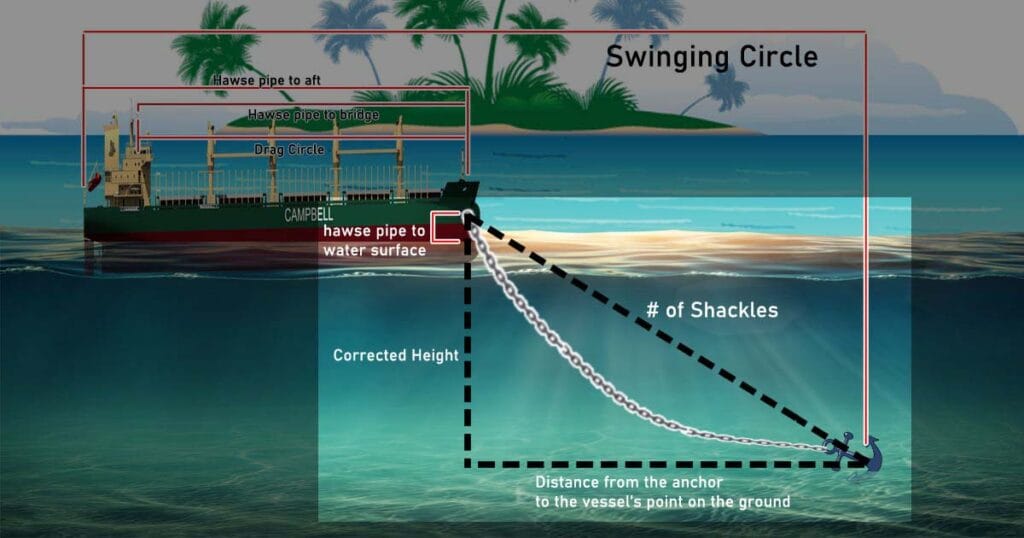
⚙️ Step 1: Calculate Corrected Height (CH)
The anchor chain doesn’t start at the waterline. It starts at the hawse pipe, which is above the water surface.
Formula:
Corrected Height = Water Depth + Hawse Pipe Height Above WaterlineExample:
- Water depth = 40 meters
- Hawse pipe height = 3 meters
✅ CH = 40 + 3 = 43 meters

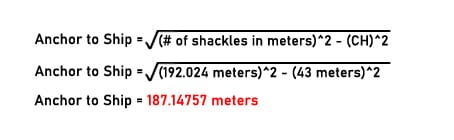
📐 Step 2: Find the Distance from Anchor to Ship
You now have a right-angled triangle:
- Vertical leg: Corrected Height (43 meters)
- Base leg: Horizontal reach of the chain (7 shackles × 27.432 = 192.024 meters)
Use Pythagorean Theorem to find the hypotenuse (diagonal distance from anchor to ship’s hawse pipe):
Formula:
Distance = √(Corrected Height² + Horizontal Chain Length²)
Distance = √(43² + 192.024²) ≈ 197.15 meters
✅ Anchor to Ship Distance = ~197.15 meters
🧭 Step 3: Calculate Drag Circle
The drag circle is the distance from the anchor to the ship’s GPS antenna or radar scanner, typically located at the bridge.
You need:
- Distance from hawse pipe to bridge (Example: 162 meters)
Formula:
Drag Circle = (Anchor to Ship Distance + Hawse to Bridge) / 1852
Drag Circle = (197.15 + 162) ÷ 1852 ≈ 0.1936 Nm
✅ Drag Circle = 359.15 meters or 0.1936 Nm

🧮 Step 4: Calculate Anchor Swinging Circle (Accurate)
Now calculate the distance from the hawse pipe to the vessel’s aft. (Example: 185 meters)
Formula:
Swinging Circle = (Anchor to Ship + Hawse to Aft) / 1852
Swinging Circle = (197.15 + 185) ÷ 1852 ≈ 0.206 Nm
✅ Accurate Swinging Circle = 382.15 meters or 0.206 Nm
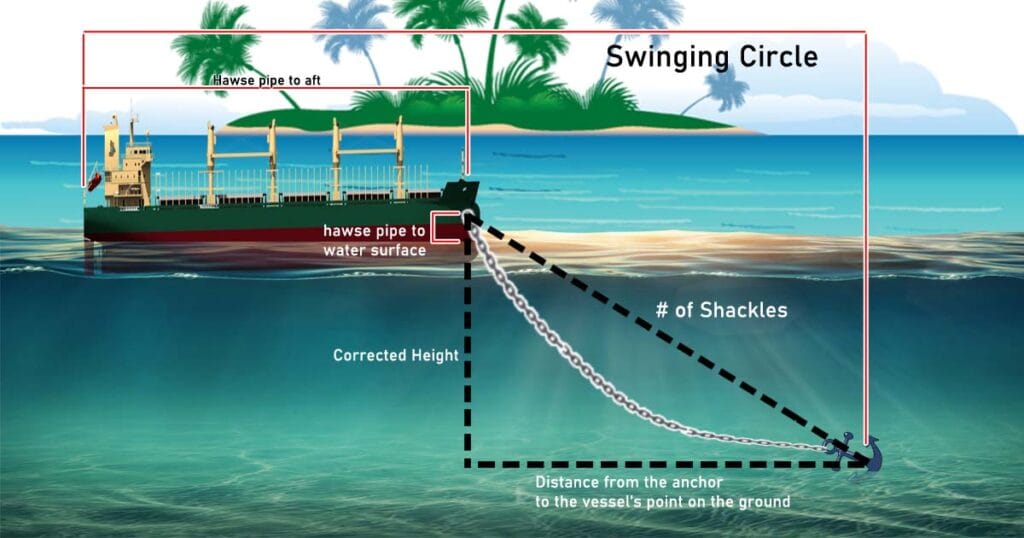
5. Draw the swinging circle.
🗺️ How to Plot the Swinging Circle on a Nautical Chart
To plot the swing circle:
- Use the position and heading at the time of anchor drop.
- Set the anchor point as the chart center.
- Draw the circle using the computed radius.
- Ensure your vessel stays within that arc during swing movements.
This plotting is often required in:
- Passage planning
- Pre-arrival anchorage briefing
- Anchor watch monitoring
📊 Comparison Table: Instant vs. Accurate Method
| Method | Meters | Nautical Miles |
| Instant Method | 382.024 m | 0.206 Nm |
| Accurate Method | 382.15 m | 0.206 Nm |
| Drag Circle | 359.15 m | 0.1936 Nm |
🔍 Insight: In this case, the difference between methods is minimal. But in tighter or more critical anchoring situations, using the Accurate Method could prevent costly near-misses.
📉 Why Accuracy Matters in Real Operations
In congested ports:
- A 5- to 10-meter error can cause your swing arc to overlap with another vessel’s.
- Sudden weather changes or current shifts can rapidly alter the swing arc.
- Port authorities may require charted swing circles for safety clearances.
📎 Final Thoughts: Precision Anchoring Saves Ships 🚨
Understanding and applying the correct method for anchor swinging circle calculation isn’t just about math, it’s about preventing collisions, protecting your vessel, and staying compliant in busy anchorages.
Whether you’re using the Instant Method or the Accurate Method, make sure to:
- Know your vessel’s particulars
- Account for all necessary dimensions
- Use a plotted swing radius as part of your anchor watch
🔚 Conclusion
Accurate calculation of the anchor swinging circle is a must-know skill for deck officers.
Whether anchoring in tight straits or spacious bays, mastering both methods keeps your vessel and crew safe.
⚓ Which method does your ship use more often? Drop your experience in the comments below!
Let’s help each other anchor safer! ⚓💬
May the winds be in your favor.
Leave a Reply