


If you’re a cadet filling out your Training Record Book (TRB) or a maritime professional handling operations, understanding your vessel’s particulars is a must.
Ship’s particulars, also called vessel specifications, are a standardized set of data that describe the vessel’s dimensions, capacities, engine power, communication equipment, and more.
Whether for navigation planning, cargo operations, or port clearance, this data is used daily by seafarers, charterers, port authorities, and marine insurers.
In this guide, you’ll learn:
- ✅ What ship’s particulars include
- ✅ Where to locate them onboard and online
- ✅ Why they’re crucial for safe and efficient operations
⚙️ What Are Ship’s Particulars?
Ship’s particulars (also known as vessel particulars or ship specification sheet) are a comprehensive list of technical and operational information about a ship.
This document is essential for both safety and commercial operations.
🧾 Standard Details Found in a Vessel’s Particulars:
- Ship name and IMO number
- Call sign and flag
- Ship type and classification society
- Year built and shipyard
- Owner, operator, and manager details
- Main engine type and power output
- Fuel consumption (laden vs. ballast)
- Gross and net tonnage
- Deadweight and displacement
- Draft, air draft, beam, length overall (LOA)
- Cargo and ballast tank capacities
- Manifold height and distance
- Mooring and anchoring equipment
- Navigation and communication systems
- Crane and derrick specifications
- Emergency contact information
🧠 Note: These fields align with standard international vessel databases and can be cited by tools like AIS platforms and port systems.

📍 Where to Find a Ship’s Particulars (Onboard and Online)
Ship’s particulars are accessible from various locations onboard the vessel, as well as through online tracking services.
🔎 Onboard Locations:
| Location | What You’ll Find |
|---|---|
| Bridge | Basic ship data, call sign, GMDSS info– usually on a laminated poster or metal plate. |
| Cargo Control Room (CCR) | Cargo pump capacity, tank layout, ballast system specs, Inert Gas system. |
| Engine Control Room (ECR) | Main engine specs, auxiliary machinery, fuel consumption, power ratings. |
| Ship’s Computer | Complete editable documents in Word or Excel format, used for chartering, port forms, and reporting. |
🌐 Online Sources:
- MarineTraffic, Vesselfinder, and similar ship tracking platforms provide basic particulars.
- Paid maritime databases offer full technical sheets with downloadable formats.
- Flag-state or class society databases may also list registered vessel specifications.
🔗 Pro Tip: Always cross-check onboard data with your ship’s Classification Society records for accuracy.
🧭 Why Are Ship’s Particulars Important?
Ship’s particulars are not just a formality. They’re critical for operational, safety, commercial, and legal processes.
Here’s how various maritime professionals use them:
⚓ 1. Safe Navigation
Second Officers use ship dimensions, air draft, and draft to:
- Calculate Under Keel Clearance (UKC)
- Plan routes through canals, straits, and bridges
- Prevent grounding and collision risks
📑 2. Voyage Planning
Ship’s particulars are essential in voyage planning. Accurate particulars help with:
- Weather routing
- Calculating Estimated Time of Arrival (ETA)
- Determining fuel consumption per leg (laden vs. ballast)

💼 3. Chartering and Voyage Costing
Charterers use particulars to assess:
- If a terminal can accommodate the vessel (e.g., draft, crane height)
- Loading/unloading rates and cargo volume
- Port fees based on gross tonnage or length overall (LOA)
⚙️ 4. Ship Operations
Owners and operators use ship’s particulars to:
- Set freight rates
- Estimate operating costs
- Manage drydocking and repair schedules
🏗️ 5. Cargo Handling
Chief Officers need detailed info on:
- Cargo tank capacities and pump rates
- Safe stress/load distribution
- Tank layouts and segregation plans
🛥️ 6. Port and Pilotage
Port authorities rely on vessel particulars for:
- Berth allocation
- Pilotage planning
- Tug requirements
🛡️ 7. Marine Insurance and Class Surveys
Insurers and class societies evaluate based on:
- Vessel size, machinery, and build details
- Operational capabilities
- Marine insurance premiums
- Compliance for risk assessment and coverage
📘 Real Examples of Ship’s Particulars
Here are some typical use cases where you’ll encounter vessel particulars:
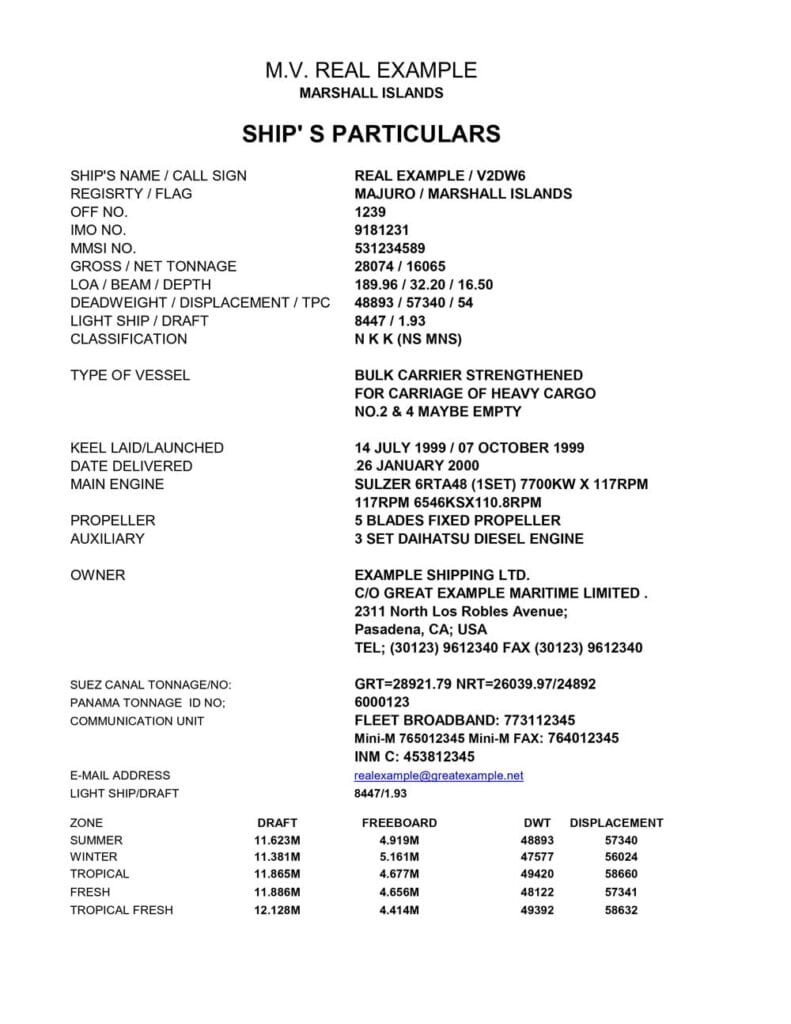
🧾 1. For General Ship Info
- Includes machineries, owner name and address, tonnages, and load lines.
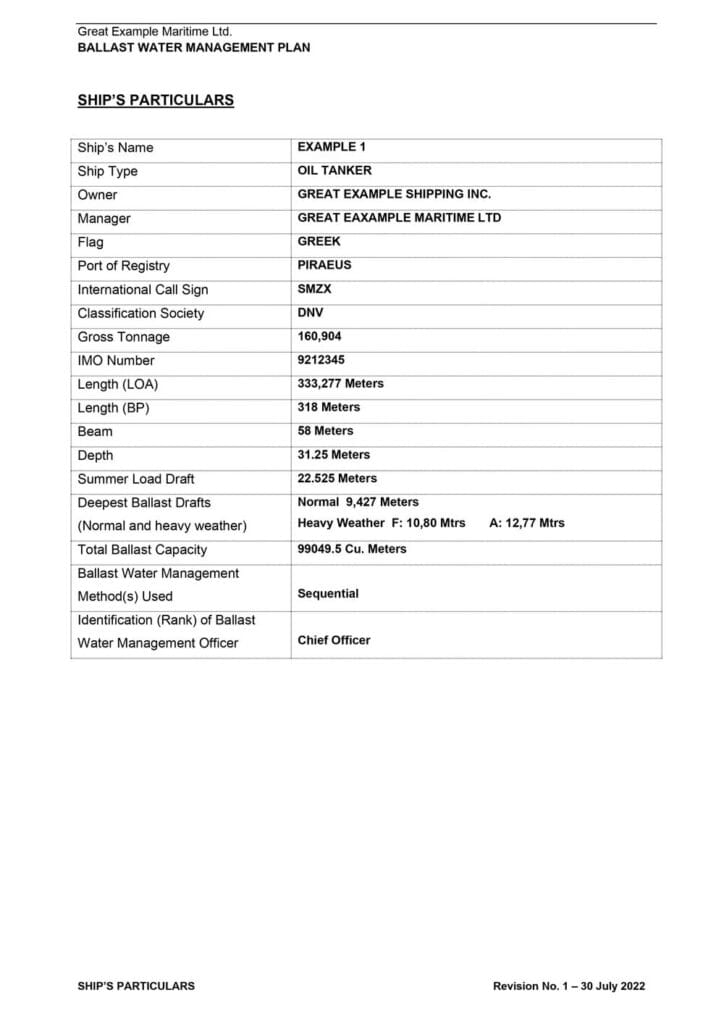
🧾 2. For the Ballast Water Management Plan (BWMP)
- Includes ship dimensions, ballast capacities, and BWM officer.
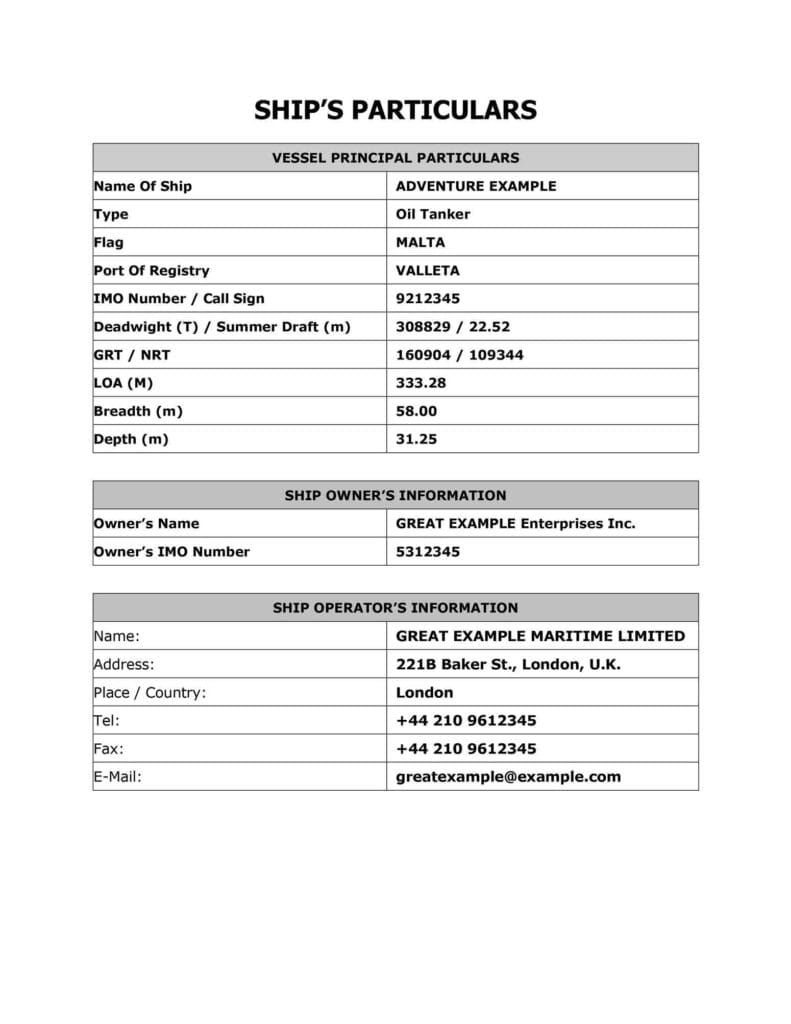
📞 3. For General Communication Use
- When calling agents, terminals, or port officials, the Captain may refer to a standard vessel particulars sheet to provide key details quickly.
📄 Most of these documents are between 2 to 4 pages long and may include tables, diagrams, or technical drawings.


❓ Frequently Asked Questions
🔍 What is the purpose of a ship’s particulars?
To document all technical and operational specifications of the vessel for safe navigation, operations, and compliance.
🧭 Who uses ship’s particulars?
Seafarers, charterers, port authorities, marine insurers, and classification societies use them for daily operations and planning.
📄 Is there a standard format?
Yes. Most vessels follow IMO or Classification Society templates. Formats vary slightly but contain the same core data points.
🌐 Can I find ship’s particulars online?
Yes. AIS websites like MarineTraffic offer basic data. Full details may require subscriptions or access to class records.
🧰 Can cadets use this for their Training Record Book?
Absolutely! Many TRBs require cadets to fill out the ship’s particulars as one of their first familiarization tasks.
⚓ Final Thoughts
Ship’s particulars are more than just specs. They’re a vital operational reference used across nearly every maritime process
Whether you’re a deck cadet or a senior officer, understanding this document is essential to your career at sea.
🧭 Always keep a copy accessible- bridge, ECR, CCR, or digital.
📂 Download your editable version of ship’s particulars and start building familiarity today.
May the winds be in your favor.


Leave a Reply