


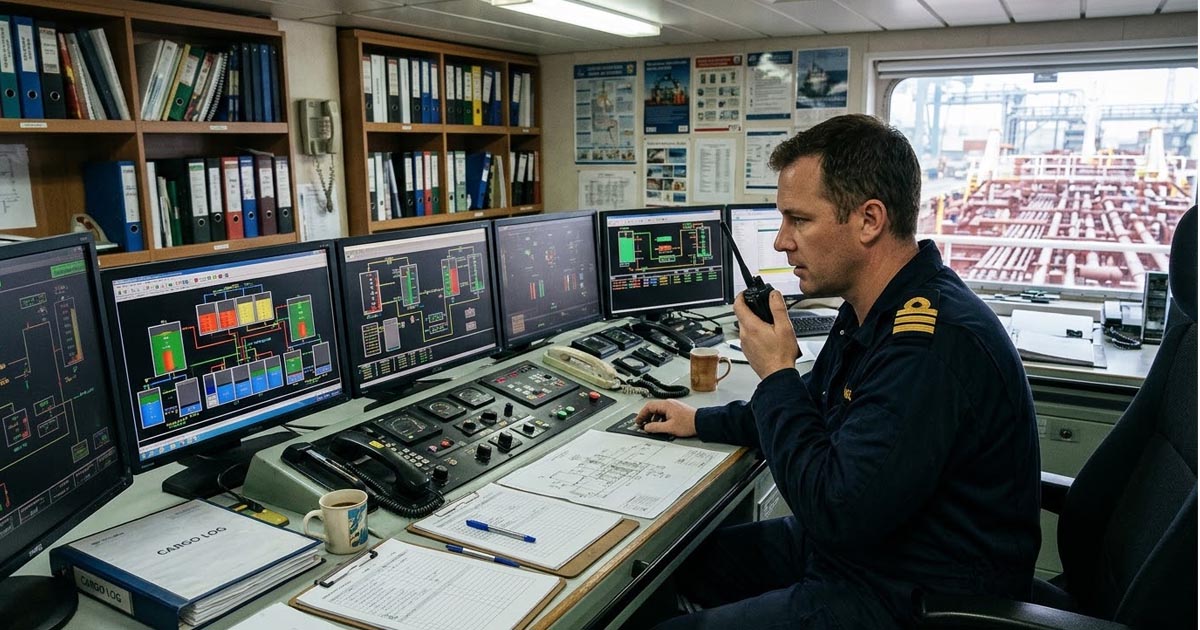
A Chief Officer, also known as a Chief Mate, earns a median advertised salary of $8,000 per month on international merchant ships, according to our analysis of 970 comparable recruitment offers.
Most advertised salaries fall between $7,250 and $10,750 per month. But vessel type makes a big difference. LNG tanker Chief Officers receive a median offer of $17,000, while those on general cargo ships are offered around $6,480.
These figures come from job listings posted between May 2023 and October 2026. They represent advertised wages, not guaranteed take-home earnings.
Think of them as a market snapshot, not a payslip.
Want to know what the job involves? Read our Chief Mate duties and responsibilities guide.
📊 How Much Does a Chief Officer Make per Month?
The typical advertised salary is $8,000 a month. We use the median, not the average, so a few LNG offers or low coastal rates don’t skew the picture.
| Measure | Monthly pay (USD) | What it means |
| Median | $8,000 | Half of offers pay more, half less |
| Middle 50% | 7,250–10,750 | Where the core of the market sits |
| 10th percentile | $6,200 | Coasters and small general cargo |
| 90th percentile | $12,500 | LNG, LPG, and chemical tankers |
| Full range | 2,400–18,550 | Lowest to highest offer |
| Fixed-amount median | $8,000 | 607 offers with no range |
| Wage disclosure | 60.4% | 1,066 of 1,764 listings gave a usable wage |
| Marked negotiable | 10.7% | 189 listings |
| Contract length | 4.0 months | Middle 50%: 3.5–4.5 months |
🔎 Scope check: This covers international listings under multinational crewing contracts. US-flag union and UK Merchant Navy pay work differently, are usually quoted per year, and carry domestic tax. Don’t compare them directly.
🚢 Chief Officer Salary by Vessel Type
Here’s where things get interesting.
A Chief Officer handling LNG cargo has different operational responsibilities from one working on a bulk carrier or general cargo ship.
Those differences are reflected in the salaries companies advertise.
The table below covers vessel categories with at least 10 comparable offers.
| Vessel type | Offers | Median/month | Middle 50% |
| LNG Tanker | 43 | $17,000 | $16,000–$18,200 |
| LPG Tanker | 66 | $12,500 | $11,800–$13,000 |
| Crude Oil Tanker | 68 | $11,500 | $11,000–$12,000 |
| Chemical Tanker | 78 | $11,000 | $10,500–$11,725 |
| Oil Tanker (General) | 16 | $10,750 | $10,500–$11,125 |
| Product Tanker | 27 | $10,750 | $9,000–$11,000 |
| Ro-Ro / Vehicle Carrier | 26 | $8,300 | $7,750–$9,000 |
| Container Ship | 138 | $7,850 | $7,400–$8,250 |
| Bulk Carrier | 180 | $7,831 | $7,500–$8,200 |
| Offshore Supply / AHTS | 20 | $7,808 | $7,200–$8,500 |
| Multi-Purpose Vessel | 10 | $7,557 | $7,200–$8,000 |
| General Cargo | 173 | $6,480 | $6,000–$7,200 |
| Coaster | 17 | $6,210 | $5,500–$6,500 |
These 13 categories represent 862 offers. Another 53 listings had unspecified vessel types, while 55 belonged to smaller categories excluded from the ranking.
🔥 Why Do LNG Chief Officers Earn More?
- LNG: $17,000 is 162.3% more than general cargo (+$10,520) and 117.1% more than bulk carriers (+$9,169). You’re paid for cryogenic cargo, containment systems, and strict competence rules.
- Chemical: $11,000 is 40.5% more than bulk (+$3,169), for tank cleaning standards, CDI vetting, and toxic cargo accountability.
- Container vs. bulk: $7,850 against $7,831, just $19 apart. Deck officers move easily between the two.
😎 Pro tip: Switching from bulk to LNG won’t double your pay automatically. Operators want gas endorsements and documented cargo experience.
🧾 What’s Included in a Chief Officer’s Salary?
An advertised salary doesn’t always explain how your wages are calculated.
Depending on the company and employment agreement, your pay package may include:
- Basic wage: Your contractual salary used for calculating applicable overtime and other entitlements.
- Guaranteed overtime: A fixed allowance covering an agreed number of overtime hours.
- Leave pay: Compensation for earned leave, included in the wage package or paid separately.
- Seniority increments: Additional pay for experience or completed service.
- Rejoining bonuses: Incentives offered by some companies for returning officers.
- Tanker allowances: Additional compensation associated with specialized cargo duties.
Some companies advertise one consolidated monthly amount. Others separate basic wages, overtime, and allowances.
😎 Pro tip: Before signing, request the complete wage breakdown. An $8,500 all-in offer isn’t necessarily better than an $8,000 offer with separately paid benefits.
📅 How Much Does a Chief Officer Earn per Contract or Year?
Our dataset shows a median contract length of four months.
At $8,000 per month, a four-month paid contract would generate approximately $32,000 before applicable deductions.
But monthly salary doesn’t automatically equal year-round income.
| Paid months per year | Earnings at $8,000/month |
| 6 months | $48,000 |
| 8 months | $64,000 |
| 10 months | $80,000 |
| 12 months | $96,000 |
These are illustrative calculations, not estimates of typical annual earnings.
Some officers receive paid leave or continuous employment benefits. Others earn wages mainly during active service.
Always check whether leave pay is included and how your rotation affects annual compensation.
🎯 What Determines a Chief Officer’s Pay?
Four important factors can influence what shipping companies offer.
1. Cargo experience and endorsements
Officers with relevant oil, chemical, LPG, or LNG qualifications may qualify for specialized positions offering higher wages.
2. Charterer vetting requirements
Tanker operators may require specific experience and familiarity with inspection standards such as OCIMF SIRE 2.0.
3. Trading area and vessel operations
Worldwide trading, regional routes, and coastal operations can involve different salary structures. Coaster Chief Officers receive a median offer of $6,210 in our dataset.
4. Collective bargaining agreements
Employment agreements, including applicable IBF or ITF arrangements, can influence wage scales, overtime, leave, and other benefits.
These factors help explain why offers differ, although our salary comparisons don’t establish how much each factor independently affects pay.
🪜 Chief Officer vs. Captain and Second Officer Salary
Promotion brings more responsibility. But how much does the advertised salary change?
| Rank | Offers | Median/month | Middle 50% |
| Master (Captain) | 720 | $10,325 | $9,350–$14,250 |
| Chief Officer | 970 | $8,000 | $7,250–$10,750 |
| Second Officer | 808 | $4,188 | $3,750–$4,800 |
Second Officer to Chief Officer
The median salary difference is $3,812 per month, or approximately 91%.
That’s a substantial jump.
As Chief Mate, you’re no longer responsible only for navigational watchkeeping. You also oversee cargo operations, stability, deck maintenance, safety, and deck department personnel.
Chief Officer to Master
The Master’s median salary is $10,325, approximately 29% higher than the Chief Officer’s $8,000.
That increase comes with overall command responsibility, including vessel safety, regulatory compliance, and the welfare of everyone on board.
These figures compare separate groups of job offers, not guaranteed individual promotion increases.
Read our Ship Captain Salary Guide for a closer look.
Chief Officer vs. Second Engineer
Both ranks have an advertised median salary of $8,000 in our dataset.
The Chief Officer comparison covers 970 offers, while the Second Engineer comparison covers 986.
Learn more about the Second Engineer’s duties and responsibilities.
🛢️ Offshore Chief Officer Salary: Daily Rates
Some offshore Chief Officers work under daily-rate contracts instead of fixed monthly salaries.
Our separate analysis of 96 offshore day-rate offers found:
| Salary measure | Daily rate |
| Median | $250 |
| Middle 50% | $200–$325 |
Don’t automatically multiply the day rate by 30 to estimate monthly earnings.
Offshore rotations and paid-day arrangements differ. Check whether off-duty periods are compensated before comparing offers.
⚠️ War-Risk Pay for Chief Officers
Chief Officers serving on vessels covered by applicable collective bargaining agreements may qualify for additional compensation in designated warlike areas.
Depending on the current IBF agreement and area designation, provisions may include:
- A bonus equivalent to 100% of daily basic wage.
- A minimum five-day compensation period.
- Rights concerning refusal of transit and repatriation.
These benefits aren’t automatically available on every ship or voyage.
😎 Pro tip: War-risk area boundaries and agreement terms can change. Check the latest applicable provisions before relying on any entitlement.
❓ Frequently Asked Questions
How much does a Chief Mate earn per month?
The median advertised Chief Mate salary is $8,000 per month, based on 970 comparable international recruitment offers. The middle 50% range from $7,250 to $10,750.
Which ship pays the highest Chief Officer salary?
LNG tankers have the highest median in our dataset at $17,000 per month, followed by LPG tankers at $12,500 and crude oil tankers at $11,500.
How much does a Chief Officer earn on a bulk carrier?
Bulk carrier Chief Officers receive a median advertised salary of $7,831 per month, based on 180 comparable offers.
Does a Chief Officer earn more than a Chief Engineer?
Not typically in our dataset. Chief Engineers have a median advertised salary of $10,000, compared with $8,000 for Chief Officers—a 25% difference.
Do Chief Officers receive seniority pay?
Some companies offer seniority increments, rejoining incentives, or other benefits based on experience and employment arrangements.
🔍 How We Calculated These Salaries
We analyzed maritime recruitment listings from 16 crewing portals, covering May 25, 2023, through October 21, 2026.
Here’s how the numbers were calculated:
- Collected 2,303 Chief Officer vacancies.
- Removed 539 duplicate agency reposts using a 30-day matching window.
- Identified 1,764 unique listings.
- Excluded 475 undisclosed salaries, 189 negotiable listings, 96 offshore day rates, one other-period listing, and 33 monthly salary outliers.
- Analyzed the remaining 970 comparable monthly offers.
- Compared the overall median against 607 fixed-amount offers. Both produced $8,000.
We required at least 30 offers for headline figures and 10 for vessel-specific comparisons.
Data limitations: These are advertised recruitment salaries, not verified payroll records. Listings without usable wages may follow different compensation patterns, and the dataset doesn’t represent every shipping company worldwide.
Use the figures as an international recruitment benchmark, not a guaranteed wage scale.
⚓ Final Thoughts
Chief Officer is among the better-paid ranks on international merchant ships, with a median advertised salary of $8,000 per month in our dataset.
However, vessel specialization makes a considerable difference. LNG, LPG, and oil tankers generally offer higher salaries than conventional dry cargo vessels.
If you’re comparing contracts, look beyond the headline wage. Consider leave pay, rotation, allowances, vessel type, and opportunities for career advancement.
Know your contract, understand your worth, and keep advancing your career at sea.
Are you being paid fairly? Take our anonymous seafarer salary survey and help build the International Seafarer Salary Report.
Leave a Reply