

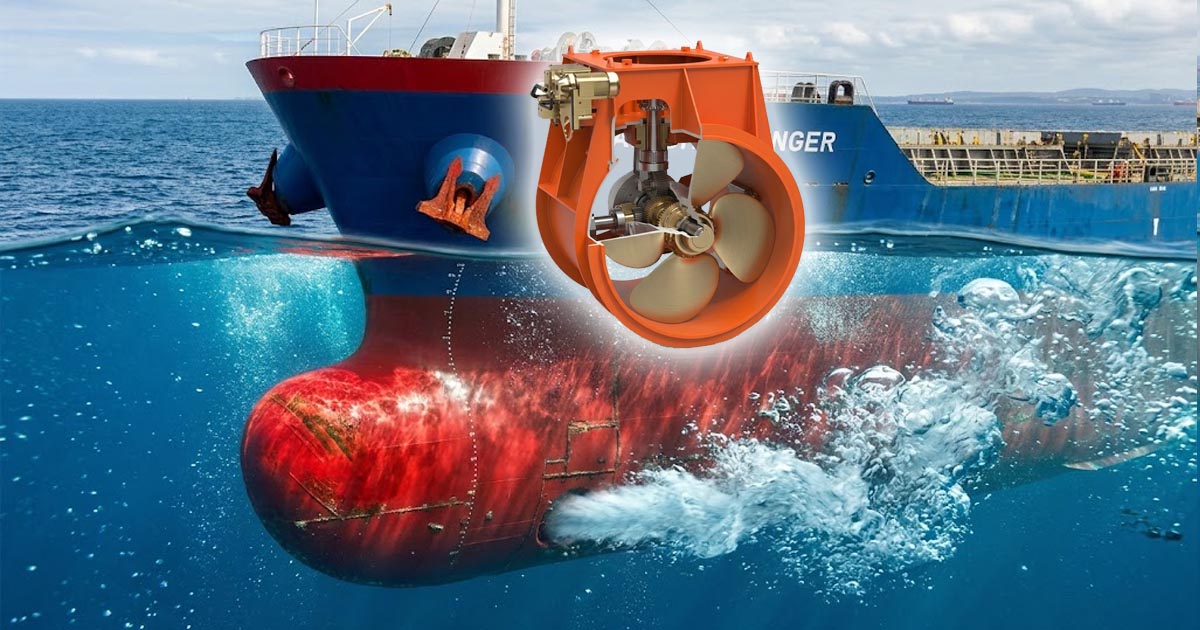
Your bow thruster lever sits at neutral, yet the bow of your laden bulk carrier creeps off the quay during berthing.
That drift is residual thrust, and it comes down to one fact: zero pitch is a target, not a guarantee.
How CPP Bow Thrusters Achieve Zero Thrust
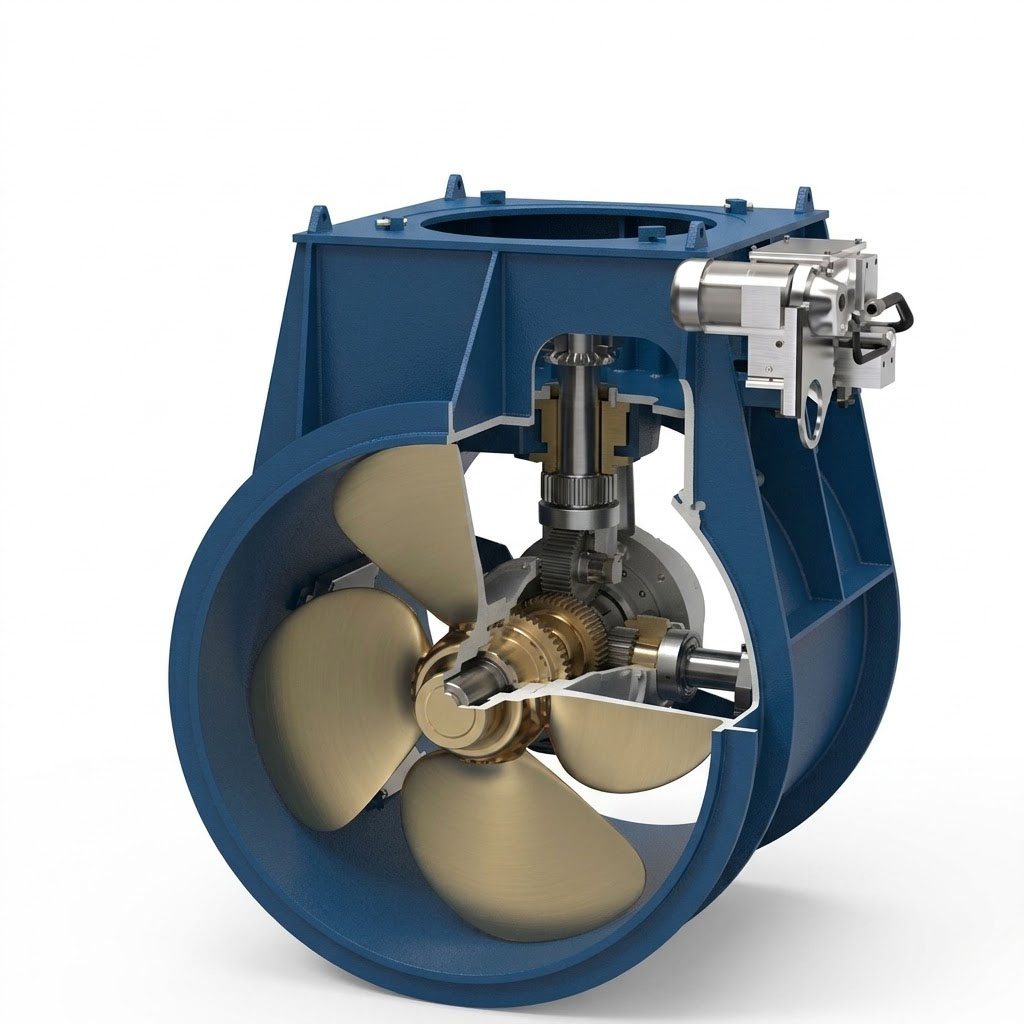
A controllable pitch propeller (CPP) bow thruster generates thrust by rotating its blades around their own axis inside the hub.
The command from the bridge moves a hydraulic actuator that twists the blades, changing their angle of attack against the water flowing through the tunnel.
At the manufacturer’s defined zero-pitch setting, the blade angle is positioned to produce approximately zero net thrust under specified operating conditions.
Zero pitch is therefore a control reference, not an absolute guarantee of zero hydrodynamic force.
In many CPP tunnel-thruster installations, the electric motor runs at a fixed or nominal speed while thrust is controlled primarily through blade pitch.
Other installations may combine pitch and speed control, depending on the thruster design.
⚓ Three Different “Zeros”
| Reference | Meaning |
| Command zero | The bridge control is at neutral. |
| Feedback zero | The pitch feedback system reports its calibrated neutral position. |
| Hydrodynamic zero | The propeller produces negligible net transverse thrust under the prevailing conditions. |
These conditions should normally correspond, but they are not necessarily identical. A thruster can show command and feedback at zero while still producing a small residual force because of mechanical, hydraulic, calibration, or hydrodynamic factors.
Theory vs. Shipboard Reality
Manufacturing tolerances, hub wear, and control drift mean the “zero” on your indicator may still carry a small thrust vector.
That is why a tunnel thruster at zero can nudge a light container ship a few centimeters off the berth.
Confusing the panel reading with reality is a classic trap. For maneuvering decisions, the bridge team should consider both equipment indications and the vessel’s actual response.
💡 Pro Tip: A practical way to assess whether a CPP bow thruster is at hydrodynamic zero is to observe the water flow around the tunnel opening. With the thruster (Command Zero and Feedback Zero) at neutral, there should be no sustained transverse flow indicating thrust predominantly toward either port or starboard. Persistent flow to one side may indicate residual thrust and should be investigated.
Hydraulic Control and Feedback Mechanisms
The Role of Hydraulic Actuators
Blade pitch is moved by a hydraulic piston, either inside the hub or in an external actuator depending on the design.
The bridge lever sends an electrical signal to a pitch control unit, which meters oil to one side of the piston to drive the blades to the commanded angle.
⚠️ Important: Hydraulic operating pressure is manufacturer- and installation-specific. Always take the applicable pressure range from the thruster’s technical manual.
Feedback Loops and Position Reporting
A pitch-position feedback sensor reports the actual blade position to the control unit. Depending on the system design, this may use a potentiometer, encoder, or another position-sensing device.
The unit compares commanded pitch against reported pitch and corrects until the error falls within tolerance.
When the control loop is correctly calibrated, the feedback should closely match the commanded pitch.
However, matching command and feedback does not by itself prove that hydrodynamic thrust is exactly zero.
💡 Pro Tip: At the start of every maneuvering like mooring or unmooring, run a short thruster test and watch the pitch repeater settle. It should come cleanly to zero without oscillation. Report sluggish or wandering indication to the engine department before the pilot boards.
Causes of Unwanted Residual Thrust
| Cause | Effect | Indicator |
| Mechanical wear | Blade seals, bearings, and linkage wear alter blade positioning | Gradual drift from zero over time |
| Control system hunting | Pitch overshoots and corrects around commanded value | Flickering pitch indication or audible valve cycling |
| Oil temperature extremes | Cold oil slows response; hot oil increases internal leakage | Sluggish return to zero or blade creep |
| Feedback sensor error | Control unit receives incorrect blade position data | Mismatch between command and actual thrust |
| Calibration drift | Zero-point reference shifts over time | Residual thrust with lever at neutral |
Mechanical Imperfections and Wear
Components such as blade seals, bearings, pitch-linkage components, and other internal mechanisms can wear over time, depending on the thruster design.
Wear or mechanical misalignment can affect the relationship between commanded pitch and actual blade position.
Control System Hunting and Oscillation
Hunting is the pitch repeatedly overshooting and correcting around the commanded value, often visible as a flickering pitch indication or audible cycling of the hydraulic valve.
It usually points to feedback error, valve stiction, or an over-sensitive control loop.
Hunting around zero means the pitch system is repeatedly moving around the commanded position, which can produce fluctuating thrust instead of stable neutral operation.
Hydraulic Oil Temperature and Viscosity Effects
Cold, thick oil flows slowly through the metering valves, so response to your lever lags.
High oil temperature reduces viscosity and can increase internal leakage in worn hydraulic components.
Oil condition, component clearances, and valve condition should therefore be considered when investigating pitch creep.
⚠️ Caution: Never assume the thruster is inactive because the lever is centered. Residual thrust from a creeping pitch position can push a mooring gang, part a spring line, or set the vessel onto the berth. Confirm the pitch indicator and watch the vessel’s actual movement before declaring the thruster neutral.
Note: The vessel’s SMS should specify the required pre-arrival and pre-departure tests for the bow thruster and other maneuvering equipment. Record any hunting, abnormal indication, or slow return to zero so recurring defects can be identified and addressed.
When to Calibrate or Maintain the System
Calibration or zero-point adjustment may be required when the commanded pitch, feedback indication, and actual thruster response no longer correspond.
The exact procedure depends on the manufacturer and control-system design.
Watch for These Signs:
- Persistent hunting – pitch oscillates around the command for more than a few seconds after lever movement
- Failure to hold zero – indication drifts from null or vessel shows steady residual thrust with lever centered
- Sluggish response – clear lag between lever input and pitch indication, especially on cold starts
- Station mismatch – bridge wing and main console repeaters disagree on blade angle
Maintenance Priorities
Routine maintenance should cover:
- Oil cleanliness and condition
- Filter differential pressure
- Accumulator pre-charge
- Feedback sensor checks
The ISM Code requires companies to establish procedures for maintaining ships and equipment safely, including procedures for identifying defects, reporting non-conformities, and taking corrective action.
The specific bow-thruster checks should therefore be defined by the vessel’s SMS, manufacturer instructions, and applicable class requirements.
During applicable inspections, inspectors may review the operational readiness, maintenance, and testing of safety-critical equipment.
For vessels subject to SIRE 2.0, the inspection scope should be checked against the current OCIMF question library and applicable vessel-specific requirements.
Quick Zero-Thrust Troubleshooting
- Confirm the command – Check that the bridge lever is actually at neutral
- Compare command and feedback – Check pitch command against pitch feedback indication
- Check for hunting – Look for oscillating pitch feedback or repeated hydraulic valve activity
- Check hydraulic conditions – Verify oil level, temperature, filter condition, and hydraulic pressure against manufacturer limits
- Compare repeaters – Check whether main console and bridge-wing indications agree
- Verify actual response – If safe and operationally appropriate, observe whether the vessel continues developing lateral movement after command returns to zero
- Escalate persistent faults – Record the abnormality and have responsible engineering personnel investigate according to the vessel’s SMS and manufacturer’s troubleshooting procedure
Frequently Asked Questions
Q: Is zero pitch the same as zero thrust?
A: Zero pitch is the intended setting for zero thrust, but wear, feedback error, and hydraulic leakage can leave a small residual force. Always confirm with the pitch indicator and the vessel’s actual movement.
Q: Why does my bow thruster hunt when returned to zero?
A: Hunting usually means the feedback sensor and the true blade angle disagree, so the control unit keeps correcting. Report it early; it erodes maneuvering precision and often precedes valve or sensor failure.
Q: Can oil temperature really change thruster behavior?
A: Yes. Cold oil increases viscosity and slows pitch response, while hot or degraded oil allows internal leakage and blade creep. Run the hydraulic unit within the manufacturer’s specified temperature range before critical maneuvers.
Summary
Zero pitch on a CPP bow thruster is a control target, not a physical guarantee of zero thrust.
Mechanical wear, control system issues, oil temperature effects, and calibration drift can all produce residual thrust that affects vessel maneuverability.
Regular testing, proper maintenance, and careful observation of both indicators and actual vessel response are essential for safe operations.
Subscribe to our newsletters.
May the winds be in your favor.
Leave a Reply