

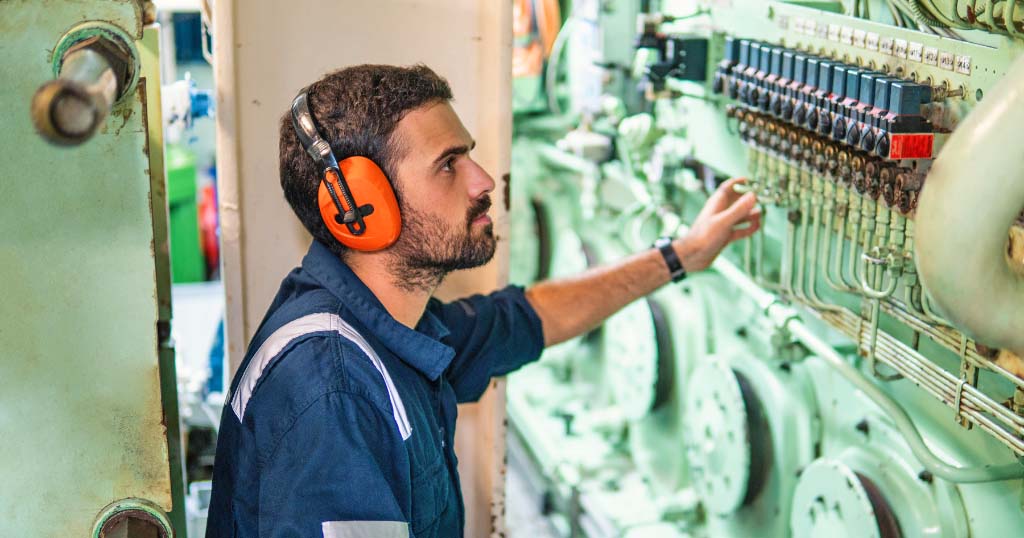
Maritime operations depend on equipment that cannot fail without putting lives, cargo, or the environment at risk.
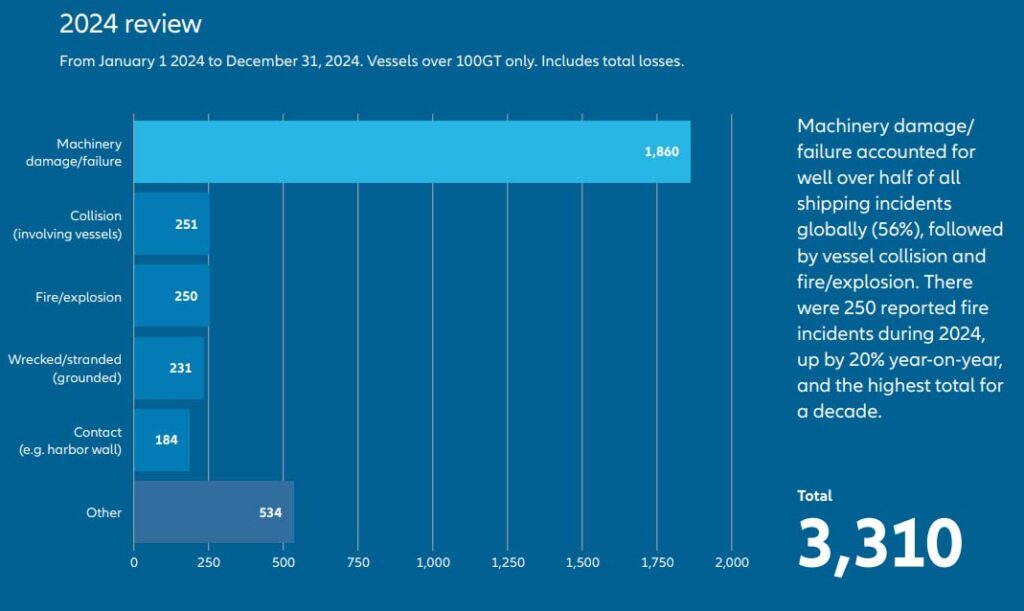
According to Allianz’s Safety and Shipping Review 2024, machinery damage and technical failures account for 56% of all shipping incidents worldwide, making equipment integrity the single largest risk driver.
The IMO has responded with new implementation outputs under the ISM Code, while shipowners are adopting AI-based diagnostics, green batteries, and cybersecurity upgrades to reduce accidents.
This guide explains what counts as critical equipment on board, how to classify it under ISM Code 10.3, and what happens when these systems fail.
What Defines Critical Equipment? ISM Code 10.3 Explained 🔎
The International Safety Management (ISM) Code, Section 10.3, requires shipowners and operators to identify equipment “whose sudden failure may result in hazardous situations.”
These are designated as critical equipment because a breakdown directly compromises ship safety, crew survival, or environmental protection.
Critical equipment must be:
- Clearly identified and logged in the Safety Management System (SMS).
- Routinely tested to prove readiness, including standby systems.
- Covered by documented maintenance, redundancy plans, and crew familiarization.
On April 2025, the IMO released “Guidelines on maritime cyber risk management” through MSC-FAL.1/Circ.3/Rev.3 that tackles cybersecurity risks and how it affects critical systems onboard.
This means GMDSS, ECDIS, and even propulsion monitoring systems are now considered both safety-critical and cyber-critical.
Critical vs. Standby: Definitions and Examples
While the terms are often used interchangeably, the ISM Code distinguishes between equipment based on its role in a safety system.
- Critical Equipment: A system whose unexpected failure directly and immediately poses a risk of a hazardous situation. The main steering gear, for instance, is a critical piece of equipment because its failure during a close-quarters situation could lead to a collision or grounding.
- Standby Equipment: A system intended for emergency use or to provide redundancy for a primary system. The anchors are a prime example- they are not in continuous use but are critical for an emergency stop or securing the vessel.
| Type | Example | Failure Impact | Risk Level |
|---|---|---|---|
| Critical | Steering Gear | Immediate loss of maneuverability; high risk of collision or grounding | 🔴 High |
| Critical | Main Engine | Blackout or grounding; possible pollution | 🔴 High |
| Standby | Anchors | Used in emergencies only; low operational risk if unavailable | 🟡 Moderate |
| Standby | Ballast Pumps | Workarounds possible; no immediate hazard | 🟡 Moderate |
👉 In short:
critical = direct hazard if it fails;
standby = support role, activated if primary fails.
Crew Dependency and Risk Logic
Not all equipment carries equal weight. The impact depends on how much the crew relies on it for safe operations.
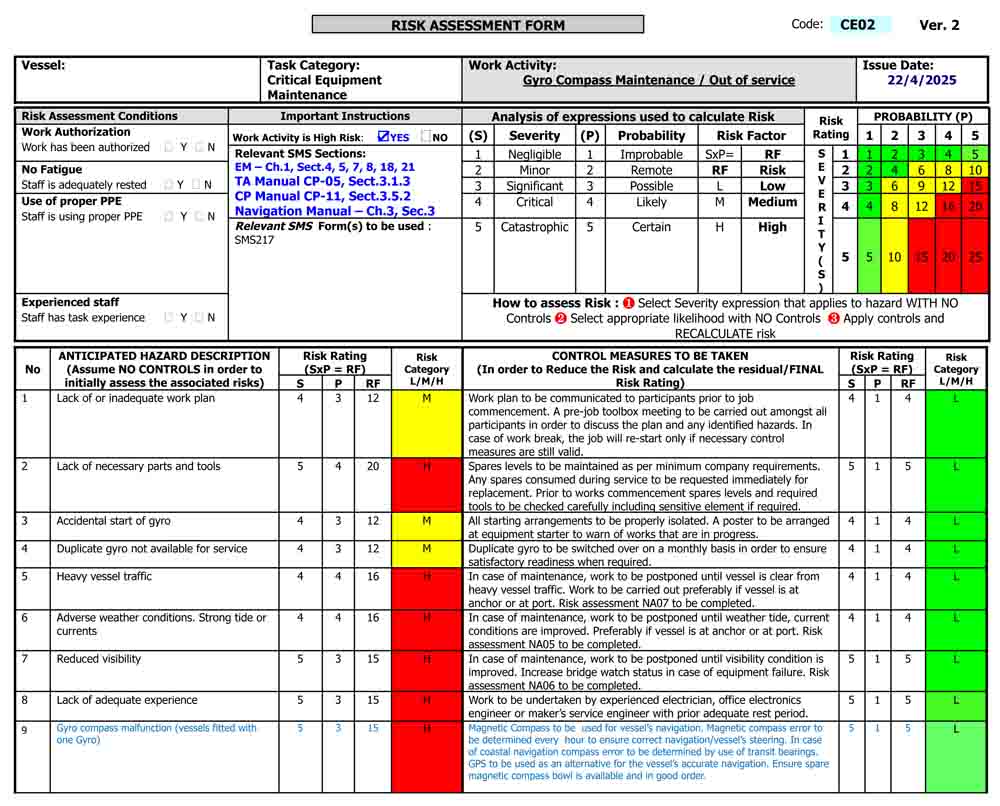
The industry uses a simple scoring model:
Risk = Severity × Likelihood- Severity (1–5): How severe is failure? (1 = Negligible, 5 = catastrophic)
- Likelihood (1–5): How often could failure realistically happen? (1 = Improbable, 5 = Certain)
Example:
- Steering Gear → Severity = 5 (loss of control), Likelihood = 4 → Risk Score = 20 (critical).
- Anchor Windlass → Severity = 2 (workaround possible), Likelihood = 2 → Risk Score = 4 (standby).
This logic ensures crew training, drills, and maintenance routines align with the actual safety importance of each system.
A Risk-Based Framework to Classify Criticality ⚖️
A systematic framework helps prioritize resources:
How to Score Criticality: Impact, Likelihood, Redundancy
- List all major equipment (propulsion, steering, navigation, safety, cargo-handling).
- Score severity of sudden failure (1–5).
- Score likelihood of failure based on PMS history, age, or condition (1–5).
- Check redundancy: Is there a reliable backup? If not, increase priority.
- Calculate risk = Severity × Likelihood.
- High-risk (15–25): Must be logged as critical equipment in the SMS, with regular testing and crew drills.
- Medium-risk (6–14): Classified as standby but still monitored.
- Low-risk (1–5): Routine maintenance, but not SMS-critical.
👉 This method creates a transparent, auditable Critical Equipment Register that satisfies ISM 10.3 and aligns with 2025 audit practices.
Core Categories of Critical Equipment ⚓
Critical shipboard systems fall into six main categories. Each carries specific risks, redundancy requirements, and maintenance needs.
Propulsion and Power (Main and Auxiliary Engines, Emergency Generators)
- Why critical: The propulsion plant is the ship’s heartbeat. Loss of the main engine or electrical power can lead to blackout, grounding, or collision. Emergency generators are mandatory under SOLAS to restore power for navigation, communication, and safety.
- Failure modes: Fuel pump seizure, lube oil contamination, control air leaks, generator non-start.
- 2025 upgrade: AI-based engine diagnostics and hybrid Battery Energy Storage Systems (BESS) allow smoother black-starts and reduced emissions during emergencies.
- Redundancy: Emergency generator plus battery UPS. Dual-fuel designs add resilience.
- PMS/Test: Emergency generator weekly start; main engine alarms and shutdown tests per voyage.
- Crew action: Isolate fault, transfer to emergency generator, maintain steering control, notify engine room team.
Steering and Maneuvering (Steering Gear, Bow Thrusters)
- Why critical: Steering gear failure is a top collision and grounding risk. Bow thrusters assist safe port entry/exit and enhance maneuverability.
- Failure modes: Hydraulic leaks, actuator faults, electrical supply failure.
- 2025 upgrade: Predictive AI monitoring hydraulic pressure, early-warning vibration sensors, and joystick integration for redundancy.
- Redundancy: SOLAS requires dual independent steering pumps. Manual trick wheel is the last fallback.
- PMS/Test: Full gear test before departure; emergency steering drill every 3 months.
- Crew action: Switch to standby pump, engage manual steering, and alert VTS system.
Navigation and Communication (ECDIS, GMDSS, Radar, Gyro)
- Why critical: These systems ensure situational awareness and regulatory compliance. ECDIS failure can cause navigational errors, while loss of GMDSS endangers distress communication.
- Failure modes: Signal loss, software crash, antenna damage.
- 2025 upgrade: AI-assisted route optimization, cyber firewalls for GMDSS terminals, and resilient PNT (Position, Navigation, Timing) backups.
- Redundancy: Dual ECDIS and radar setup required on many ships; paper charts or backup GPS still essential; Magnetic Compass as back-up.
- PMS/Test: GMDSS tested weekly; radar and ECDIS alarms checked monthly.
- Crew action: Shift to secondary ECDIS or GPS, plot manually, maintain VHF watch.
Safety Systems (Fire Suppression, Lifeboats, EEBD)
- Why critical: Fire and abandonment systems are life-saving appliances (LSA). Their failure directly endangers crew survival.
- Failure modes: Lifeboat release gear jamming, CO₂ system leakage, expired EEBD canisters.
- Redundancy: Portable extinguishers, spare EEBDs, secondary lifeboats/rafts.
- PMS/Test: Fire-fighting systems checked monthly; lifeboat drills every 3 months; EEBD checked monthly.
- Crew action: Activate backups, switch to manual launch, muster crew, and communicate with shore authorities.
Environmental Systems (OWS, Ballast Water Management, Sewage Treatment Plant)
- Why critical: Malfunction leads to pollution incidents and heavy MARPOL fines.
- Failure modes: Oily Water Separator (OWS) alarm bypass, ballast water UV lamp failure, sewage treatment plant blockage.
- Redundancy: Holding tanks, portable pumps, manual overboard valves (locked/sealed under MARPOL).
- PMS/Test: OWS calibration biweekly; ballast sensors checked per voyage; sewage filters monthly.
- Crew action: Halt discharges, notify authorities, switch to holding tanks until repaired.
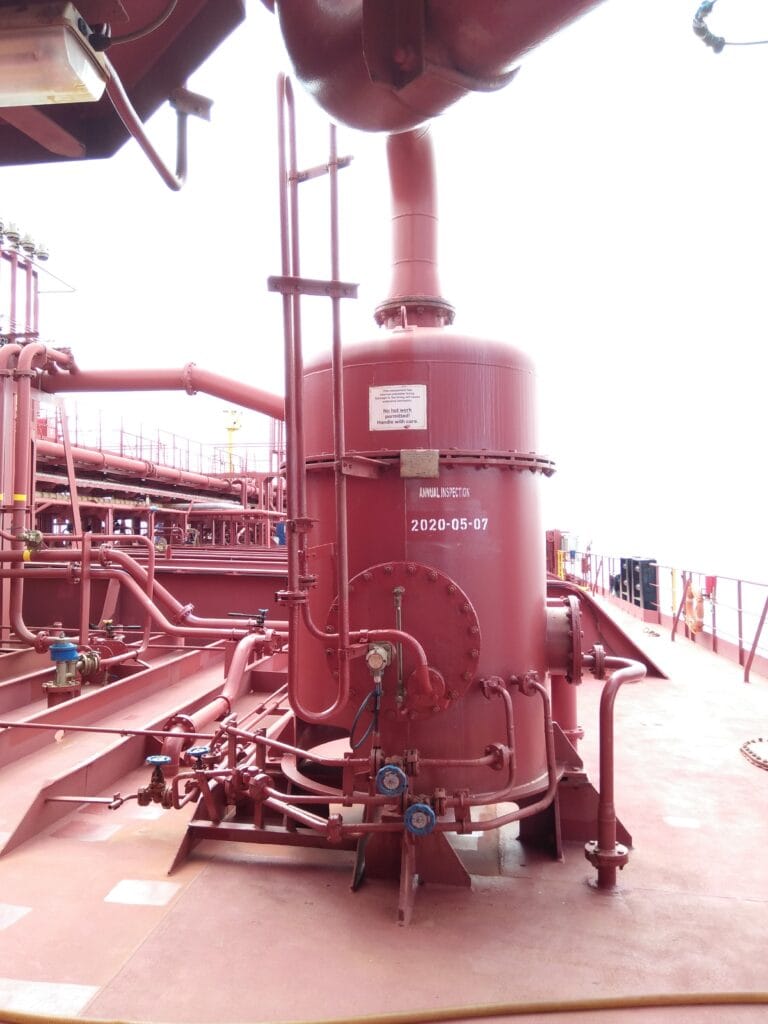
Cargo-Specific Systems (Inert Gas Plant, RoRo Ramps, Cranes)
- Why critical: Cargo-related failures can cause explosions, cargo loss, or PSC detention.
- Failure modes: Inert gas (IG) blower trips, RoRo ramp hydraulics leaking, crane load cell failure.
- Redundancy: Secondary ramps, portable blowers, and spare crane wires.
- PMS/Test: IG pressure checks during operation; ramps tested pre-arrival; cranes load-tested annually.
- Crew action: Activate ESD (Emergency Shut-Down), secure cargo, and notify charterers/terminals.
When Systems Fail: Scenarios and Contingencies 🧭
Even the best-maintained systems can fail. Recent MAIB reports highlight real risks:
- 2022 Steering Failure: The fully laden capesize bulk carrier Hagen Oldendorff experienced issues in the rudder systems leading to grounding of the vessel on the western side of the channel. (Source: ATSB)
- 2023 Blackout Incident: Container ship MV Dali collided with and caused the collapse of the Francis Scott Key Bridge in Baltimore, Maryland due to a sudden loss of electrical power and propulsion shortly after leaving the terminal. (Source: NTSB)
Contingency Flow
When accidents occur, contingency flowchart ensures rapid response:
- Stabilize → Stop dangerous movement (drop anchor, switch to manual control).
- Isolate → Shut down faulty unit to prevent escalation.
- Notify → Bridge, engine control room, and shore office.
- Implement Backup → Activate standby system or manual procedure.
- Log & Report → Update SMS, notify flag/PSC if required.
Redundancy and Crew Actions
Every critical system must have a backup protocol:
- Steering → Switch to standby pump or engage emergency steering.
- Power → Engage emergency generator and UPS.
- Navigation → Use backup GPS, radar plotting, celestial navigation (for open sea blackout) and paper charts.
- Cargo → Activate ESD systems, stop operations.
Training and Drills for Emergencies
Drills ensure that contingency steps are executed under pressure:
- Emergency Steering drills: every 3 months (ISM requirement).
- Blackout response drills: once a year or as necessary.
- Fire & abandon ship drills: monthly, including EEBD and lifeboat launch.
- 2025 trend: AI-based simulators now allow officers to rehearse ECDIS failures, cyber-attacks, and system blackouts virtually, boosting realism.
Shipboard drills are scheduled on a regular basis to familiarize the crew on the procedures in case emergency occurs.

Future-Proofing Critical Equipment
Predictive Maintenance and IoT Sensors
- Continuous monitoring of engine vibrations, steering pressure, and OWS discharge quality.
- Data sent to shore-based Fleet Operation Centers for real-time analysis.
AI-Based Failure Detection
- Algorithms detect anomalies before failure, scheduling proactive maintenance.
- Example: Steering pump pressure drops flagged hours before actual breakdown.
Regulatory Trends and Tech Adoption
- IMO: Expanded scope for remote audits and cybersecurity readiness.
- SOLAS amendments: Growing focus on redundancy in digital navigation.
- MARPOL enforcement: More PSC detentions linked to OWS tampering, pushing IoT compliance tools into mainstream use.
Build Your Critical Equipment Register 🗂️
To comply with ISM Code 10.3, every ship should maintain a Critical Equipment List or Register.
This document lists all systems whose sudden failure could cause a hazardous situation, along with their testing and spares.
Recommended columns for your register:
- Equipment ID – e.g., ENG-001
- System / Description – e.g., Steering Gear Hydraulic Pump
- Criticality Score – Risk score (Severity × Likelihood)
- PMS / Test Interval – e.g., Weekly function test
- Redundancy / Backup – e.g., Standby pump available
- Spares Onboard – e.g., Hydraulic seals, oil filters
- Crew Responsibility – Officer in charge
Example entry:
| Equipment ID | System / Description | Criticality Score | PMS / Test Interval | Redundancy | Spares Onboard | Responsible Crew |
|---|---|---|---|---|---|---|
| ENG-001 | Steering Gear Pump (Port) | 20 (Critical) | Weekly + Pre-voyage | Starboard pump | Seal kit, hydraulic oil | 2/O + C/E |
👉 Tip: Maintain the list as a CSV or Excel file. Share it with crew and shore management, and update during ISM audits. A downloadable template (CSV/Excel) ensures consistency across fleets.
FAQ: Quick Answers on Critical Equipment ❓
Q1: What is considered critical equipment under ISM Code 10.3?
Any system whose sudden failure could lead to hazardous situations, including propulsion, steering, navigation, firefighting, lifesaving, and pollution prevention systems.
Q3: How often should standby equipment be tested?
Standby systems must be tested at intervals that prove readiness– typically weekly for emergency generators, pre-departure/arrival for steering gear, and monthly for fire pumps.
Q4: What’s the difference between critical and standby equipment?
- Critical equipment → Its failure poses an immediate hazard (e.g., steering gear).
- Standby equipment → Support systems used if primary units fail (e.g., anchors, standby pumps).
Q5: How do you score criticality?
By applying Risk = Severity × Likelihood. Systems with scores 16–25 are critical and must be logged in the SMS.
Q6: What happens if critical equipment fails at sea?
Activate redundancy (emergency generator, backup steering), stabilize operations, notify shore office/flag, and log the failure in the SMS.
Q7: Who is responsible for maintaining the register?
The Designated Person Ashore (DPA) ensures oversight, but the ship’s master and chief engineer are responsible for keeping it current onboard.
Conclusion ⚓
Summary of Key Takeaways
- Critical equipment is defined under ISM Code 10.3 as systems whose sudden failure can create hazardous situations.
- These systems span propulsion, steering, navigation, safety, environmental, and cargo-handling equipment.
- A risk-based framework (Severity × Likelihood) helps classify criticality and prioritize resources.
- Redundancy, crew drills, and PMS routines are essential to maintain readiness.
- Future-proofing with AI, IoT sensors, and cybersecurity upgrades is considered to enhance safety in 2025 and beyond.
Why This Knowledge Matters for Mariners, Owners, and Regulators
For mariners, it’s about survival and safe ship handling.
For owners, it’s about avoiding costly incidents, PSC detentions, and pollution fines.
For regulators, it ensures the ISM Code’s purpose- safe ships and clean seas, is upheld.
By maintaining a Critical Equipment List, testing systems regularly, and preparing for failures with drills and digital upgrades, the maritime industry can significantly cut down on accidents and chart a safer course for the future.
May the winds be in your favor.
Leave a Reply