


When a ship arrives at a port, one of the first priorities is securing it safely to the berth.
This process is known as mooring– a critical maritime operation that allows cargo handling, bunkering, maintenance, and crew changes to be carried out safely.
But mooring is more than just “tying up” the vessel.
It’s a complex operation involving strategic planning, the right equipment, and seamless coordination between the ship’s crew, pilot, tugboats, and shore mooring gangs.
Failure in this operation can lead to drifting, accidents, or severe injuries.
✅ Definition of Mooring
Mooring is the act of securing a vessel to a fixed or floating structure using ropes, wires, or chains to hold it in position.
This can occur at:
- Port terminals (piers, quays, wharfs)
- Offshore facilities (buoys, SPMs, sea islands)
- Other vessels (Ship-to-Ship or STS operations)
The primary goal is to prevent unintended movement of the ship caused by wind, waves, current, or nearby vessel activity.
🛳️ Why Mooring Is Crucial for Ship Safety
A securely moored ship ensures:
- ✅ Safe cargo loading/unloading
- ✅ Protection of crew and terminal staff
- ✅ Avoids damages to ship and port facilities
- ✅ Stability during bunkering or maintenance
- ✅ Compliance with port regulations
When improperly moored, a vessel may drift or surge, increasing the risk of berth damage, equipment failure, or crew injury, particularly in high-traffic or weather-affected terminals.

📌 Mooring Locations and Scenarios
| Type of Mooring Location | Description |
|---|---|
| Terminal Berthing | Standard port mooring at a pier or quay |
| Buoy Mooring | Offshore mooring using single or multiple buoys |
| STS Operation | Mooring to another vessel at sea or anchorage |
| Dolphin Mooring | Mooring to fixed structures offshore or along terminals |
| Barge Mooring | Small-scale mooring using basic gear and limited space |
These setups require specific mooring systems and techniques depending on the vessel size, berth configuration, and environmental forces.
Types of Mooring Systems Used in Maritime Operations
Mooring systems vary based on ship types, location, and operational needs.
Choosing the correct system is critical to ensure the vessel stays securely in place despite external forces like wind, current, and tide.
Below are the most common types of mooring systems used on merchant ships, offshore terminals, and special-purpose vessels.
1. 🧷 Terminal Mooring (Conventional Berthing)
Terminal mooring is the most widely used method for vessels berthing at ports, piers, or quays.
It involves multiple lines (headlines, stern lines, breast lines, and spring lines) arranged symmetrically from bow and stern to shore bollards.
- ✅ Ideal for: Container ships, tankers, bulk carriers
- ✅ Purpose: Ensures ship remains alongside for cargo and port operations
- ✅ Common Setup: 3-2-2 arrangement (head/stern, breast, spring)

2. 🔘 Single Point Mooring (SPM)
In an SPM system, the vessel is moored to a floating buoy anchored to the seabed.
This allows the ship to rotate freely with wind and current changes, reducing stress on mooring lines.
- ✅ Used by: Crude oil tankers, VLCCs, FPSOs
- ✅ Key Benefit: Flexibility and safety during offshore loading/unloading
- ✅ Location: Often found offshore in deep waters
💡 Fun fact: The SPM allows 360° rotation around the buoy, which reduces hull strain.
3. 🕸️ Multi-Buoy Mooring (MBM or Spider Mooring)
This system uses multiple buoys anchored around the ship to hold it in position.
Lines are secured from both bow and stern to separate buoys like a spider web pattern.
- ✅ Used in: Shallow offshore terminals, limited quay space
- ✅ Benefit: Secure positioning without shore infrastructure
- ✅ Alternate Name: Spider Mooring
4. ⛴️ Ship-to-Ship Transfer (STS Operation)
STS mooring is when two ships are moored side-by-side to transfer cargo- commonly petroleum products.
It can occur while underway, at anchor, or alongside a terminal berth.
- ✅ Used by: Tankers, LNG carriers
- ✅ Requirement: Fenders, lines, coordinated team action
- ✅ Risks: Surge, wave interaction, collision
5. 🛶 Barge Mooring
A barge mooring setup is simpler.
It involves securing a barge to piers, locks, or another vessel using fewer and smaller lines due to its size and limited operational scope.
- ✅ Common in: Inland waterways, rivers, small terminals
- ✅ Gear Used: Light synthetic ropes, chocks, bitts
6. 🚢 Tugboat Handling
Though not a mooring system per se, tugboat handling plays a critical role during docking and undocking.
Tugs use towing lines (wires or synthetic ropes) to push, pull, or steady the vessel.
- ✅ Vital for: Large vessels, ports with tight maneuvering areas
- ✅ Tethered or free: Depending on maneuvering needs
- ✅ Controlled by: Pilot via VHF or bridge team
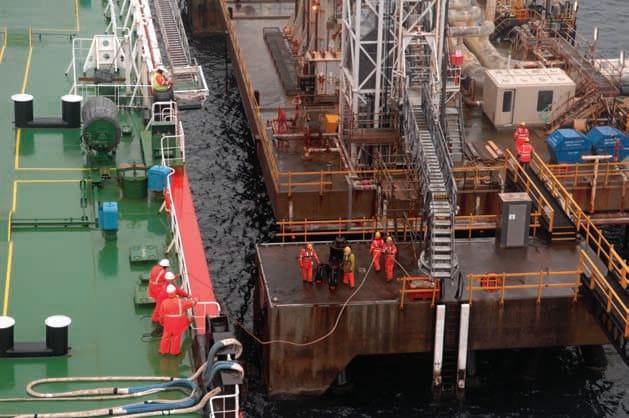
7. ⚓ Emergency Towage Arrangement
When a ship is disabled or distressed, emergency towing is used to bring her to safety.
These setups involve pre-rigged emergency towing gear at bow and stern per SOLAS/IMO requirements.
- ✅ Mandatory under: SOLAS Chapter II-1 Regulation 3-4.2
- ✅ Includes: Emergency towing pennant, chain stopper, strongpoint
- ✅ Used by: Tugs during rescue/towage
8. 🧊 Specialized Mooring Systems
These are designed for specific marine environments such as:
- Offshore FPSOs
- Polar operations
- Subsea energy platforms
- Dynamic positioning systems (DP)
They require customized setups considering water depth, sea state, ice loads, or platform mobility.
Mooring Winches, Capstans, and Other Mooring Equipment
Mooring equipment is the backbone of safe and efficient mooring operations.
Each component- from winches to bollards, plays a critical role in line handling, tension control, and overall ship stability at berth.
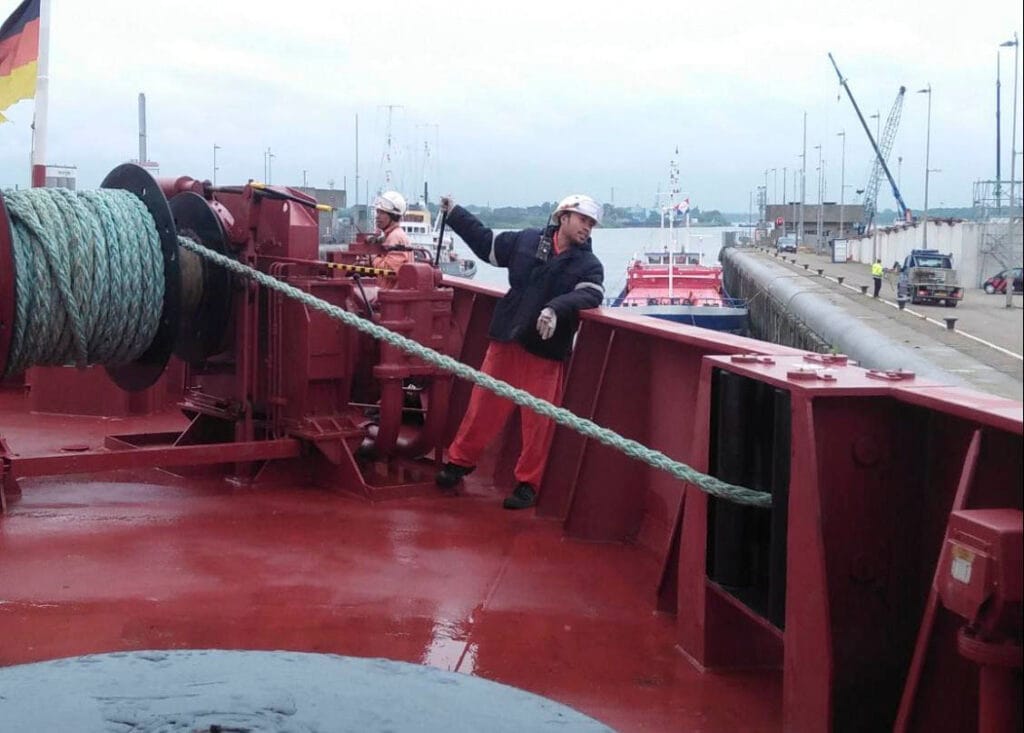
🧰 Common Mooring Equipment and Their Functions
| Equipment | Function |
|---|---|
| Mooring Winch | Used to let out, heave in, or hold mooring lines under tension. Can be manual, electric, or hydraulic. |
| Capstan | Vertical-axis winch for heaving mooring lines; commonly found on the forecastle. |
| Bitts | Heavy-duty cylindrical posts on deck where lines are secured using turns or figure-eight patterns. |
| Chocks (Closed/Open Type) | Guide mooring lines from winch to shore fittings, reducing chafing and line wear. |
| Fairleads | Direct lines through sheaves or rollers to prevent line snagging and damage. |
| Bollards | Strong posts onshore or onboard used for securing lines. |
| Stoppers (Chain or Rope Type) | Temporarily hold the load of mooring lines while adjustments are made. |
🔩 Winch Safety Features and Settings
Modern mooring winches often include:
- Load Monitoring Systems – Indicate line tension to prevent overload or snapback.
- Render and Recovery Controls – Allow auto-tension or constant-tension settings.
- Manual Brake Release – Emergency option if power fails.
- Local and Remote Control Stations – Enhance operational flexibility.
🔎 Check manufacturer manuals for safe working load (SWL), brake holding capacity, and proper use procedures.
⚠️ Preventive Maintenance and Inspections
Routine checks and servicing reduce failure risk during mooring:
- Grease rotating parts (bearings, gears) regularly.
- Check brake linings for wear and replace as per schedule.
- Inspect hydraulic/pneumatic systems for leaks or pressure loss.
- Verify tension settings before operation.
- Test remote control systems and emergency stop buttons.
🛠️ Ensure all equipment is tagged and included in the vessel’s Planned Maintenance System (PMS) per ISM Code requirements.

Mooring Line Types and Characteristics
Understanding the different types of mooring lines is crucial for maintaining mooring integrity, preventing parting under load, and avoiding injury from snapback zones.
🔗 Common Types of Mooring Lines on Merchant Ships
| Line Type | Material | Key Features | Typical Use |
|---|---|---|---|
| High Modulus Synthetic Fibers (HMSF) | Synthetic | Ultra-high strength, light, minimal snapback | Tankers and offshore mooring |
| Wire Mooring Lines | Steel wires twisted around a steel core | High strength, low elasticity, heavy | Used with winches, especially on tankers |
| Conventional Fiber Mooring Lines | Natural or Synthetic Fibers | Light, flexible, less expensive | Often used by smaller vessels |
⛓️ Wire ropes and high modulus lines require specific sheaves and fittings to avoid damage.
🧪 Key Mooring Line Properties to Know
| Property | Importance |
|---|---|
| Breaking Load (MBL) | Maximum tension before failure; select lines rated above expected loads |
| Elongation at Break | Indicates stretch; nylon has high elongation, HMSF has low |
| Abrasion Resistance | Crucial for contact with sharp edges or rough chocks |
| UV & Chemical Resistance | Required for durability in exposed marine environments |
| Water Absorption | Can affect line weight and performance (e.g., polypropylene floats) |
✅ Best Practices for Mooring Line Handling
- Always coil lines properly after use to prevent kinks and knots.
- Inspect regularly for broken strands, chafing, and heat damage.
- Use chafing gear when lines pass over sharp or abrasive surfaces.
- Avoid mixing line types (e.g., wire and synthetic) in the same mooring arrangement.
- Follow the vessel’s Mooring Equipment Guidelines (MEG4) as per MSC.1/Circ.1619.
⚙️ Train deck crew regularly on rope handling, heaving line throw techniques, and mooring tension monitoring.
⚠️ Common Mooring Hazards and Safety Risks
Mooring is among the most dangerous shipboard operations.
Accidents during mooring often result in serious injury or death due to high-tension lines, human error, and poor situational awareness.
🚧 1. Snapback Zones
When a mooring line under tension breaks, it recoils violently toward the ship or berth.
These snapback zones are invisible danger areas that can fatally injure personnel standing within their path.
- Key Risk: Lines parting due to overloading, poor condition, or uneven tension.
- Best Practice: Mark snapback zones clearly on deck and never stand in the bight or direct line of tensioned ropes.

🧷 2. Poor Communication
Miscommunication between the bridge, mooring stations, and shore personnel is a leading cause of mooring accidents.
Delayed or misunderstood instructions can result in premature line tensioning, line breaks, or crushing injuries.
- Use closed-loop communication and standard commands.
- Ensure clear VHF or UHF radio contact is established before operations begin.
🧯 3. Equipment Failures
Worn-out bollards, faulty winches, or corroded fairleads and roller chocks can contribute to sudden mechanical failure.
- Routine maintenance and pre-operation checks are vital.
- Report and isolate defective equipment before use.
🧍 4. Unsafe Behavior
Crew standing in unsafe positions, walking over active mooring lines, or engaging in horseplay during operations increases the likelihood of incidents.
- Conduct regular toolbox talks and risk assessments.
- Assign a designated mooring supervisor to monitor safety compliance.
🆘 Emergency Procedures During Mooring Operations
Despite precautions, emergencies may occur. Every crew member must know how to respond quickly and safely.
🔔 Immediate Actions During a Mooring Emergency
- Raise the Alarm – Notify the bridge, engine room, and all relevant stations.
- Evacuate Snapback Zones – Direct all non-essential personnel away from danger areas.
- Stop Machinery – Isolate winches or capstans if a line is fouled or jammed.
- Cut the Line if Necessary – Use mooring knives or hydraulic cutters if tensioned lines threaten life or vessel safety.
- Administer First Aid – Apply immediate treatment and call for medical help onboard.
🧪 Post-Emergency Protocols
- Review and update risk assessments and procedures as needed.
- Conduct an incident investigation and create a near-miss or accident report.
- Debrief the crew and implement corrective actions.
⚠️ Safety Tips for Mooring Operations
Mooring is a high-risk task.
Many accidents and fatalities occur during line handling and tensioning.
Follow these safety tips to avoid injury:
✅ Best Practices for Mooring Safety
- Wear proper PPE: Helmet, gloves, safety shoes, coveralls, and eye protection.
- Avoid the snap-back zone: Never stand in line with mooring ropes under tension. Learn and mark snap-back areas on deck.
- Always maintain visual communication: Bridge team, winch operators, and deck crew must coordinate through hand signals or radios.
- Keep clear of moving ropes and winches: Never stand near rotating drums or moving parts.
- Check line tension frequently: Especially during tide changes or ship movements.
- Do not peek between the ship and quay/ fender: If a mooring rope is stuck, avoid placing your head on the ship’s side to check the fenders.
- Secure loose lines and tails: Prevent tripping and entanglement.
- Conduct toolbox meetings before mooring: Clarify assignments and emergency procedures.
- Stay alert: Mooring conditions can change rapidly due to weather, current, or vessel drift.
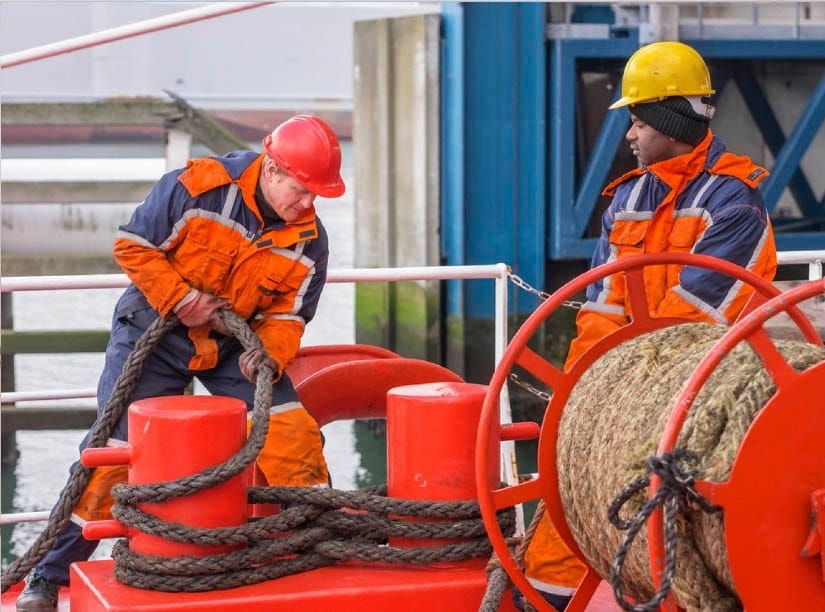
❓ FAQs on Mooring Operations
1. What is the safest way to moor a ship?
Use a balanced mooring arrangement (headlines, breast lines, spring lines), ensure proper line tension, and avoid snap-back zones.
2. Why do mooring ropes break?
Due to overloading, poor maintenance, improper handling, or incompatible ship-shore arrangements.
3. What is the snap-back zone?
The area where a rope violently recoils if it breaks under tension. It is one of the most dangerous zones during mooring.
4. Can mooring operations be done by autopilot or AI?
Not fully. While automated mooring systems exist (e.g., vacuum or magnetic mooring) and we have autonomous ships on the horizon, most vessels still rely on manual operations.
5. What are the signs of rope failure during mooring?
Frayed strands, uneven stretch, discoloration, and strange sounds (like cracking or popping) under tension.
🔚 Conclusion: Handle Mooring With Skill, Teamwork, and Caution
Mooring may appear routine, but it demands precision, preparation, and strict safety awareness.
Whether you’re a cadet learning the basics or an officer leading the team, knowing the types of mooring lines, configurations, and safety practices is crucial.
Mastering mooring operations helps ensure the safety of the crew, the vessel, and port infrastructure- making it one of the most vital seamanship skills at sea. ⚓
📣 Call to Action
Want to learn more about ship handling and deck operations?
👉 Explore our Navigation and Ship Knowledge sections for more seafarer-friendly guides!
📩 Got a question or topic suggestion? Drop it in the comments or message us directly. We’re here to help maritime professionals thrive.
May the winds be in your favor.
Leave a Reply