



Accessing a ship safely- whether at sea, at anchor, or alongside, is impossible without proper ladder systems.
These ladders aren’t just tools; they are critical maritime equipment designed for safe pilot boarding, crew transfer, emergency escape, and day-to-day operations.
Whether you’re a deck cadet preparing for shipboard life or an officer overseeing deck operations, understanding the different types of ladders used on a ship’s side is essential for compliance, efficiency, and safety.
Let’s explore each one, starting with the most common.
Types of Ladders Used on Ship’s Side
目 1. Pilot Ladder
A pilot ladder is a portable rope ladder fitted with wooden steps and spreaders that prevent twisting during use.
It is the standard boarding arrangement for marine pilots, surveyors, inspectors, and sometimes even crew members when at anchorage or offshore.
🔧 Key Features
- Constructed from manila or synthetic ropes
- Hardwood rungs spaced at regular intervals
- Rubber spreaders to keep the ladder rigid and stable
- Must comply with SOLAS Chapter V, Regulation 23
⚓ Primary Use
Used for embarking and disembarking:
- Marine pilots
- Port officials
- Crew during offshore transfers
This ladder is critical during pilot transfer operations, particularly in port approaches where precise maneuvering is required.
The pilot ladder’s rigid structure and safe design make it the most reliable method of ship access over the side.
✅ Safety Tip: Follow the correct way to rig a pilot ladder. Always inspect the steps, securing ropes, and spreaders before use.

⚙️ 2. Accommodation Ladder
Also known as a portable gangway, the accommodation ladder is a turnable, aluminum stairway fixed to the ship’s deck and lowered over the side using wires and winches.
🔧 Key Features
- Made of lightweight aluminum
- Powered by motorized wires for raising and lowering
- Includes handrails and non-slip steps
- Supported by rollers that rest on the quay or sea surface
⚓ Primary Use
Ideal for use:
- While berthing alongside the pier
- At anchorage with calmer seas
- In combination with a pilot ladder when freeboard exceeds 9 meters
It serves as a safe and stable bridge between ship and shore.
Unlike pilot ladders, it provides greater comfort and stability for crew changes, port inspections, or passenger embarkation.
✅ Pro Tip: Always check for a proper slope angle (not more than 45°) and secure the safety net underneath the ladder.

🛠️ 3. Combination Ladder
A combination ladder is used when the ship’s freeboard exceeds 9 meters, making it unsafe or exhausting for pilots to use a pilot ladder alone.
This setup combines the pilot ladder with the accommodation ladder, offering a safer and more compliant boarding method, especially during rough weather or in high-sided vessels like tankers and bulk carriers.
🔧 Key Features
- Accommodation ladder lowered to within 5 meters above sea level
- Pilot ladder rigged securely at the bottom platform
- Safety net and handrails included
- Compliant with SOLAS Chapter V, Regulation 23
⚓ Primary Use
- Pilot boarding/disembarking on ships with high freeboards
- Crew changes in offshore conditions
- Inspections and surveys in ports or anchorages
Combination ladders are common on large tankers like VLCCs, LNG carriers, and even container vessels where safe access is critical.
The pilot first climbs the pilot ladder, then transitions to the accommodation ladder at its lower platform.
✅ Safety Tip: To prevent accidents involving combination ladders, the pilot ladder and accommodation ladder must be independently secured.

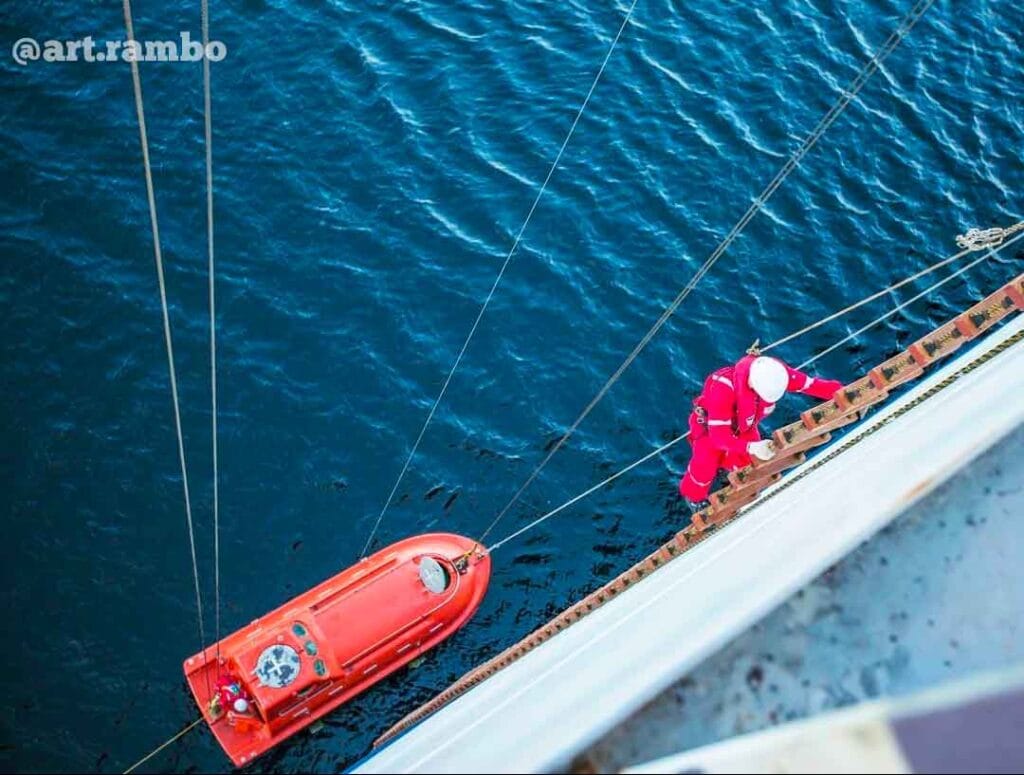
🧗 4. Embarkation Ladder
An embarkation ladder is a rope ladder used specifically for emergency evacuation and boarding lifeboats or liferafts.
It resembles the pilot ladder but lacks spreaders and rubber steps, making it lighter and easier to deploy quickly.
🔧 Key Features
- Constructed from wooden steps and manila or synthetic ropes
- No spreaders or bottom rubber step
- Designed for quick deployment
- Permanently secured near liferaft stations
⚓ Primary Use
- Boarding lifeboats/liferafts in emergencies
- Re-boarding the ship if it’s found afloat after abandonment
- SOLAS Chapter III compliant for abandon ship procedures
Positioned near lifeboat stations, these ladders are pre-installed on deck, often covered by canvas.
In emergencies, two assigned crew members are responsible for rigging the ladder before abandoning ship.
✅ Survival Tip: In an emergency, ensure the embarkation ladder is rigged before launching the lifeboat to be able to go back to the ship once deemed safe.
🌉 5. Gangway
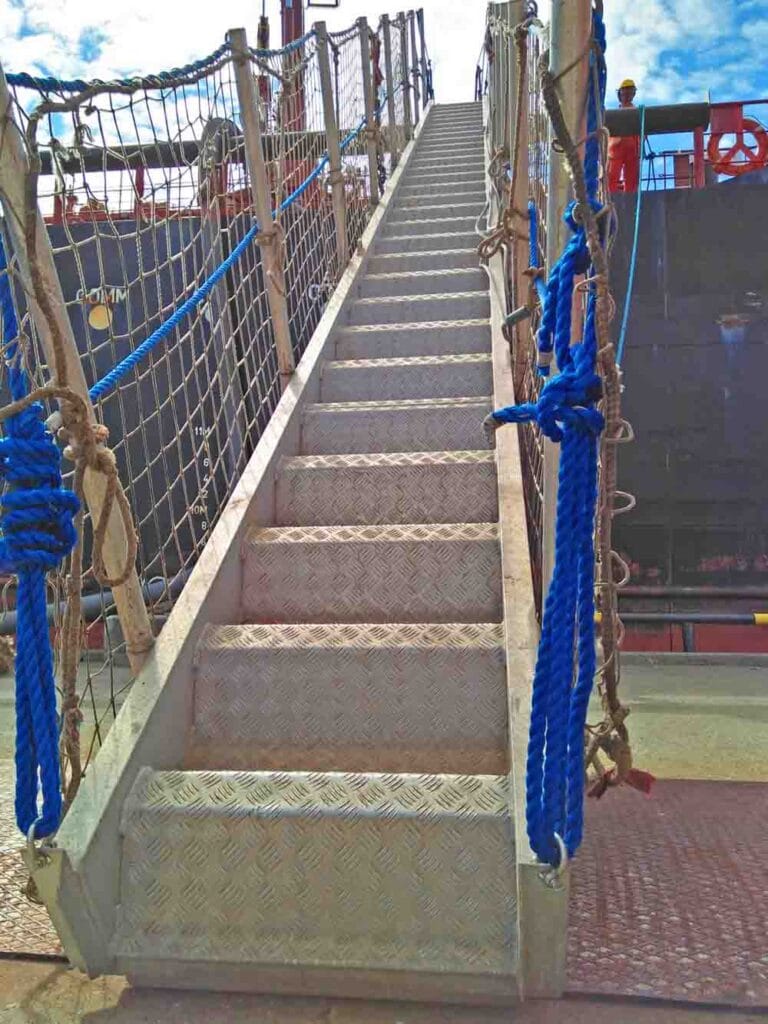
The gangway is a portable bridge used to connect the ship to a quay, terminal, or another vessel.
It’s different from the accommodation ladder in that it rests entirely on the shore and can be moved freely using the ship’s crane or davit.
🔧 Key Features
- Made of steel or aluminum
- Equipped with stanchions, ropes, and safety netting
- Non-slip treads and adjustable lengths
- Requires a stable, flat surface on the pier or shore
⚓ Primary Use
- Access between ship and jetty or terminal
- Used during alongside berthing
- Quick solution for temporary or secondary access
Gangways are commonly used on tankers, Ro-Ros, bulk carriers, and passenger ships, offering crew, stevedores, and inspectors a simple, safe way to board the vessel from the shore.
✅ Tip: Always rig the gangway safety net and assign a watchman during port calls as per ISPS Code.
目 6. Jacob’s Ladder
The Jacob’s ladder is a highly portable rope ladder used for overside work and mast access.
Unlike pilot or embarkation ladders, it’s not permanently fixed or regulated for personnel transfers.
Instead, it’s a work-at-height tool used by seafarers during maintenance and inspections.
🔧 Key Features
- Wooden or aluminum rungs
- Secured by manila or synthetic ropes
- Extremely lightweight and flexible
- Easily rolled, stored, or deployed as needed
⚓ Primary Use
- Overside painting or inspection jobs
- Working aloft, especially on masts or derricks
- Used in tandem with bosun’s chair or plank stage (gindola)
Its name originates from the biblical story of Jacob dreaming of a ladder to heaven.
Today, modern seafarers still use this versatile tool for everyday jobs that involve quick deployment and mobility.
✅ Maintenance Tip: Always inspect the ropes and step fittings for wear before use. Secure both ends during overside operations.

🧭 Summary: Ladder Types for Ship Access and Safety
| Ladder Type | Main Use | Construction | Notes |
|---|---|---|---|
| Pilot Ladder | Pilot boarding, crew access | Rope & wooden steps | Must have spreaders; SOLAS-compliant |
| Accommodation Ladder | Ship-to-shore access | Aluminum, motorized | Used at berth or anchorage |
| Combination Ladder | High freeboard access | Pilot + Accommodation | Required when freeboard >9m |
| Embarkation Ladder | Lifeboat/liferaft access | Rope & wooden steps | No spreaders; for emergencies |
| Gangway | Port or ship access | Metal/ aluminum bridge | Requires stable shore or deck surface |
| Jacob’s Ladder | Work aloft / overside tasks | Rope & wood/aluminum | For maintenance; not for personnel transfers |
❓ FAQ: Ladders Used on the Ship’s Side
⚓ What is the difference between a pilot ladder and an embarkation ladder?
A pilot ladder has spreaders and rubber steps for stability and strength, while an embarkation ladder is simpler, lighter, and used only in emergencies.
⚓ When is a combination ladder required?
Per SOLAS, combination ladders are mandatory when a ship’s freeboard exceeds 9 meters during pilot transfer operations.
⚓ Is a gangway the same as an accommodation ladder?
No. A gangway is portable and rests on the dock, while an accommodation ladder is fixed to the ship and lowered using wires or winches.
⚓ Can Jacob’s ladder be used for pilot transfer?
No. It’s not SOLAS-approved for personnel transfer. Jacob’s ladders are only used for maintenance and inspection tasks.
⚓ Are these ladders inspected regularly?
Yes. SOLAS and ISM Code require routine inspection, testing, and maintenance of access equipment. Pilot and accommodation ladders, in particular, are subject to port state control checks.
🧩 Conclusion: Mastering Ladder Safety at Sea
Ladders may seem like simple tools, but at sea, they are important on board.
Whether you’re boarding a ship, conducting a port inspection, or launching a lifeboat, understanding the right type of ladder to use can make the difference between a smooth operation and a serious hazard.
As a seafarer, your working knowledge of these ladders– and their safety checks, reflects your competence and readiness.
✅ Stay sharp, stay safe. Bookmark this guide or share it with your shipmates. Your life might depend on one of these ladders someday.
May the winds be in your favor
Leave a Reply