


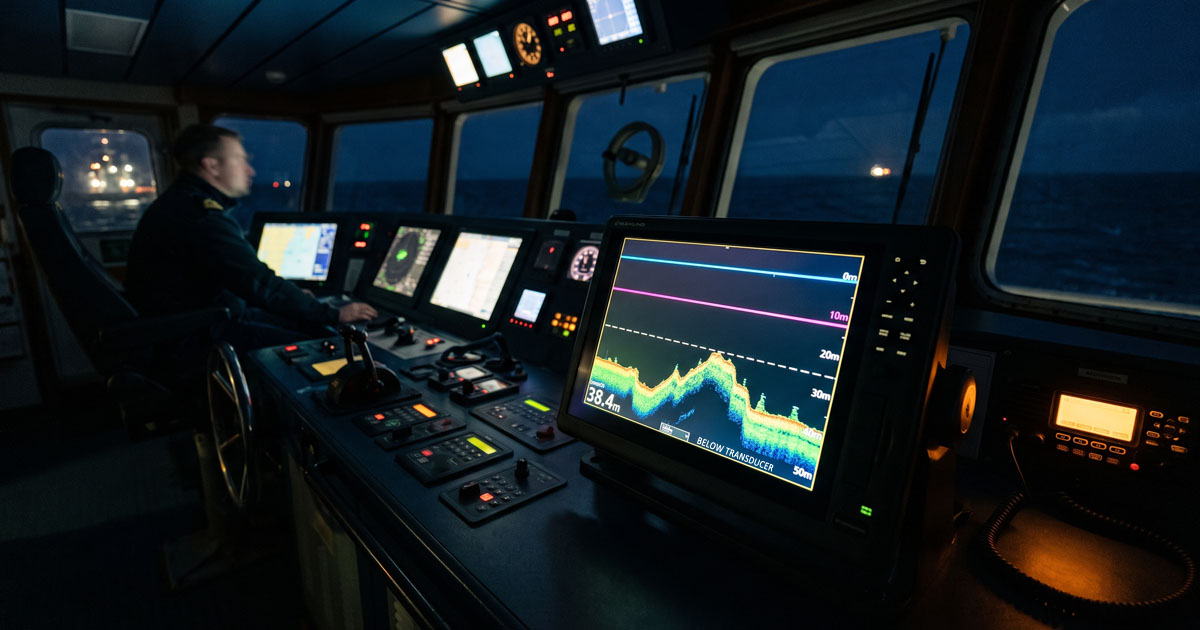
An echo sounder draft offset determines the reference point from which a depth reading is displayed. If the officer of the watch misunderstands that reference, a displayed depth can be mistaken for the actual clearance beneath the vessel.
For example, an echo sounder may show 2.0 m. But is that 2.0 m below the transducer, below the keel, or from the sea surface to the seabed?
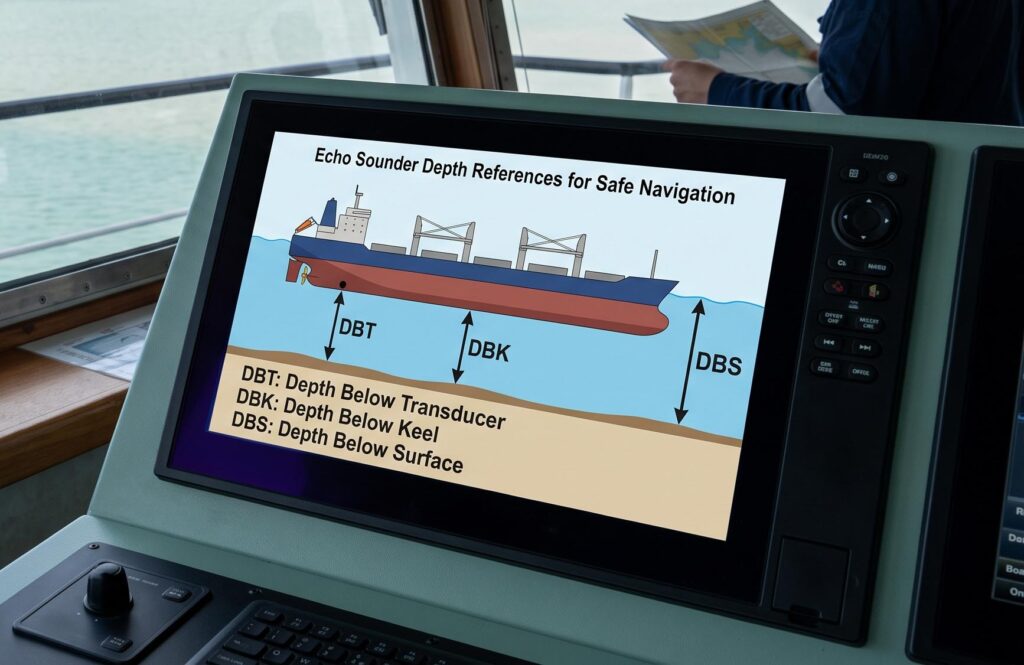
The answer depends on whether the equipment is displaying DBT, DBK, or DBS.
Understanding these references is essential when navigating in shallow water, planning under-keel clearance, and checking actual depths against charted information.
⚓ DBT, DBK and DBS: What Do They Mean?
Modern Echo sounders label their outputs with three reference codes, and each measures depth from a different point on the ship.
| Reference | Meaning | Measurement Reference |
| DBT | Depth Below Transducer | From the transducer face to the seabed |
| DBK | Depth Below Keel | From the configured keel reference to the seabed |
| DBS | Depth Below Surface | From the water surface to the seabed |
DBT: Depth Below Transducer
DBT is the direct depth measured acoustically from the transducer to the seabed.
If the transducer is located above the vessel’s lowest keel point, DBT will normally be greater than the depth below the keel by the vertical separation between those reference points.
DBT is useful because it represents the basic measured depth before the equipment applies a reference correction.
DBK: Depth Below Keel
DBK displays depth relative to the keel reference configured for the echo sounder.
When the equipment has been correctly configured and the reference corresponds to the vessel’s relevant lowest underwater point, DBK can provide the depth available below the keel.
However, officers should not assume that every manufacturer’s “keel” setting uses an identical reference or offset convention.
📌 Always verify the equipment manual and the vessel’s approved installation or calibration data.
For safe navigation, the important question is simple:
What reference point is this displayed depth measured from?
DBS: Depth Below Surface
DBS represents the depth from the water surface to the seabed.
This makes DBS useful when comparing the echo sounder reading with an independently determined total water depth.
However, charted depths are generally referred to chart datum, not the instantaneous sea surface. Therefore, a direct comparison requires the navigator to account for the applicable tidal or water-level information and ensure that all depths use compatible vertical references.
The International Hydrographic Organization defines chart sounding datum as the tidal datum to which charted soundings are referred.
📐 How Does an Echo Sounder Offset Work?
The physical location of the transducer is fixed, but the vessel’s draft changes as the loading condition changes.
The echo sounder uses a correction or offset to convert the measured depth into another reference.
For a vessel where the transducer is located 0.5 m above the keel reference, the simplified relationship is:
DBK = DBT − 0.5 m
If DBT reads 2.0 m:
2.0 m − 0.5 m = 1.5 m below keel
This means the vessel has approximately 1.5 m between the configured keel reference and the seabed, subject to the accuracy and limitations of the equipment and the vessel’s motion.
⚠️ Important: Offset terminology and sign conventions vary between manufacturers. Some equipment may require a positive or negative draft correction depending on how the reference is configured. Never enter an offset based only on a generic formula.
Use:
- The echo sounder manufacturer’s manual
- The vessel’s approved installation or calibration information
- The transducer location and reference details
- The vessel’s onboard procedures
⚓ DBT, DBK and DBS Conversion Formulas
The exact conversion depends on the equipment’s configured reference. Conceptually:
Converting DBT to DBK
If the transducer is above the keel reference:
- DBK = DBT − Vertical distance between transducer and keel reference
Converting DBT to DBS
If the vertical distance from the water surface to the transducer is known:
- DBS = DBT + Draft at the transducer location
The draft used should correspond to the location of the transducer when trim is significant.
Converting DBS to Depth Below Keel
Conceptually:
- Depth below keel = DBS − Draft at the relevant keel reference
This calculation is only reliable when the draft and echo sounder references are correctly matched.
| Display Mode | What the Number Represents | Navigation Check |
| DBT | Depth below the transducer | Apply the correct vessel-specific reference correction if required |
| DBK | Depth below the configured keel reference | Verify that the offset and reference are correctly configured |
| DBS | Depth from the water surface to the seabed | Account for the vessel’s draft and matching reference location |
📍 Why Transducer Position and Trim Matter
The transducer may be positioned forward, aft, or near midships.
When the vessel is trimmed, the draft at the transducer’s position can differ from the mean draft.
For example, if a vessel is trimmed by the stern and the transducer is located forward, the local draft at the transducer may be less than the mean draft.
Therefore, when using DBS for a detailed cross-check, use the draft applicable to the relevant position rather than automatically using mean draft.
This is particularly important during:
- Shallow-water navigation
- Channel transits
- Berthing and unberthing
- Restricted waters
- Heavy loading conditions
🧮 Worked Example
Assume:
- Vessel draft: 12.5 m
- Transducer position: 0.5 m above the keel reference
- Echo sounder mode: DBT
- Displayed reading: 2.0 m
The conceptual conversion is:
DBK = 2.0 − 0.5 = 1.5 m
The displayed 2.0 m is therefore not automatically the clearance beneath the keel.
The reference correction must first be considered.
If the sounder displays DBS, the navigator can also compare the reading with the expected actual water depth, provided that the vessel’s draft, trim, water level, and chart datum relationships are properly accounted for.
💡 Never treat a single echo sounder reading as the complete UKC calculation. Actual navigational clearance may also be affected by squat, heel, waves, vessel motion, seabed irregularities, sensor accuracy, and other factors identified in the vessel’s UKC or passage-planning procedures.
🚨 Common Echo Sounder Mistakes
1. Treating DBT as Depth Below Keel
A DBT reading is measured from the transducer.
If the transducer is above the keel, treating DBT as UKC can overstate the available clearance.
2. Assuming Every Offset Uses the Same Sign
Different manufacturers and installations may use different offset conventions.
Always confirm how the specific equipment applies the correction.
3. Using Mean Draft Without Considering Transducer Position
Trim can make the local draft at the transducer significantly different from the vessel’s mean draft.
4. Forgetting to Verify the Display Reference
After maintenance, configuration changes, equipment replacement, or power interruption, confirm the actual reference being displayed.
Do not rely only on a familiar-looking number.
5. Comparing Echo Sounder Depth Directly With a Chart Without Checking Datum
Charted soundings are referenced to chart datum, while the echo sounder measures the instantaneous distance to the seabed from a vessel-based reference.
The International Hydrographic Organization emphasizes the importance of clearly defined vertical reference systems for bathymetric information.
✅ Echo Sounder Verification Checklist
Before entering shallow or restricted water, verify:
- Which reference is displayed: DBT, DBK, or DBS?
- What is the transducer’s physical location?
- What offset is configured in the equipment?
- Does the configured offset match the vessel’s documented data?
- What is the vessel’s current draft and trim?
- Is the displayed reference suitable for the UKC calculation?
- Are charted depths and water levels being compared using compatible vertical references?
- Have squat, vessel motion, and other applicable UKC factors been considered?
A simple handover statement can also prevent confusion:
Echo sounder is displaying DBT. The transducer-to-keel reference correction is 0.5 m. A DBT reading must not be treated directly as depth below keel.
⚖️ Regulatory and Navigational Context
SOLAS Chapter V includes carriage requirements for ships to be fitted with equipment capable of measuring and displaying available water depth. The officer of the navigational watch must also make effective use of available navigational information and equipment as part of safe navigation.
The exact carriage and operational requirements depend on the vessel type, size, construction date, and applicable regulations.
For interpreting charted depths, navigators must also understand chart datum and water-level references.
The IHO defines chart sounding datum as the datum to which charted soundings are referred and publishes standards governing hydrographic surveys and vertical reference systems.
❓ Frequently Asked Questions
What is the difference between DBT and DBK?
DBT is measured below the transducer, while DBK is referenced to the configured keel reference. If the transducer is above the keel, DBT will generally be greater than DBK by the applicable vertical separation.
Does the echo sounder offset change when the vessel loads cargo?
The physical relationship between the transducer and the keel reference remains fixed. However, the vessel’s draft changes with loading, which affects calculations involving the water surface or DBS reference.
Can I use DBS to calculate depth below keel?
Yes, conceptually, by subtracting the applicable draft from DBS. However, the draft location and reference must match the calculation, especially when the vessel has significant trim.
Why does my echo sounder disagree with the charted depth?
Possible reasons include differences in chart datum and water level, transducer reference settings, vessel position, seabed changes, sensor accuracy, vessel motion, or outdated navigational information.
📣 Final Takeaway
The most important echo sounder question is not:
“What number is on the screen?”
It is:
“What is that number measured from?”
DBT, DBK, and DBS represent different vertical references. Confusing them can produce an incorrect picture of the water available beneath the vessel.
⚓ Before navigating in shallow water, verify the echo sounder’s display mode, the vessel-specific offset, the transducer position, current draft and trim, and the vertical datum used for comparison with charted depths.
A correctly interpreted echo sounder is not just a depth indicator. It is an essential cross-check for safe navigation.
💬 What reference does your vessel normally use, DBT, DBK, or DBS? Subscribe to Captain’s Mode and get the best resources delivered to your mailbox!
May the winds be in your favor.
Leave a Reply