



At first glance, it seems contradictory- using a magnetic compass on a ship made of metal.
After all, magnets attract iron, and ships are massive steel structures.
Yet, every seagoing vessel, from tankers to fishing boats, still relies on a magnetic compass as a vital navigational tool.
So, how does this instrument remain accurate despite the surrounding metal?
Let’s break it down. ⚓
✅ Key Takeaways
- A magnetic compass determines the ship’s heading based on the Earth’s magnetic field.
- Metal ships cause magnetic deviation, but correctors- like permanent magnets and soft iron spheres, minimize its effects.
- The compass binnacle isolates and stabilizes the compass using gimbals and liquid damping.
- Under SOLAS Chapter V Regulation 19.2.1, all ships must carry a properly adjusted magnetic compass, regardless of size.
🧲 What Is a Ship’s Magnetic Compass?
A ship’s magnetic compass is a navigation device that uses a magnetized needle or compass card suspended in a fluid-filled bowl.
It freely rotates in the horizontal plane, aligning itself with Earth’s magnetic field lines.
This allows mariners to determine the ship’s heading relative to magnetic north.
Key Components:
- Compass Card: Marked in 360°, it rotates to show heading.
- Magnetized Element: Aligns with magnetic north.
- Binnacle: Protective housing containing magnetic correctors.
- Lubber’s Line: Indicates the ship’s forward direction.
⚠️ Why Is a Magnetic Compass Still Essential?
Despite modern navigation systems like gyrocompasses and ECDIS, the magnetic compass remains a legal and practical requirement at sea.
Reasons It’s Still Vital:
- Failsafe Backup: Operates without electrical power- critical during blackouts or gyro failures.
- Mechanical Simplicity: Fewer components mean less maintenance and higher reliability.
- SOLAS Compliance: Required by IMO and SOLAS regulations as a primary or backup heading reference.
🧭 Types of Magnetic Compasses on Ships
There are two main magnetic compasses used onboard:
1. Standard Compass
- Installed on the monkey island or above the bridge.
- Equipped with an azimuth circle for bearing-taking.
- Protected by a binnacle with correcting magnets.
2. Steering Compass
- Mounted at the steering position or helm.
- Aids in course-keeping, not bearing-taking.
- Same working principle, but designed for real-time steering use.
📌 Note: Both compasses are magnetically corrected and housed in binnacles but serve different purposes.

⚙️ How Does a Magnetic Compass Work on a Metal Ship?
Although the ship’s steel hull affects magnetic readings, the compass remains functional thanks to design, installation, and correction systems.
How Accuracy Is Maintained:
- Quality Materials: Uses strong magnets and low-friction pivots.
- Strategic Placement: Installed far from electrical and magnetic interference (typically on the monkey island).
- Binnacle Correctors:
- Permanent Magnet Correctors: Neutralize fixed magnetism of the ship.
- Soft Iron Correctors: Offset magnetism induced by Earth’s field.
- Heeling Magnet: Adjusts for magnetic influence when the ship heels or changes latitude.
- Gimbal Mount: Keeps compass level despite pitch and roll.
- Damping Fluid: Reduces needle oscillation and provides smooth movement.

📉 Compass Deviation vs Variation
Understanding the difference between deviation and variation is essential for accurate navigation.
🔁 Deviation (Ship-Specific)
Deviation is the error between the compass heading and the magnetic heading.
- Cause: Magnetic fields within the ship- permanent magnetism, electrical equipment, steel structures.
- Correction: Use of correcting magnets, soft iron correctors, and a deviation card.
- Nature: Varies depending on the ship’s heading and changes over time.
🌍 Variation (Location-Specific)
Variation is the angular difference between magnetic north and true north at a specific location.
- Cause: Earth’s natural magnetic field irregularities.
- Source: Shown on nautical charts, ECDIS, or GPS systems.
- Nature: Changes annually and by geographic position.
🧭 Final Compass Heading = True Heading ± Variation ± Deviation📋 What Is a Deviation Card (or Deviation Table)?
A deviation card records the compass error for each heading, helping navigators apply necessary corrections.
How It’s Prepared:
- During an annual compass swing, the vessel is turned through 360°.
- At specific headings, errors are observed and logged.
- These readings are compiled into a deviation table posted near the chart table and bridge console.
🧾 Purpose: To allow bridge officers to apply accurate corrections based on the vessel’s current heading.
🧩 Key Parts of a Ship’s Magnetic Compass
Understanding the components of a ship’s magnetic compass is crucial for both maintenance and practical use.
| Part | Function |
| Compass Card | Rotates to show the vessel’s heading in degrees (0° to 360°). |
| Compass Bowl | Liquid-filled casing that houses and stabilizes the card. |
| Binnacle | Enclosure that holds the compass and correctors; mounted securely. |
| Correctors | Permanent magnets and soft iron spheres that minimize deviation. |
| Azimuth Circle | Device for taking celestial or terrestrial bearings. |
| Lubber’s Line | Fixed line indicating the ship’s forward direction. |
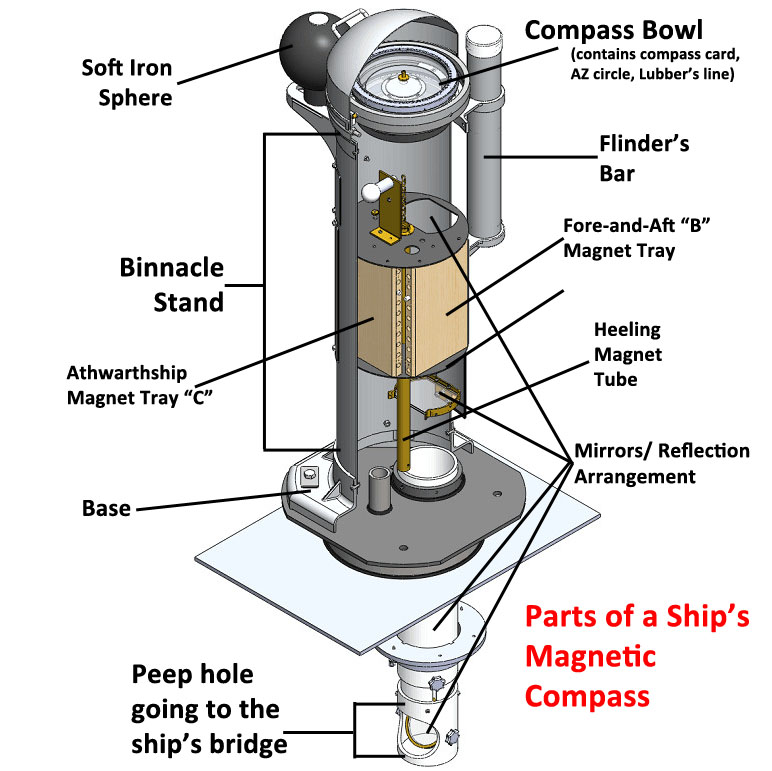
🧭 A Brief History of the Magnetic Compass
Before compasses, mariners relied on coastal landmarks, celestial navigation, and seamanship passed down through generations.
This method worked, but it lacked precision.
Key Milestones:
- Invented ~2,000 years ago in China, the magnetic compass transformed sea travel.
- By the 13th century, it was widely adopted in Europe, enabling open-ocean navigation.
- As ships transitioned from wood to steel hulls, compass accuracy degraded, prompting the development of binnacles and correcting devices.
⚓ The magnetic compass became the cornerstone of maritime navigation for centuries and still holds critical importance today.
⚖️ SOLAS Carriage Requirements for Magnetic Compasses
Even with advanced electronic systems, the International Maritime Organization (IMO) mandates the carriage of a magnetic compass under SOLAS Chapter V Regulation 19.2.1.
Required by SOLAS:
“All ships, irrespective of size, shall have a properly adjusted standard magnetic compass… or other means independent of any power supply.”
Supporting Standards:
- IMO Resolution A.382(X): Specifies performance requirements for magnetic compasses, azimuth devices, and binnacle construction.
🛑 This ensures that even in a total power failure, vessels retain a reliable heading reference.
❓ Frequently Asked Questions (FAQs)
🔍 How do you read a deviation card?
Refer to the deviation corresponding to your current heading. Add or subtract the value from your magnetic compass reading to correct the heading.
⚙️ Can magnetic compasses be adjusted manually?
Yes. Adjusters can manipulate the correctors during compass swing procedures to minimize deviation.
🧲 Does GPS replace the magnetic compass?
No. GPS gives positional data, not heading. The magnetic compass remains vital for steering and as a non-electronic backup.
🛟 What happens if the compass isn’t corrected?
Navigation errors can increase, especially in steel ships where deviation can exceed several degrees without correction.
🧭 Final Thoughts
Despite the dominance of electronic navigation tools, the magnetic compass remains a cornerstone of safe seamanship.
Its simplicity, reliability, and independence from power sources make it indispensable.
Whether you’re steering a bulk carrier or conducting celestial checks on a training ship, this timeless instrument, when properly corrected, keeps your heading true. ⚓
💡 “A ship without a magnetic compass is like a sailor without a sense of direction.”
May the winds be in your favor.
Leave a Reply