


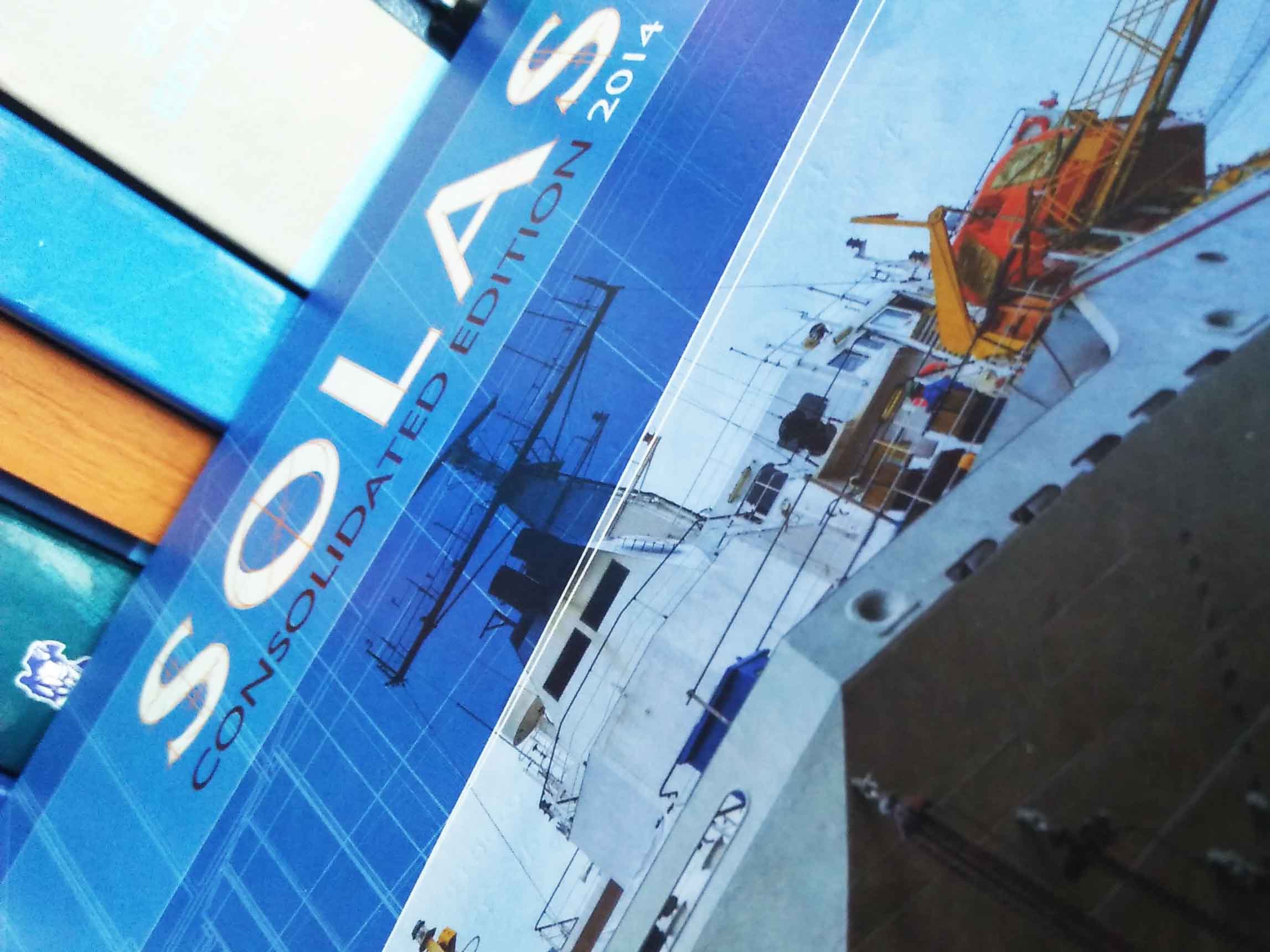
The International Convention for the Safety of Life at Sea (SOLAS) is the most critical maritime safety treaty ever enforced.
Adopted in 1974 and administered by the International Maritime Organization (IMO), the convention outlines international rules to ensure:
- 🔧 Safe ship construction
- 🛠️ Proper equipment installation
- ⚙️ Operational safety for merchant vessels
Today, SOLAS governs all seagoing ships of 500 gross tonnage and above on international voyages.
If you’re a seafarer, maritime cadet, or shipping company, SOLAS compliance is not optional- it’s mandatory.
The current legally binding text is known as “SOLAS 1974, as amended”.
📜 A Tragic Beginning: How the Titanic Gave Birth to SOLAS
The SOLAS Convention was born from tragedy.
In 1912, the RMS Titanic sank in the North Atlantic, claiming over 1,500 lives– a result of insufficient lifeboats, poor communication, and lack of ice surveillance.
The disaster triggered global outrage, leading to the first international SOLAS Convention in 1914.
Timeline of SOLAS Conventions
| Year | Convention | Status |
|---|---|---|
| 1914 | First SOLAS | Never entered into force (WWI) |
| 1933 | Second SOLAS | Superseded |
| 1952 | Third SOLAS | Superseded |
| 1965 | Fourth SOLAS | Superseded |
| 1974 | Fifth SOLAS | ✅ Current version (in force since May 25, 1980) |
The 1974 version is unique- it allows “tacit acceptance” of amendments, meaning updates can be adopted without convening a new conference, making it adaptable to modern technologies and maritime incidents.
📘 SOLAS Chapters Overview
The current version of SOLAS consists of 14 Chapters, each containing Parts, Sections, and Regulations.
These chapters set standards for everything- from vessel design and lifesaving equipment to radio communications and polar navigation.
🔑 Pro Tip: Here’s a classic mnemonic used by many maritime cadets to memorize the SOLAS chapters:
“General ConCon Li, Radio Sa Car Car. Nuke Man High. SaSec AddS Vecom Pol.”
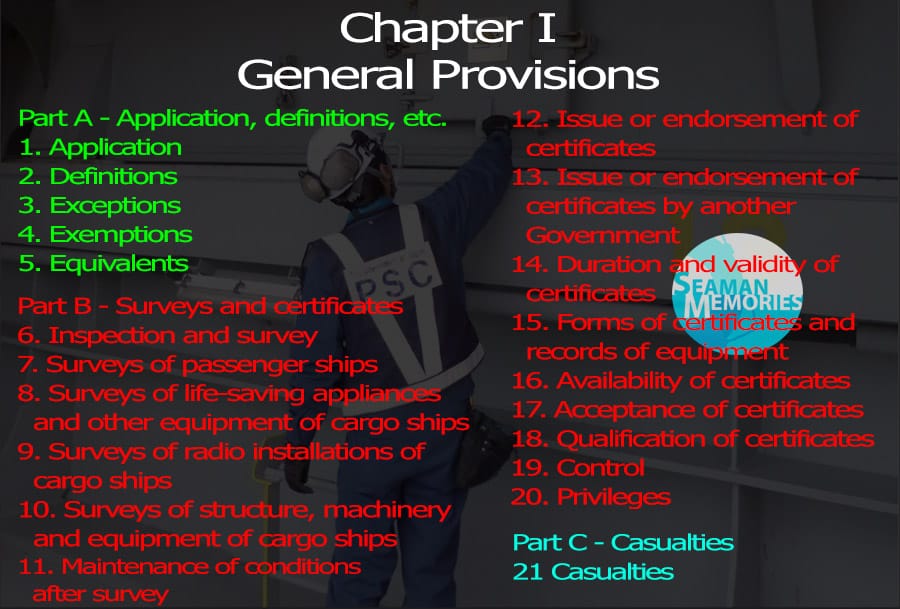
🔎 Chapter I: General Provisions
Chapter I sets the legal foundation for the rest of the SOLAS Convention.
It focuses on:
- 🧾 Surveys, inspections, and certification of ships
- 🛂 Port State Control inspections
- 🕵️ Investigation of marine casualties
✅ Key Takeaways:
- Vessel Certification: All SOLAS-applicable vessels must carry valid certificates proving compliance.
- Applicability: SOLAS typically applies to passenger ships and cargo ships over 500 GT on international voyages.
- Exemptions: Certain small ships and vessels on domestic voyages may be exempt.
🔧 Enforcement Powers
Port State Control (PSC) officers and nominated surveyors have the authority to inspect, detain, or demand repairs if the vessel violates SOLAS standards.
This makes Chapter I the enforcement “arm” of the entire convention.
🔍 Casualty Investigation
Flag States must conduct thorough investigations of shipboard accidents involving their vessels.
This helps assess whether the incident was due to non-compliance, equipment failure, or regulatory gaps.
⚒️ Chapter II-1: Construction – Structure, Stability, Machinery & Electrical
This is the longest and most technical chapter of SOLAS.
It covers:
- 🚢 Structural integrity
- 🧱 Watertight subdivision and stability
- ⚙️ Machinery and bilge systems
- 🔋 Electrical systems and power backups
⚙️ Structure of Chapter II-1:
| Part | Focus |
|---|---|
| A | General Provisions & Definitions |
| B | Subdivision and Stability |
| C | Machinery Installations |
| D | Electrical Installations |
| E | Unmanned Machinery Spaces (UMS) |
| F | Alternative Design Arrangements |
| G | Low Flashpoint Fuels (IGF Code) |
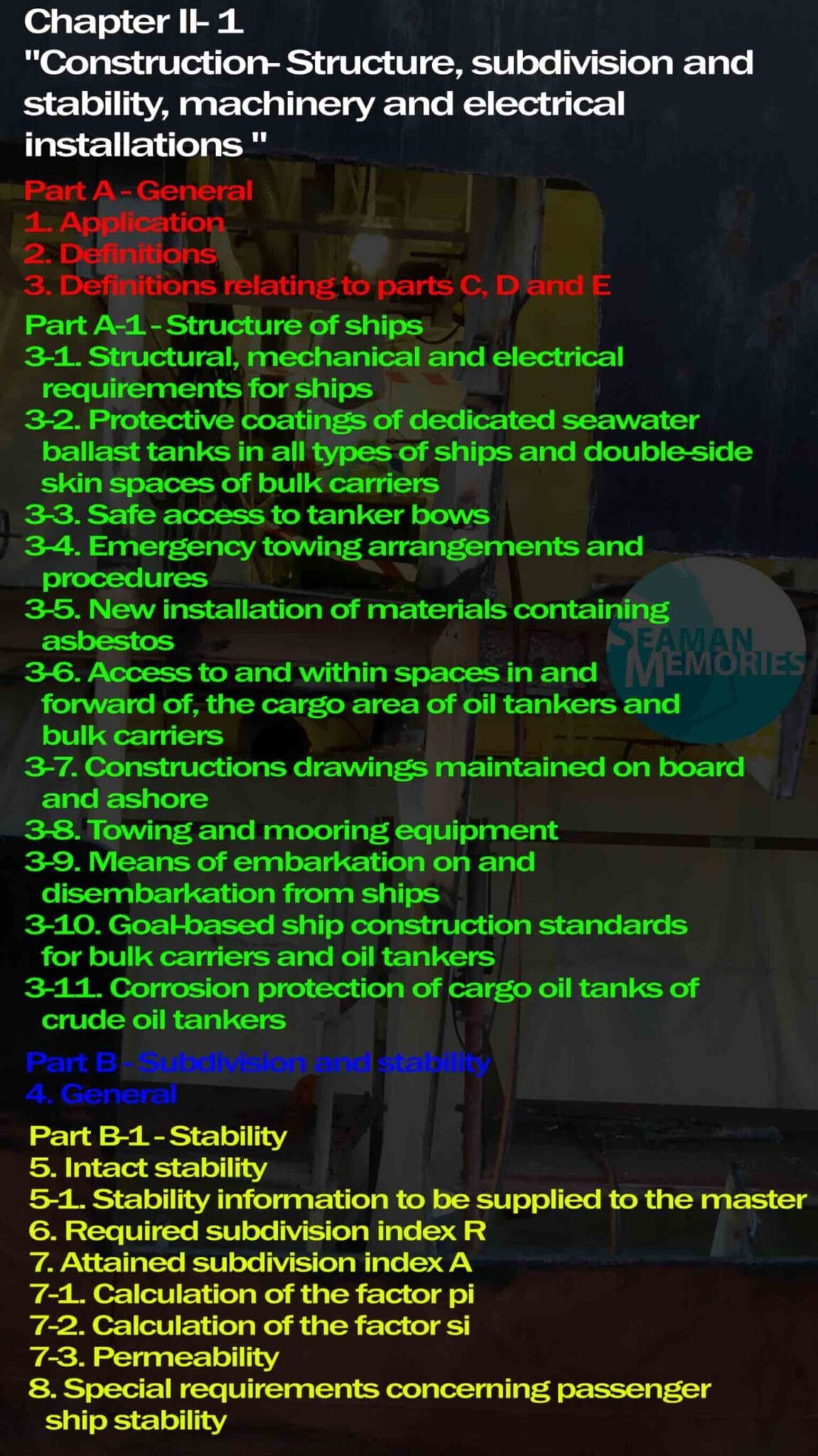
🧱 Part A – General
Covers basic definitions and sets the framework for applying structural and machinery rules from the keel-laying stage.
⚖️ Part B – Subdivision & Stability
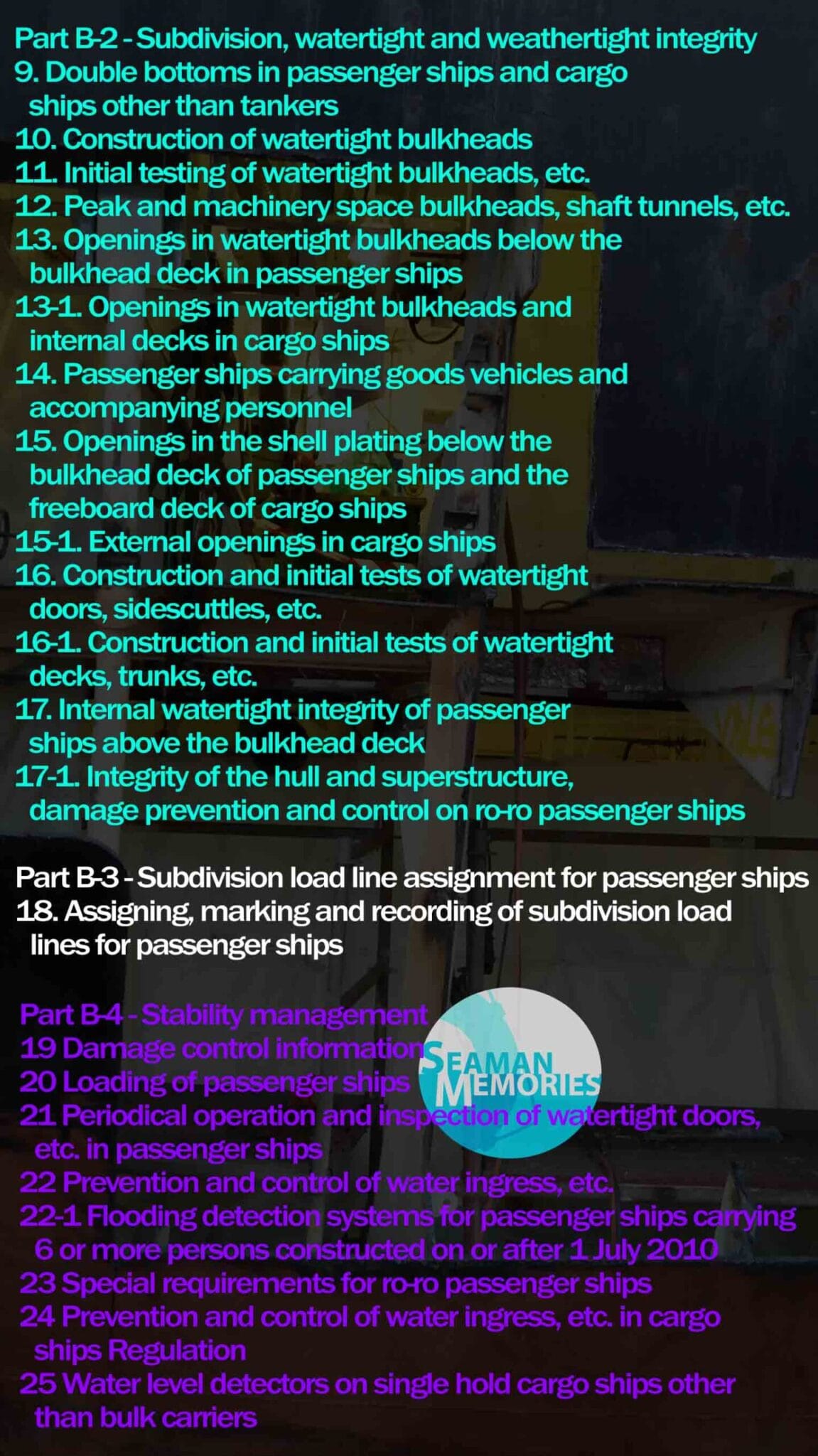
Key aspects:
- Double bottom requirements
- Watertight bulkheads
- Load line marks
- Damage stability calculations
🚨 Even with SOLAS guidelines, construction-related deficiencies are often found during PSC inspections.
🛠️ Part C – Machinery
This section governs:
- Engine room layouts
- Bilge pumping systems
- Machinery installations for safe operations
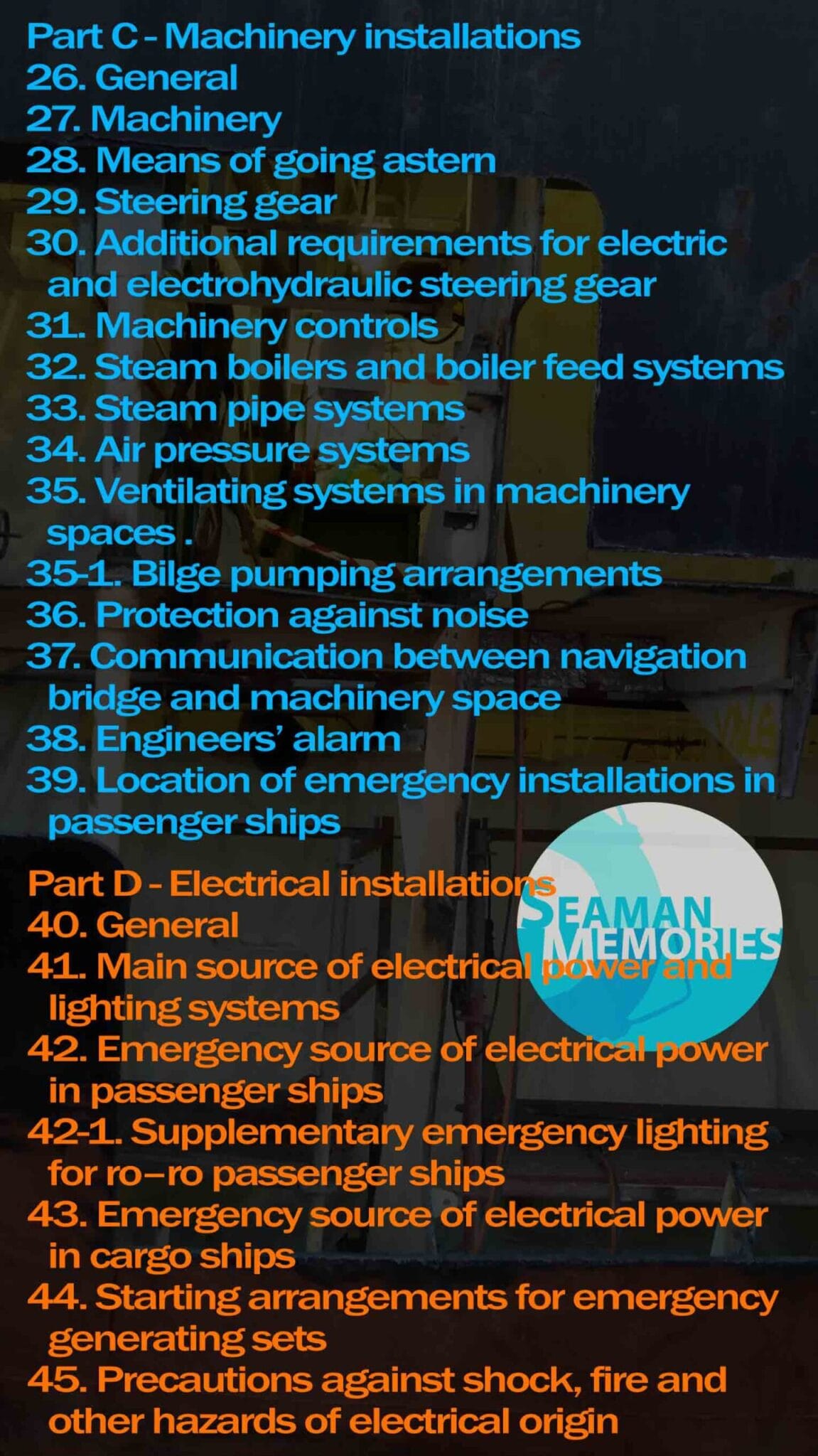
⚡ Part D – Electrical Installations
Ensures:
- Main & emergency power systems
- Safe wiring standards
- Emergency lighting & redundancy
🔕 Part E – UMS Requirements
For ships operating with unmanned engine rooms, this part requires:
- Fire detection systems
- Alarm systems
- Flood prevention
- Communication links to bridge/control room
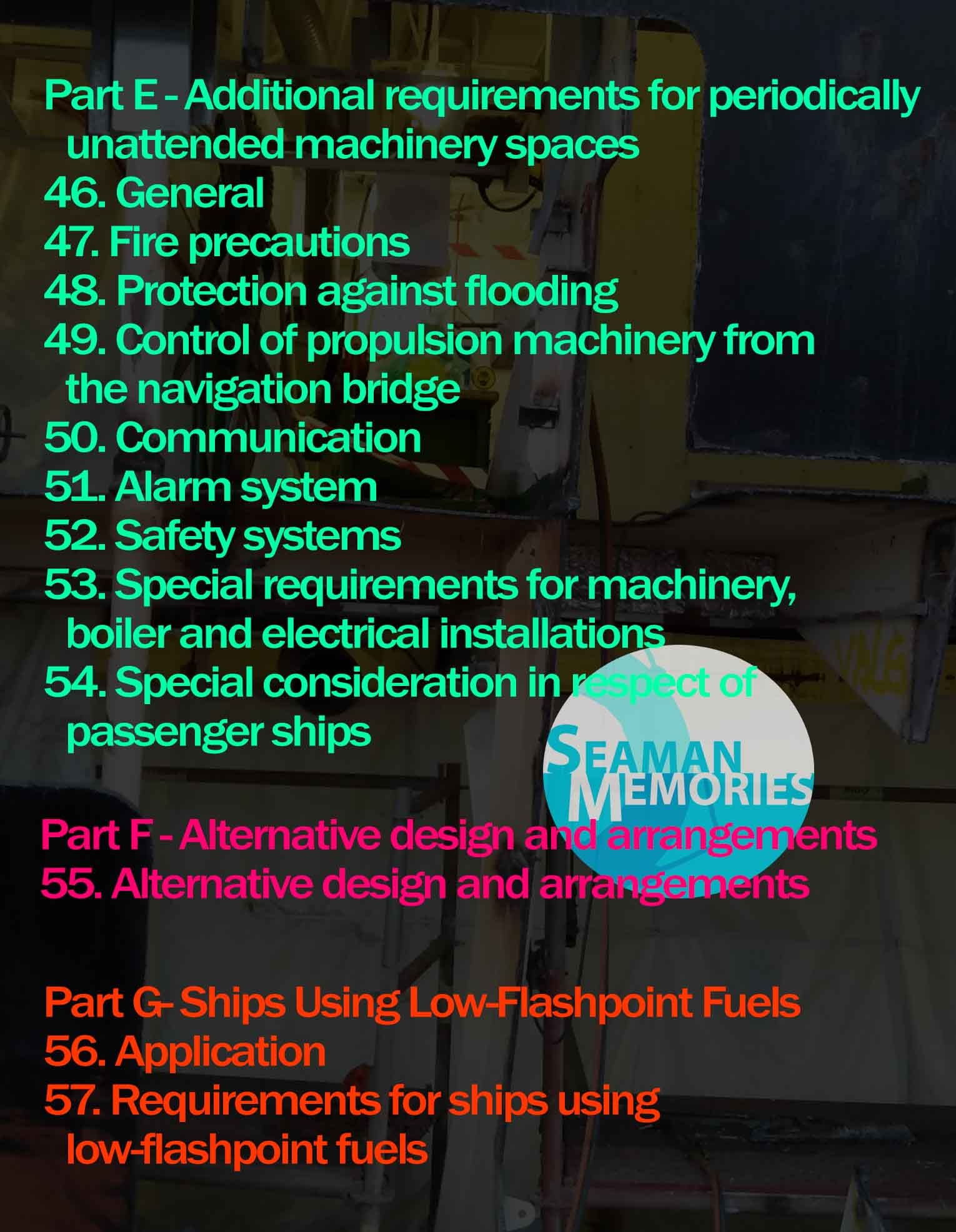
🔄 Part F – Alternative Designs
If a ship uses non-traditional or innovative designs, this section allows equivalency assessments.
🧯 Part G – Low Flashpoint Fuels
Based on the IGF Code, this part addresses safety for ships using LNG, methanol, or similar fuels, covering tank installations, ventilation, and fire protection.
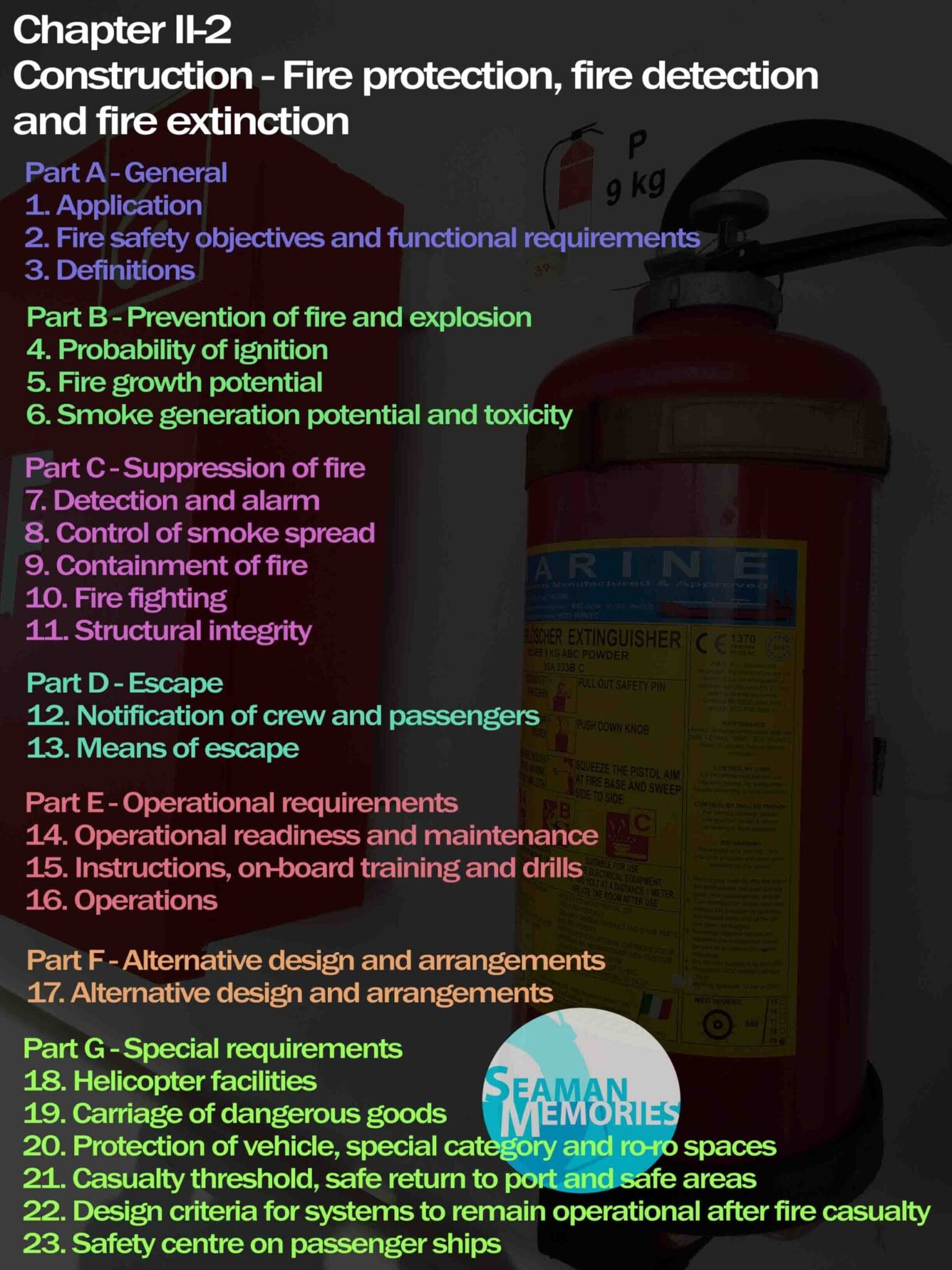
🔥 Chapter II-2: Construction – Fire Protection, Detection & Extinction
Fires are among the deadliest onboard hazards. Chapter II-2 requires:
- 🔥 Structural fire protection
- 🧯 Fire detection systems
- 🚨 Firefighting equipment and layout planning
🔍 Highlights:
- Thermal and structural fire zones in accommodation and engine spaces
- Limitations on combustible materials
- Fire alarm systems and sprinklers
- Emergency escape routes
- Cargo ignition protection (flammable vapors, gases)
🚒 This chapter applies to all SOLAS vessels, with stricter requirements for passenger ships and tankers.
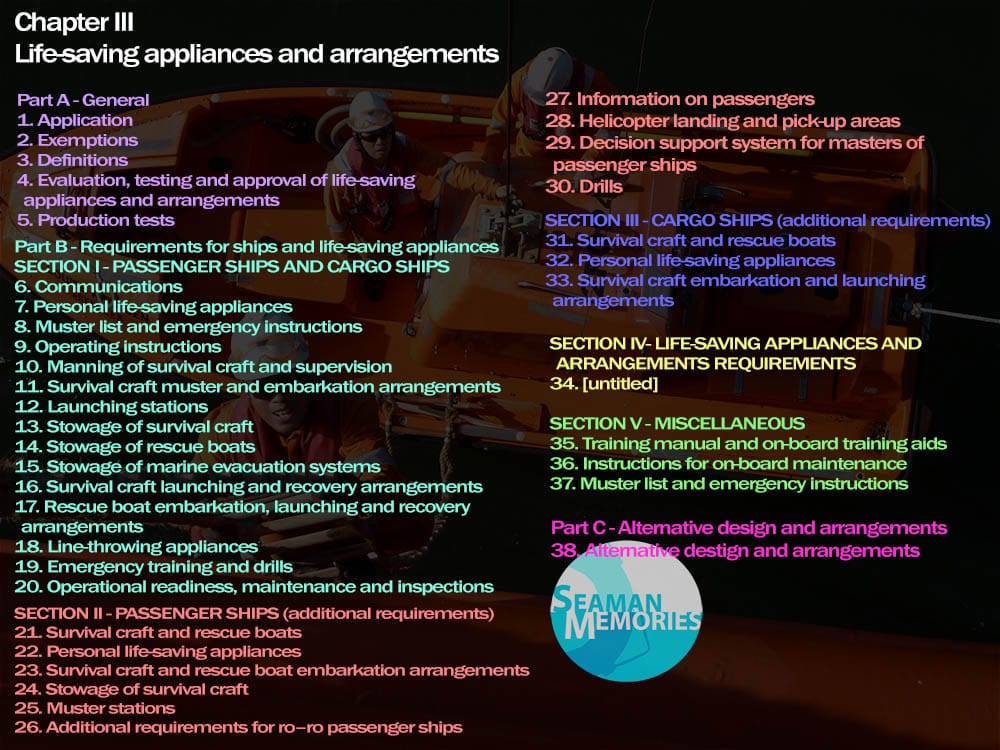
🆘 Chapter III: Life-Saving Appliances and Arrangements
Inspired directly by the Titanic’s failure, this chapter mandates:
- Lifeboats and liferafts for all persons onboard
- Personal survival equipment and training
- Evacuation procedures
- Shipboard drills and safety manuals
🔑 Mandates:
- Follows the LSA Code (International Life-Saving Appliance Code)
- Requires:
- Rescue boats
- Immersion suits
- Lifebuoys and lifejackets
- MES (Marine Evacuation Systems)
- Survival craft launching systems (manual + automatic)
🧪 This chapter aligns with Basic Safety Training (BST), reinforcing skills taught in SOLAS and STCW courses.
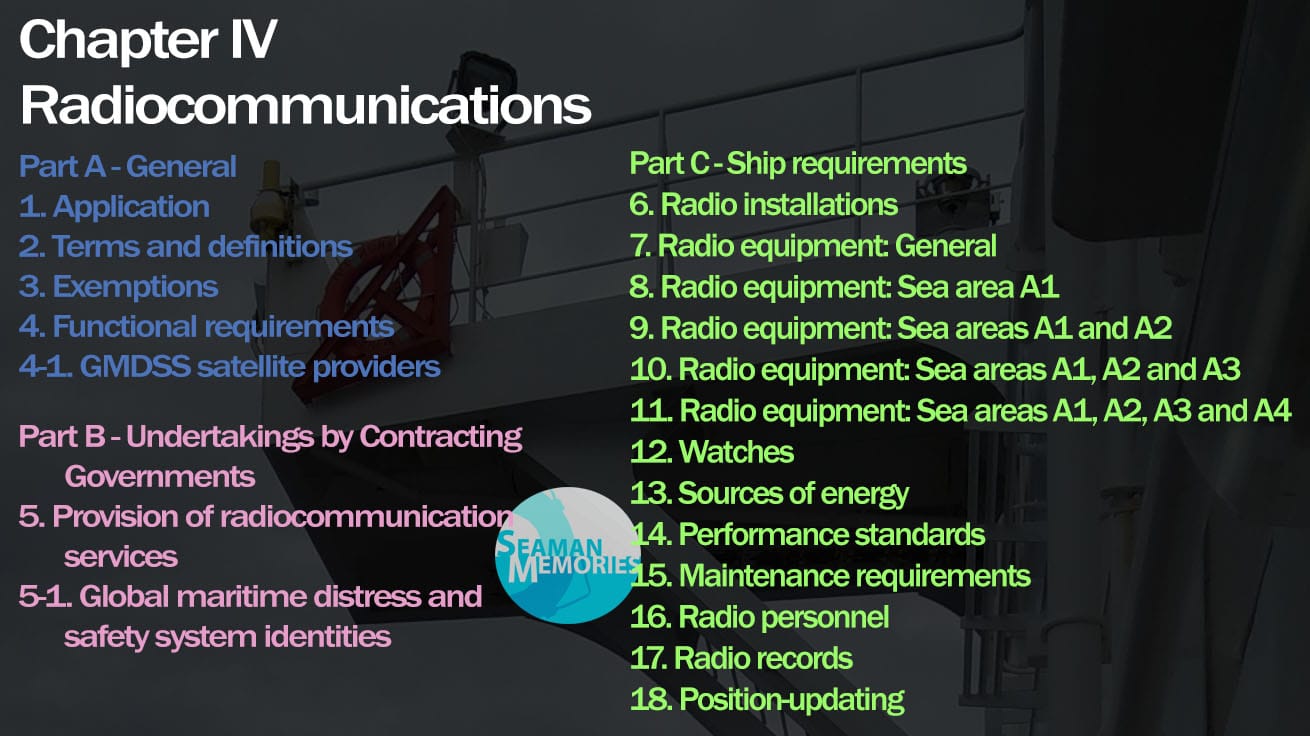
📡 Chapter IV: Radiocommunications
Revised in 1988, Chapter IV replaced outdated systems with the Global Maritime Distress and Safety System (GMDSS)– a major technological leap in maritime safety.
✅ Key Requirements:
- 📡 GMDSS: All ships ≥ 300 GT on international voyages must be GMDSS-compliant.
- 🆘 EPIRB: Emergency Position-Indicating Radio Beacon for auto distress signals.
- 🔄 SART: Search and Rescue Transponder to help locate ships/rafts during SAR.
- 🗞️ NAVTEX: Receives navigational and weather alerts in text format.
📘 DSC (Digital Selective Calling) is also required to automate distress alerts.
🌍 GMDSS Sea Areas Defined
| Sea Area | Description |
|---|---|
| A1 | Within range of VHF coast station with DSC |
| A2 | Within MF coverage (outside A1) |
| A3 | Outside A1/A2 but within INMARSAT satellite coverage |
| A4 | Polar or remote areas not covered by A1–A3 |
🚨 Under SOLAS, ships must maintain continuous watch on distress and safety frequencies based on their sea area.
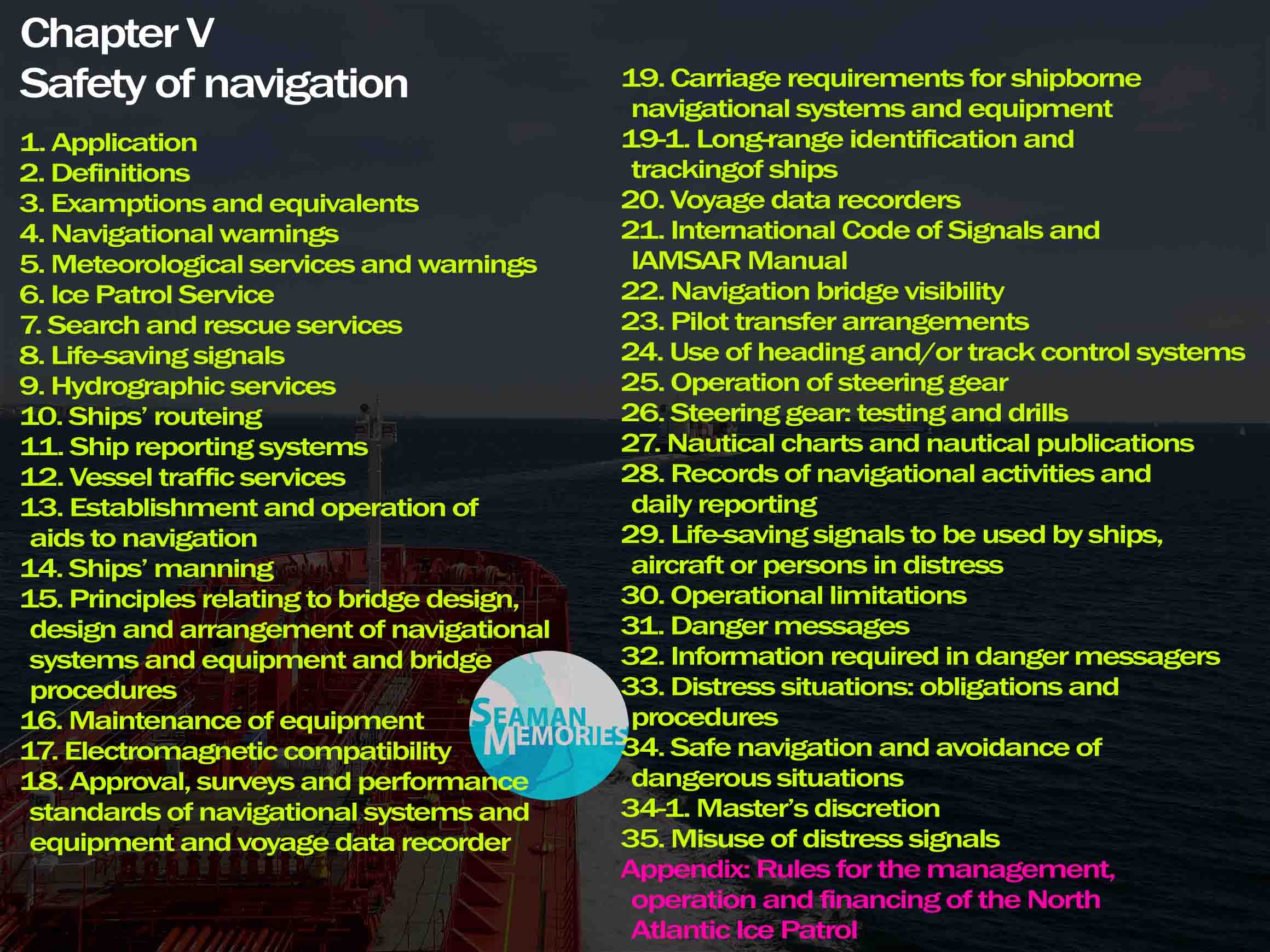
🧭 Chapter V: Safety of Navigation
Chapter V is unique because it applies to ALL vessels, including:
- Commercial ships
- Fishing boats
- Pleasure craft
- Sailing yachts
It provides essential rules for safe voyage planning and bridge operations.
🧩 Key Provisions of Chapter V
- 📡 AIS (Automatic Identification System): Required on most vessels for ship-to-ship and ship-to-shore tracking.
- 📀 VDR (Voyage Data Recorder): Like a black box; records ship data and voice logs.
- 📍 Ship Routing: Compliance with IMO-recommended traffic lanes and separation schemes.
- 🔄 Position Reporting: 24-hour positional and navigational status reports.
- 🧭 Bridge Design Standards: Clear, efficient, and ergonomic layouts for better watchkeeping.
🆘 Distress & Rescue Obligations
- 🚩 Masters are required to assist vessels in distress when safe and practicable.
- 🛰️ Navigational warnings, weather updates, and maritime safety info must be factored into voyage planning.
- 🌐 E-navigation tools and route planning software are strongly encouraged.
💡 This chapter is often enforced by Port State Control and flagged during bridge audits.
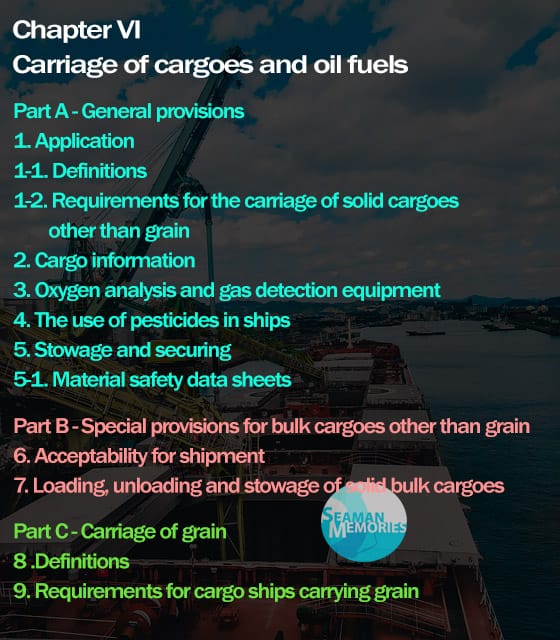
⚠️ Chapter VI: Carriage of Cargoes and Oil Fuels
Chapter VI outlines the safe loading, stowage, securing, and carriage of general cargo excluding bulk liquids and gases, which are covered under other codes.
🧱 Coverage Includes:
- 📦 Solid Bulk Cargoes: Like coal, iron ore, grain (regulated via the International Grain Code).
- ☣️ Hazardous Materials: Handling and securing dangerous goods (in conjunction with Chapter VII).
- 🪨 Cargo Unit Stowage: Proper lashings and weight distribution.
- 🧪 Oxygen/Gas Detection Equipment: Required in cargo spaces, especially for dangerous or fumigated cargoes.
- 📋 Material Safety Data Sheets (MSDS): Mandatory for hazardous substances.
⚖️ Verified Gross Mass (VGM) – Mandatory!
Introduced via SOLAS amendment in 2016 (Regulation VI/2.6), it states:
“A packed container without verified gross mass (VGM) must not be loaded aboard a ship.”
🔍 VGM includes:
- Cargo weight
- Dunnage and securing materials
- Container tare weight
⚠️ Non-compliance may result in container rejection, penalties, or delays.
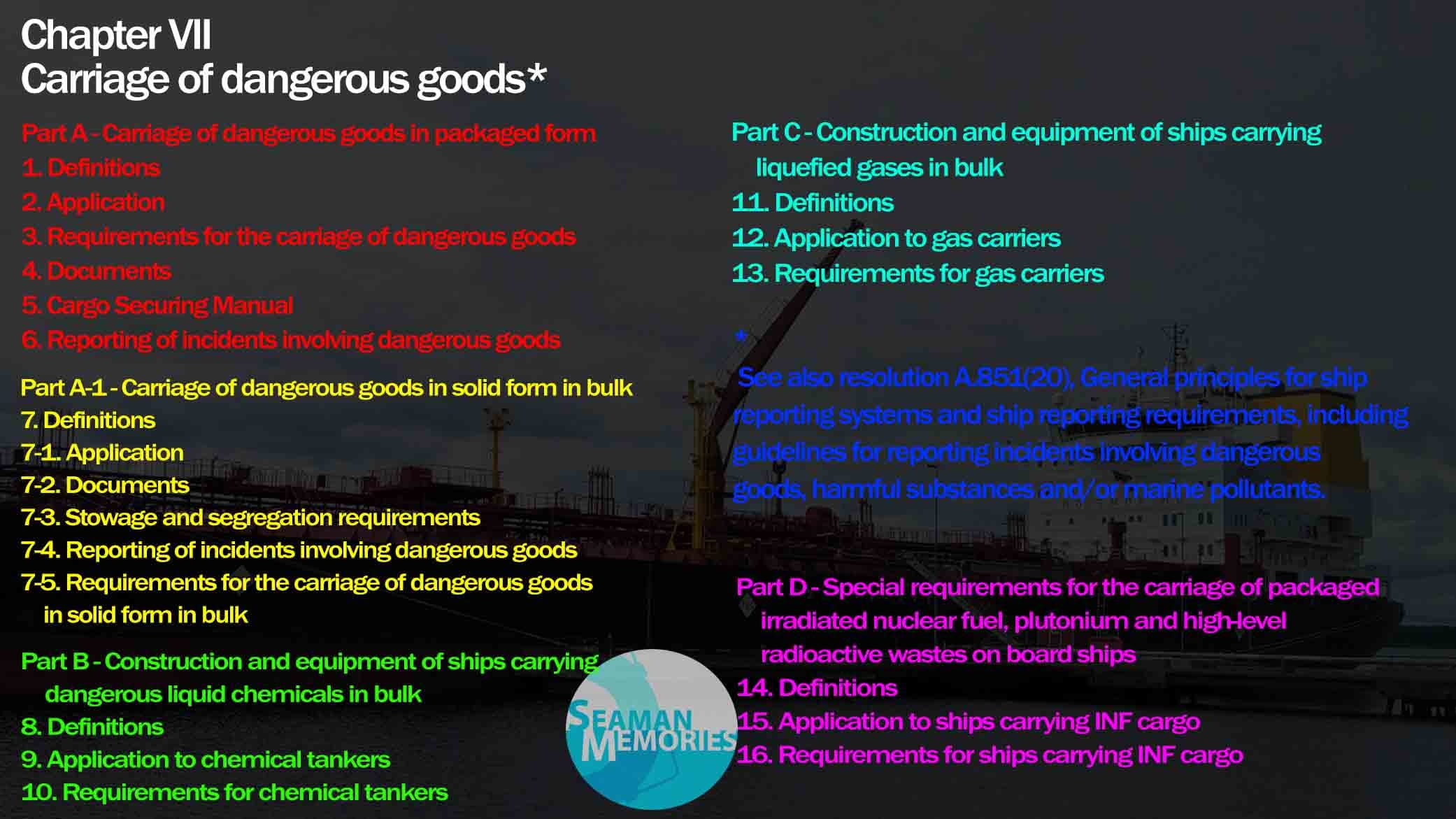
☣️ Chapter VII: Carriage of Dangerous Goods
Chapter VII governs the transportation of hazardous cargo, whether in packaged form or bulk.
It draws from multiple IMO safety codes to standardize practices globally.
📚 Adopted International Codes:
| Code | Full Name | Purpose |
|---|---|---|
| IMDG Code | International Maritime Dangerous Goods Code | Regulates packaged dangerous goods |
| IBC Code | International Bulk Chemical Code | For chemical tankers |
| IGC Code | International Gas Carrier Code | For LNG and LPG tankers |
| INF Code | Code for Safe Carriage of Irradiated Nuclear Fuel | For high-level radioactive cargo |
🔐 SOLAS Chapter VII Requirements:
- 📦 Proper packaging, labeling, and placarding of dangerous goods
- 🧪 Compatibility checks for chemicals and explosives
- 🧯 Dedicated firefighting and spill containment equipment
- 🚫 Prohibitions on incompatible cargoes
- 🛳️ Ship design requirements based on cargo type (e.g., double hull for gas carriers)
☢️ Nuclear material carriage must meet additional safeguards under the INF Code.
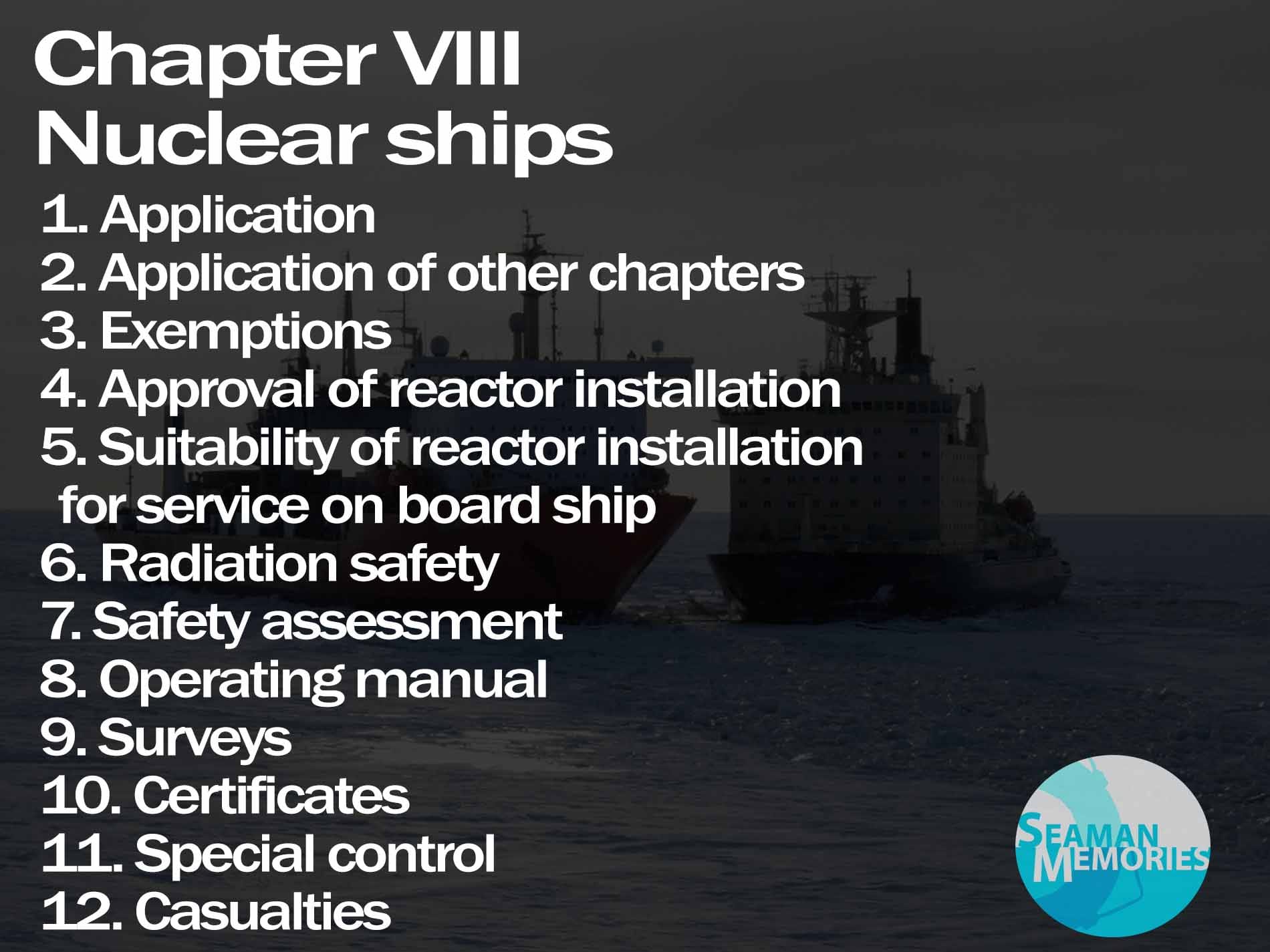
☢️ Chapter VIII: Nuclear Ships
Chapter VIII covers nuclear-powered merchant ships, which are rare but still regulated under international law.
These vessels must meet specialized safety and operational requirements due to radiation risks.
🔐 Key Provisions:
- 🛠️ Construction & Equipment: Must comply with strict radiation shielding and containment standards.
- 📄 Nuclear Ship Safety Certificate: Required for port entry or operation.
- ⚠️ Special Controls: Port states may deny entry unless safety is verified.
- 🌊 Environmental Precautions: No radiation leaks must occur at sea, in ports, or in coastal areas.
- 🔎 Reference Code: Follows the Code of Safety for Nuclear Merchant Ships.
⚠️ Although nuclear-powered cargo vessels are not common today, nuclear-powered naval vessels are frequent visitors to global ports, and their safety protocols often align with SOLAS principles.
⚙️ Chapter IX: Management for the Safe Operation of Ships
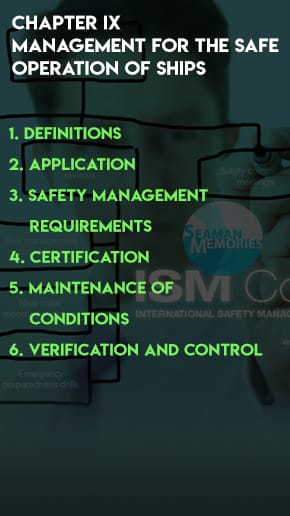
This chapter introduces the International Safety Management (ISM) Code, one of the most critical frameworks for vessel operations and pollution prevention.
It became mandatory under SOLAS in 1998 and fully enforced by 2002 for most ships over 500 GT.
✅ ISM Code Overview
- 🔐 Mandatory Safety Management System (SMS): Shipowners and operators must implement a documented system addressing:
- Safe practices in ship operation
- Risk assessment and mitigation
- Emergency preparedness
- Pollution prevention
- 🧑✈️ Designated Person Ashore (DPA): Connects ship and shore-based safety operations.
- 📝 Internal Audits: Required to verify ISM compliance before and during operations.
- 📄 Certification: Ships must carry a Safety Management Certificate (SMC) and companies a Document of Compliance (DOC).
⚠️ Failure to comply with ISM requirements can lead to PSC detentions, insurance issues, or accident liability.
🚤 Chapter X: Safety Measures for High-Speed Craft (HSC)
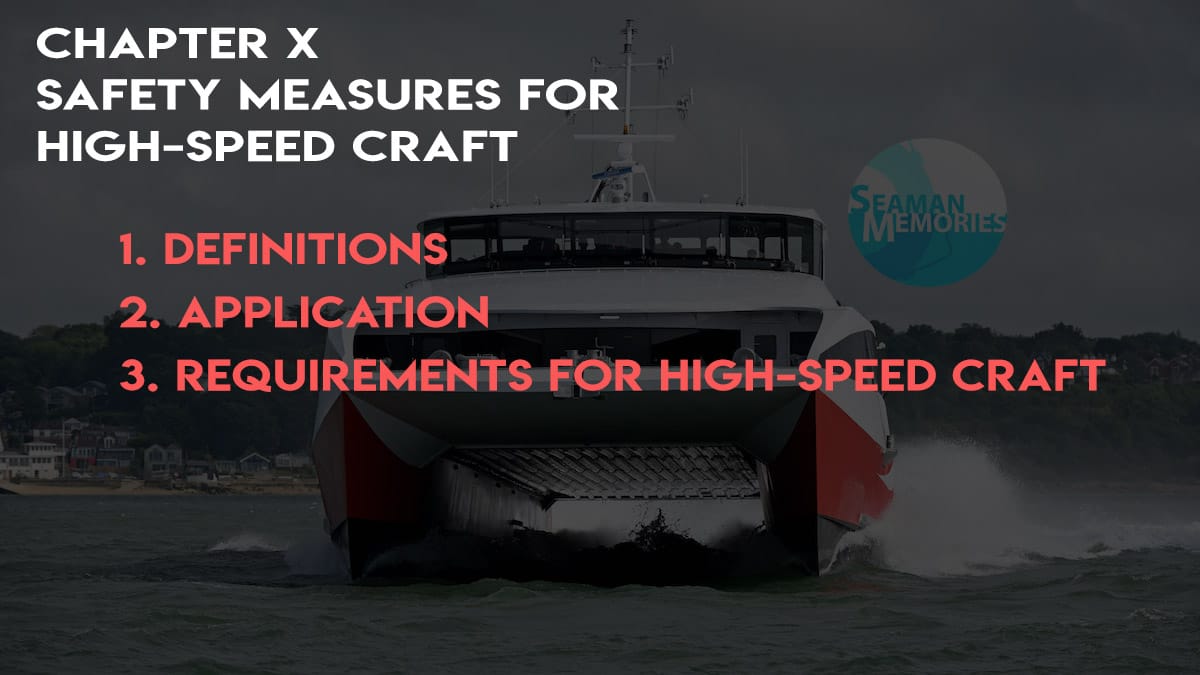
This chapter mandates the HSC Code, a specialized safety standard for high-speed passenger and cargo vessels.
🛥️ What Is a High-Speed Craft?
These are lightweight vessels designed for fast sea travel, including:
- Passenger ferries
- Jetfoils
- Catamarans
- Surface-effect ships
📘 Applicable Codes:
| Build Date | Required Code |
|---|---|
| 1 Jan 1996 – 30 June 2002 | HSC Code 1994 |
| On or after 1 July 2002 | HSC Code 2000 |
⚠️ Safety Provisions in Chapter X:
- 🧯 Enhanced fire protection
- 🧪 Evacuation and survivability standards
- 📶 Redundant communication and navigation systems
- ⚓ Minimum manning and training requirements
- 📋 Operational manuals and certification
💡 Not all flag states allow unrestricted HSC operations. Vessels may be limited to certified routes and weather conditions.
🛡️ Chapter XI-1: Special Measures to Enhance Maritime Safety
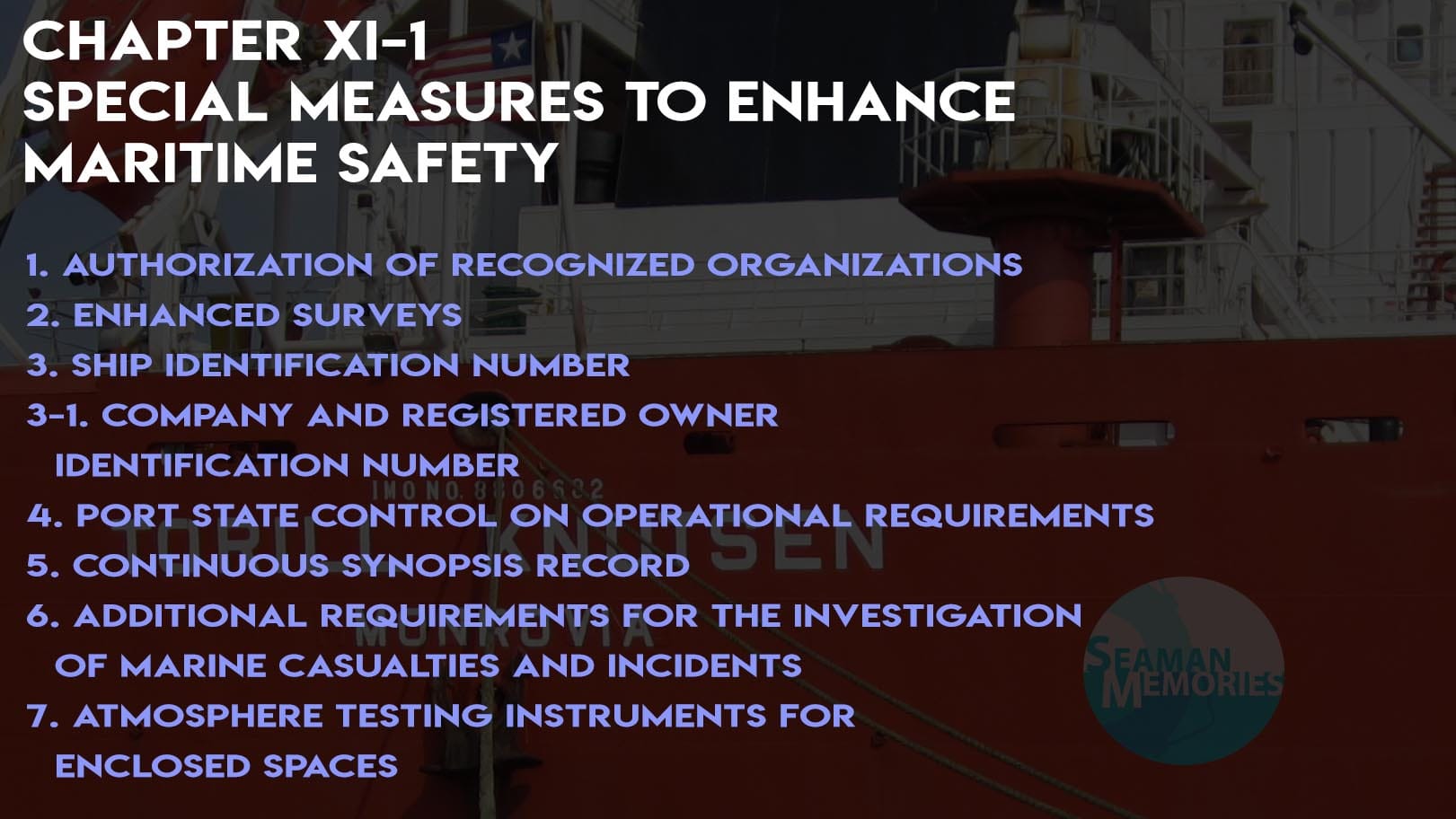
Introduced in 1996, Chapter XI-1 strengthens overall safety through additional measures beyond technical construction standards.
🧩 Core Areas:
- 📝 Ship Identification Number (IMO Number): Mandatory and permanent.
- 📑 Continuous Synopsis Record (CSR): A vessel’s lifetime operational and compliance history.
- 🧪 Atmosphere Testing Instruments: For enclosed spaces like cargo holds and tanks.
- 🧭 Port State Control Enhancements: Expanded authority for inspections and detentions.
- 🏷️ Recognition of Classification Societies: Guidelines for their authorization.
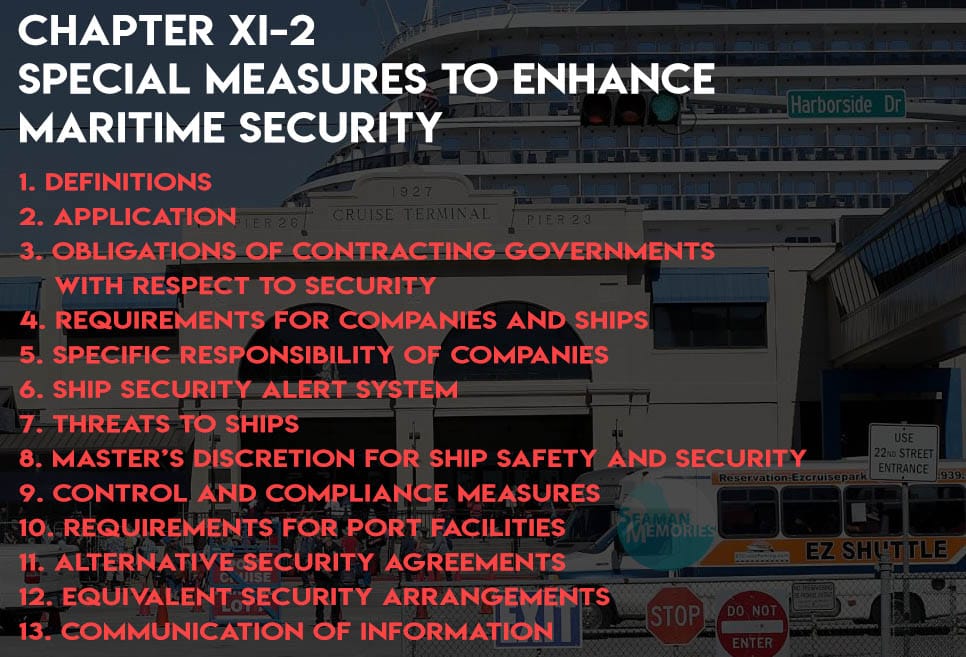
🔒 Chapter XI-2: Special Measures to Enhance Maritime Security (ISPS Code)
Chapter XI-2 introduced the International Ship and Port Facility Security (ISPS) Code, making security an integral part of SOLAS.
Adopted after the 9/11 attacks, the ISPS Code became mandatory on 1 July 2004.
🛡️ Structure of ISPS Code
| Part | Type | Focus |
|---|---|---|
| Part A | ✅ Mandatory | Minimum security requirements |
| Part B | 🟡 Recommendatory | Implementation guidance |
🔑 Key Requirements:
- 🧾 Ship Security Plan (SSP)
- 👮 Ship Security Officer (SSO)
- 🛠️ Security Equipment & Alarms
- 🔐 Port Facility Security Plan (PFSP)
- 🧑✈️ Company Security Officer (CSO)
🚨 Vessels must operate under one of three Maritime Security Levels (1 to 3) and respond accordingly.
🧭 Master’s Overriding Authority
Regulation 8 gives the Master full authority to make decisions in favor of ship security even if it goes against the interests of owners, charterers, or other stakeholders.
🧪 Security Drills and Audits
- 🔍 Audits by flag states or recognized security organizations (RSOs) verify compliance.
- ✅ Drills and training are required every 3 months.
- 📋 Records of exercises must be kept onboard.
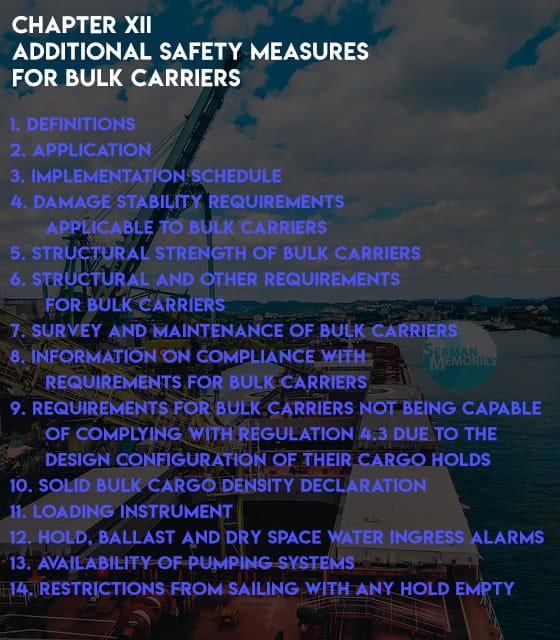
⚓ Chapter XII: Additional Safety Measures for Bulk Carriers
Introduced in 1997, Chapter XII targets bulk carriers, especially older ones, following a series of fatal structural failures in the 1990s.
🛠️ Core Requirements:
- 🧱 Double Bottoms: Mandatory in cargo holds if over 150 meters long.
- ⚙️ Structural Reinforcements: Especially in the forepart and ballast holds.
- 🧪 Hold Flooding Detection: Real-time water ingress alarms and sensors.
- 🔍 Hatch Cover Strength: Must withstand wave loads and comply with International Association of Classification Societies (IACS) standards.
- 📋 Loading Instruments: Required to prevent structural overloading.
- 🧯 Damage Stability: Enhanced for ships built after 1 July 2006.
⚠️ Many ship losses were due to sudden structural failure. SOLAS Chapter XII significantly improved survival rates and ship longevity.
✅ Chapter XIII: Verification of Compliance
Effective since 1 January 2016, this chapter enables the IMO to audit Member States for SOLAS enforcement through the IMO Member State Audit Scheme (IMSAS).
🔍 Key Audit Features:
- 🧭 Goal: Assess flag, port, and coastal states’ implementation of IMO instruments.
- 🗂️ Scope: SOLAS, MARPOL, STCW, Load Lines, and more.
- 📅 Mandatory Audits: Every 7 years or as scheduled by the IMO.
- 📈 Public Reports: Audit summaries are accessible online for transparency.
🌍 IMSAS helps close the gap between IMO regulations and actual enforcement, improving global maritime safety culture.
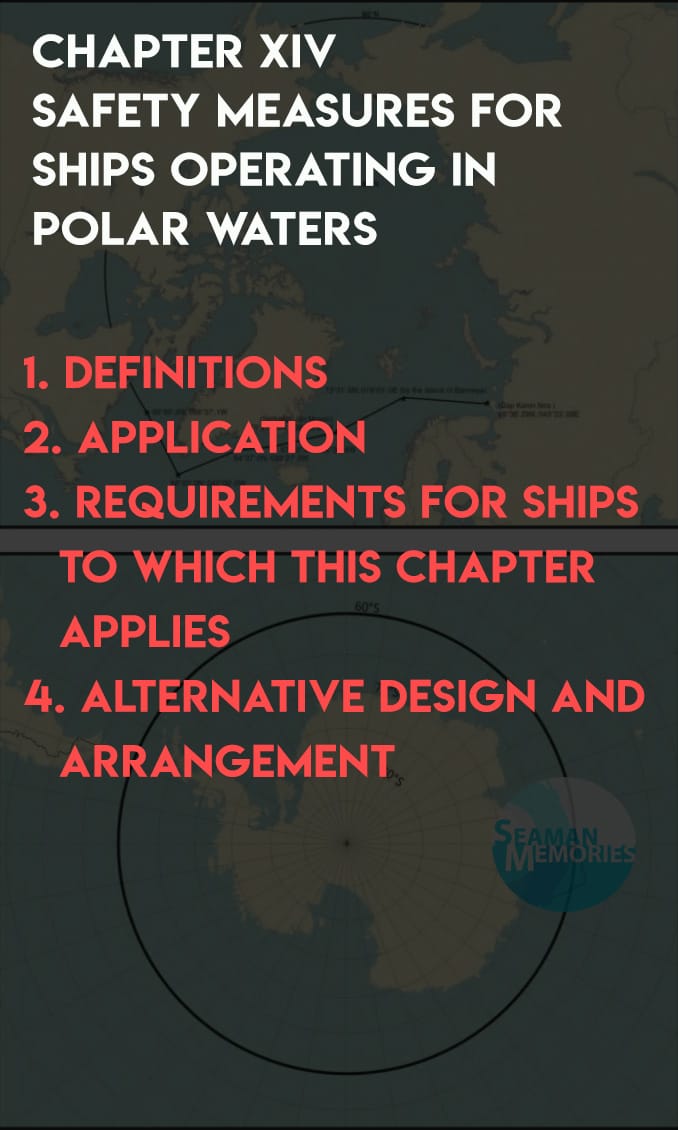
❄️ Chapter XIV: Safety Measures for Ships Operating in Polar Waters
Enforced in 2017, Chapter XIV mandates the Polar Code, a comprehensive set of requirements for ships operating in Arctic and Antarctic waters.
🧊 Why It Matters
Polar navigation presents extreme risks due to:
- Ice accretion
- Freezing temperatures
- Remote SAR (search and rescue) coverage
- Sensitive ecosystems
🧭 Polar Code Framework
| Section | Applicability |
|---|---|
| Part I-A | Mandatory (Safety Measures) |
| Part I-B | Recommendatory (Safety Guidance) |
| Part II-A | Mandatory (Pollution Prevention) |
| Part II-B | Recommendatory (Environmental Guidance) |
❄️ Key Requirements:
- 📄 Polar Water Operational Manual (PWOM): Must be onboard.
- 🚢 Ice Strengthening: Hull and propulsion must match expected ice conditions.
- 👩✈️ Specialized Crew Training: For cold weather navigation and equipment handling.
- 🧯 Survival Equipment: Modified for freezing conditions and longer exposure times.
- 🔎 SAR Preparedness: Ships must be self-reliant for longer durations.
📌 Even vessels transiting the Northern Sea Route or the Southern Ocean must comply with Chapter XIV.
📘 Full SOLAS Chapters Overview (Table)
| Chapter | Focus | Key Code/Instrument |
|---|---|---|
| I | General Provisions | Certification, Surveys |
| II-1 | Construction | Stability, Machinery |
| II-2 | Fire Safety | FSS Code |
| III | Life-Saving Appliances | LSA Code |
| IV | Radio Communications | GMDSS |
| V | Navigation Safety | COLREG, ECDIS |
| VI | Cargo Handling | Loading, Securing |
| VII | Dangerous Goods | IMDG, IBC, INF |
| VIII | Nuclear Ships | Nuclear Ship Safety Code |
| IX | Management Systems | ISM Code |
| X | High-Speed Craft | HSC Code |
| XI-1 | Safety Enhancements | IMO No., CSR |
| XI-2 | Maritime Security | ISPS Code |
| XII | Bulk Carrier Safety | Structural Standards |
| XIII | Verification of Compliance | IMSAS |
| XIV | Polar Operations | Polar Code |
❓ Frequently Asked Questions
Q: What is the SOLAS Convention in simple terms?
A: It’s the main IMO treaty that sets minimum international safety standards for ship design, equipment, and operation.
Q: Is compliance with SOLAS mandatory?
A: Yes. All ships flagged under IMO member states must comply. Port State Control can detain non-compliant vessels.
Q: Which SOLAS chapters are most important for crew?
A: Chapters III (Life-Saving), V (Navigation), IX (ISM), and XI-2 (ISPS) are most relevant for daily operations.
Q: How often is SOLAS updated?
A: Amendments are adopted by the IMO every 1–2 years via tacit acceptance under Article VIII.
📥 Downloads & Tools
✅ Download the Official SOLAS Consolidated Edition (2018)
✅ Free PowerPoint Presentation
🎯 Final Thoughts: Why SOLAS Matters More Than Ever
The SOLAS Convention of 1974, as amended, remains the most powerful and enduring framework for global maritime safety.
From ship design and fire protection to cybersecurity and polar operations, SOLAS ensures that seafarers, passengers, cargo, and the marine environment are protected, regardless of flag or waters sailed.
✅ As a maritime professional, knowing SOLAS isn’t optional, it’s part of your survival, career growth, and professional credibility.
May the winds be in your favor.
Leave a Reply