


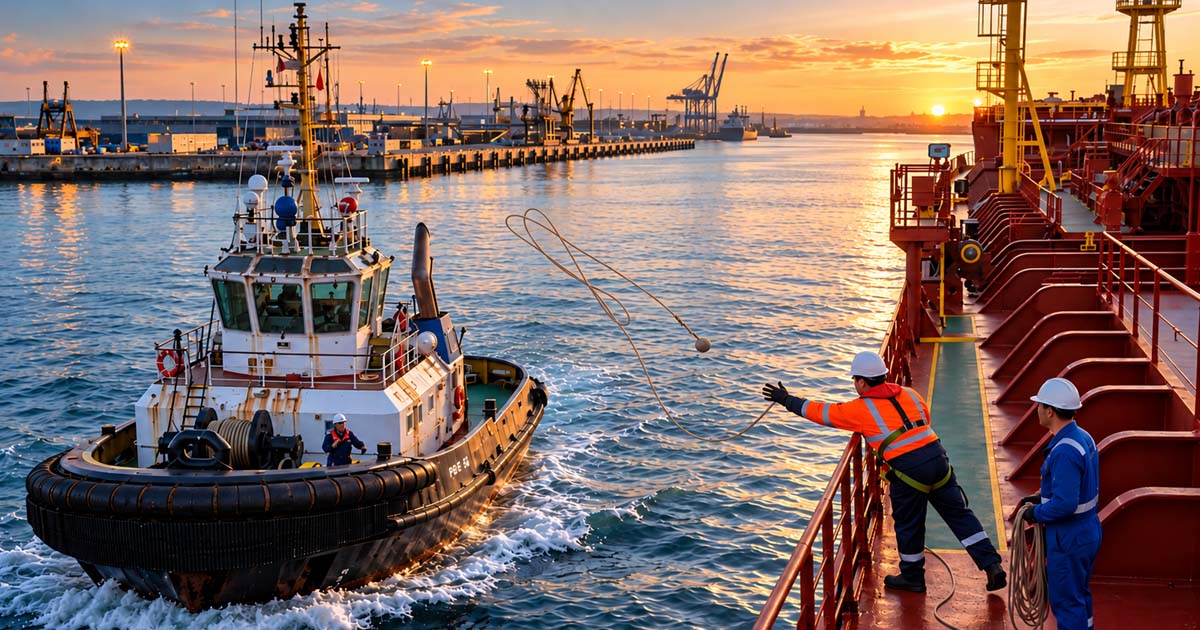
Making fast a tug’s line means securing the tug’s towing line to the ship so the tug can assist during berthing.
The operation involves the tug crew, the ship’s crew in the mooring station, and a line watcher, preferably a Responsible Officer (R.O.), who coordinates both sides especially during line handling.
In this guide, we’ll show you how to receive the tug’s line, secure it on the bollard, give the correct signals, and report when the tug is fast.
🧠 What Does Making Fast a Tug’s Line Mean?
Making fast a tug’s line means securing the tugboat to a designated bollard on the ship whether using the ship’s line or the tugboat’s towing line.
If the tug provides its own line, the ship’s crew receives it and makes it fast to the bollard.
The main equipment includes:
- Heaving line: A light line thrown from the ship to the tug.
- Messenger line: A smaller line used to pull the heavier tug’s line aboard.
- Tug’s line: The towing line supplied by the tug.
- Fairlead: A fitting that guides the line through the ship’s side.
- Bollard: A strong deck fitting used to secure the line.
For more information about these fittings, see the Ultimate Guide to Mooring Operations.
📌 Note: The procedure below covers receiving and securing the tug’s own line, not supplying a ship’s line to the tug.
⚓ How to Make Fast a Tug Line Step by Step
The tug’s line is made fast by passing a heaving line, hauling the messenger, securing the towing eye, and confirming that the crew is clear.
The following procedure follows the sequence used at the aft mooring station.
Step 1: Wait for the tug to approach
The tug comes close enough for its crew to receive the ship’s heaving line. This is usually initiated by the Captain on the bridge in cooperation with the Pilot.
After receiving the instruction, keep a heaving line ready and watch the tug’s position.
The connection must already be authorized by the bridge. You should never make fast the tugboat without confirmation from the bridge.
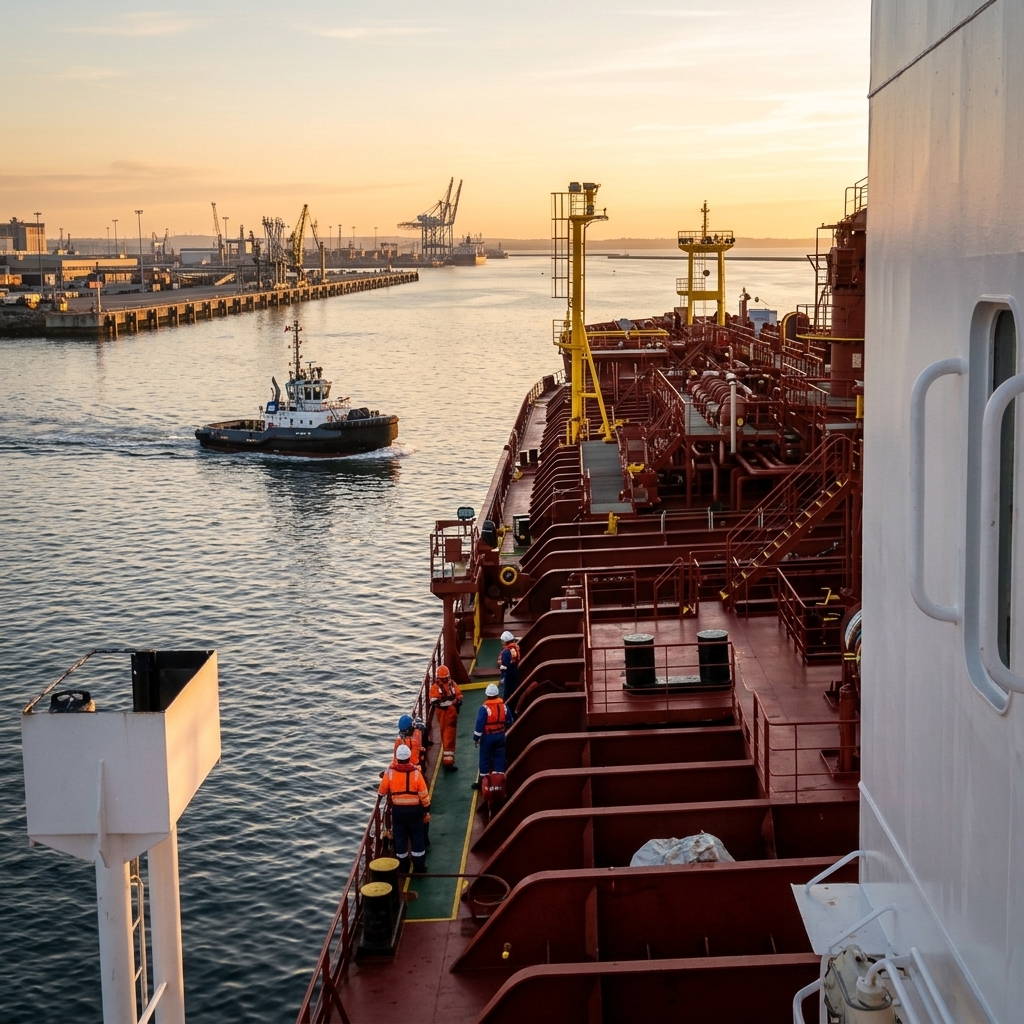
Step 2: Throw the heaving line
When the tugboat is close enough, pass the ship’s heaving line to the tug crew.
At this point, your heaving line should already be aligned with the chock or fairlead where the tug’s line will pass.
Avoid leading it across unrelated deck equipment or on obstructions.
Step 3: Haul in the messenger line
The tug crew connects its messenger line to the ship’s heaving line.
Pull the messenger aboard under the line watcher, preferably the responsible officer’s direction. This may be done by hand or by winch and the winch operator must watch the officer’s signal.
When the main towing line is about to be pulled up, the responsible officer will signal to slowly pull the messenger.
Continue hauling until the eye of the heavier tug’s line reaches the deck.
Adjust the hauling speed as directed.
⚠️ Important: When the tug’s towing line is about to pass the chock, the responsible officer may stop the heaving if the line gets stuck. This is why it’s very important to always observe and be attentive to his signal.
Step 4: Put the tug’s line eye on the bollard
Bring the towing eye to the designated bollard and place it securely over the fitting.
A responsible crew, preferably the Bosun or AB, temporarily secures the tug’s line with a rope stopper to prevent it from slipping or breaking free while the crew puts the eye to the bollard.
During this stage, the responsible officer must signal the tugboat not to do anything as the crew is securing the towing line.
Check that the eye is properly seated and the line follows the intended lead.
The R.O. monitors the tug and the crew throughout this step.
📌 Note: In some cases, you may need two or three people to carry and put the towing line to the bollard since the line may be very heavy, especially if it is soaked with water.
Step 5: Signal the crew to keep clear
Once the line is secure and the stopper is removed, the R.O directs everyone away from the towing line.
He must confirm that the eye is secured correctly, no obstructions are caught along the line, and that the crew has moved clear before telling the tug that the connection is complete.
⚠️ Important: Do not signal “tug fast” while someone is still handling the eye.
Step 6: Signal the tug and report to the bridge
The responsible officer signals to the tugboat that the line is secured. He also keeps clear from the station and informs the bridge that the tugboat is fast.
A simple report looks like this:
“Bridge, this is the mooring station aft. Tugboat fast aft centerlead. The name of the tug is Svitzer Taurus.”
⚠️Important: Inform everyone to keep clear of the towing line while the tug assists the ship.
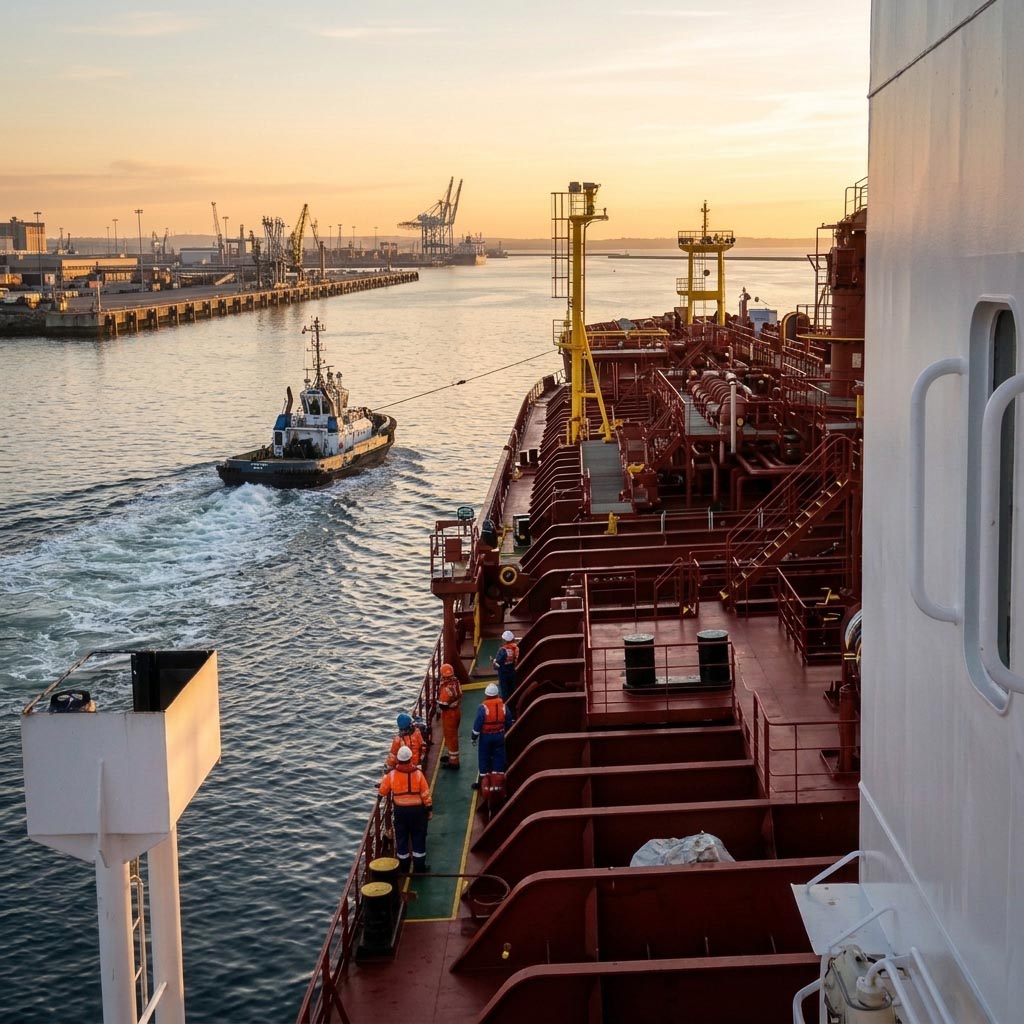
👀 What Does the Responsible Officer (R.O.) Do?
The responsible officer coordinates the ship’s crew and the tug operator during the connection.
In other cases, a responsible crew member who is well experienced, does that task especially when an officer is not yet available.
In both cases, the person must stand where they can:
- See the tug operator.
- Be seen by the tug operator.
- See and be seen by the ship’s crew.
- Observe the winch paying out the tug’s line.
- See the towing line while the crew is heaving it up.
- Recognize unsafe conditions and stop the operation when necessary.
The R.O. must pay attention to both sides, not just the crew handling the messenger.
For example, the messenger line may become too tight because the tugboat is not paying out its towing line. He must signal the crew to stop heaving, signal the tugboat to payout the towing line, then tell the crew to resume heaving.
The R.O. coordinates these movements so the whole operation becomes safe and prevent unsafe practices.
🔍 Insight: A good Responsibl Officer does more than pass instructions. He checks whether the tug and ship’s crew are responding correctly before giving the next signal.
✋ What Hand Signals Are Used When Making Fast a Tug?
Hand signals allow the line watcher to control the movement of the messenger and tug’s line.
The source account identifies four working instructions:
| Signal | Intended action |
| Heave | Haul in the messenger line |
| Slow | Reduce hauling speed |
| Stop | Stop hauling |
| Pay out more | Ask the tug to provide additional slack |
The R.O. also signals when the towing eye is secure and the ship’s crew is clear.
The actual gestures must be agreed and understood by the personnel involved. Do not assume every tug uses the same hand signals.
For spoken reporting examples, read Mooring Commands and Responses Over Ship Radio.
📌 Note: When visibility is poor or a signal is not understood, stop the movement and clarify the instruction through the approved communication method.
⚠️ What Should You Watch While Hauling the Tug’s Line?
The main concern during hauling is keeping the tug’s line under control as its weight and tension change.
The line R.O. must observe the movement of the tug and the line being brought aboard.
Watch for:
- The messenger line becoming tight while the crew is still hauling.
- The tug paying out less line than the ship needs.
- The towing eye approaching the bollard before the crew is ready.
- Crew members remaining near the working line after securing it.
- A loss of visual communication between the watcher and the tug operator.
If the operation becomes unsafe, give the stop signal and restore coordination before continuing.
❌ What Not To Do When Making Fast a Tug
1. Heaving up the towing line without watching the tug. The crew may continue pulling while the tug is not paying out enough line.
2. Poor positioning of the R.O.. The tug operator or ship’s crew cannot see the signals clearly.
3. Rushing the towing eye onto the bollard. The crew must control the line and seat the eye properly before clearing the area.
4. Signaling the tug too early. The connection should not be reported as fast until the eye is secure and the crew is clear.
5. Forgetting to report to the bridge. The bridge needs confirmation that the tug has been made fast.
📝 Summary: Making Fast a Tug’s Line
| Stage | Who acts | What happens |
| Approach | Tug operator | Brings tug into passing position |
| Heaving line | Ship’s crew | Passes line to tug crew |
| Messenger | Both crews | Transfer and haul the tug’s line |
| Securing | Ship’s crew | Places towing eye on bollard |
| Clearance | Responsible Officer (R.O.) | Signals crew to keep clear |
| Confirmation | Responsible Officer (R.O.) | Signals tug that line is fast |
| Reporting | Responsible Officer (R.O.) | Reports “tug fast” to bridge |
❓ FAQ
Can the tug’s line be made fast at either the forward or aft station?
Yes. A tug may connect forward or aft, depending on the berthing operation. The bridge specifies the connection position. See where to connect a tug line.
Does the line watcher have to be an officer?
Not necessarily. The watcher can be an officer or another responsible crew who can monitor the tug and communicate with both crews.
Why does the tug need to pay out more line?
The tug may need to provide additional slack so the ship’s crew can bring the towing eye aboard and secure it without excessive tension.
Can the ship’s crew leave the mooring station after reporting tug fast?
No. Personnel assigned to monitor the connection must remain available as directed while the tug is assisting the ship. They may need to keep clear on the area where the tugboat is made fast for safety reasons.
Is “tug fast” the same as “all fast”?
No. “Tug fast” confirms the tug’s connection to the ship. “All fast” refers to the ship’s mooring lines being secured at the berth.
🧭 Final Thoughts
A tug connection depends on people working together, not just handling a heavy rope. Every crew member should know who is directing the operation and how to respond when an instruction changes.
Before the tug starts assisting, make sure:
- ✅ The connection is properly secured.
- ✅ The crew has moved clear.
- ✅ The bridge has received the report.
Have you handled a tug’s line at the forward or aft station? Share your experience in the comments, especially how your crew coordinates with the tug operator.
May the winds be in your favor.
Leave a Reply