


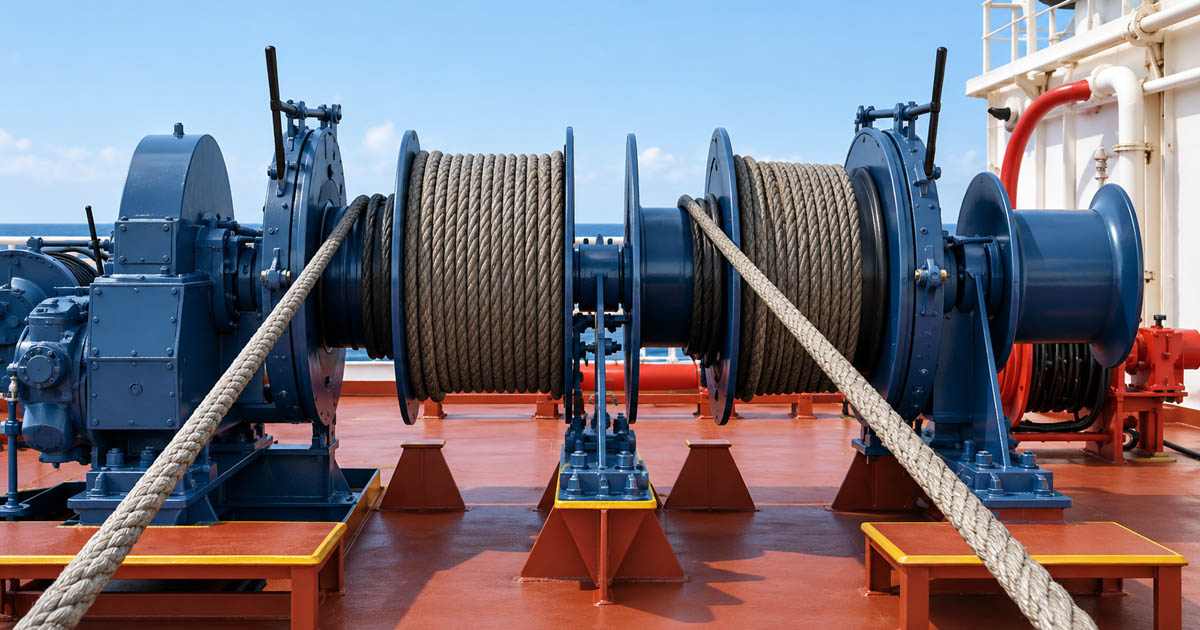
A mooring winch split drum separates line storage from the section that holds tension.
This helps prevent mooring lines from burying into lower layers and keeps brake holding performance more consistent.
But using the wrong section or leaving too many layers on the working side can create problems.
In this guide, we’ll show you how a split drum works, why the number of layers matters, and what deck crews should check during mooring.
✅ Key Takeaway: A mooring winch split drum has two sections: storage and tension. The tension section should carry the loaded mooring line in a single layer, with enough turns for the rope type and winch design. Extra layers can reduce effective brake holding capacity. Always follow the manufacturer’s instructions when transferring lines or setting the brake.
🔧 What Is a Mooring Winch Split Drum?
A mooring winch split drum is a common drum divided into two sections by a separating flange. The drum is used for handling mooring lines but each serves a different purpose.
The split drum is one part of the ship’s mooring equipment. For a broader explanation of mooring arrangements, equipment, and safety precautions, read our guide to mooring operations.
🧠 Definition:
- Storage section: Storage drum is bigger as it holds the main length of the mooring line, usually in multiple layers.
- Tension section: Tension Drum is smaller as it holds the working turns of the mooring line that carry the load.
- Dividing flange: Separates the two sections, usually with a slot for transferring the line.
The storage section is not intended to carry the final mooring load in normal split drum operation.
The tension section is designed to work with the line on its first layer.
This arrangement helps maintain more consistent heaving force and brake holding capacity.
⚙️ Why Should a Mooring Winch Split Drum Have Only One Working Layer?
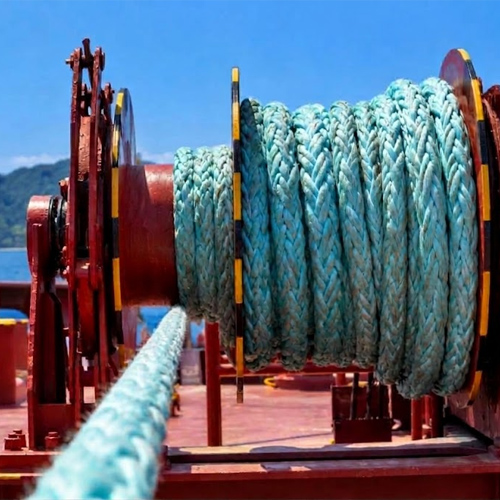
A mooring winch split drum should normally have only one layer of line on its tension section.
There are two main reasons.
1. Preventing the mooring line from burying
When a loaded mooring line is wound over several layers, the outer turns press against the layers underneath.
Under heavy tension, the rope can sink between the lower turns.
This can cause:
- Difficulty paying out the line
- Crushing or deformation of the rope
- Damage from friction and compression
- Problems when adjusting the mooring line
A split drum reduces this problem by keeping the loaded section separate from the stored rope.
2. Maintaining brake holding performance
The mooring winch brake resists the turning of the drum.
When the line builds up in additional layers, the effective drum radius increases.
A larger radius gives the line more leverage against the brake. Therefore, the same brake torque holds less line tension.
This is why the number of layers matters even when the brake setting has not changed.
📌 Note: OCIMF’s Mooring Equipment Guidelines (MEG4) recommends using no more than one layer on the tension section of split drum winches.
🔄 How to Use the Tension Section During Mooring
The mooring line is transferred to the tension section so the winch can handle and hold the working load correctly.
The exact procedure depends on the winch design and the crew operating the winches.
A typical sequence is:
- Recover the mooring line. Heave in the line on the storage section while following the officer in charge’s instructions.
- Prepare for transfer. Ensure sufficient slack is available and the line is not under uncontrolled tension.
- Transfer the line. When the officer gives the signal, move the line through the dividing flange slot so it transfers to the tension drum.
- Arrange the working turns. Keep the specified number of turns on the tension section without building a second layer.
- Take up the slack. Use the winch to adjust the line as instructed.
- Secure the winch. Apply the brake according to the ship’s procedures and disengage the gears as required.
Winch operators must follow instructions from the officer in charge and confirm commands before adjusting a mooring line. For common instructions such as “Pick up the slack,” “Heave tight,” and “Make fast,” see our guide to mooring commands and radio responses.
⚠️ Warning: Never attempt to move a heavily loaded mooring line manually between drum sections. Transferring a line under tension can damage the rope or seriously injure personnel.
⚓ How Many Turns Should Be on the Tension Section?
The number of turns depends on the rope diameter, winch design, and available space on the tension section.
The main rule is to keep the mooring line on a single working layer. Avoid adding so many turns that the rope starts forming a second layer.
💬 Firsthand Experience
In my experience, I prefer at least three or four turns on the tension section. With too few turns, the rope near the dividing flange may experience excessive pressure or become buried toward the storage section when tension increases.
I usually aim to have the rope occupy roughly the middle of the tension section, leaving some space for future adjustments.
I avoid filling the entire first layer because it leaves little room to heave in additional slack during mooring safety rounds.
If the tension section is already full, taking in more rope may cause a second layer to form. Correcting this could require safely removing tension, transferring one or two turns to the storage section, and rearranging the remaining turns before heaving again.
Leaving enough space from the beginning helps reduce the need for these adjustments.
⚠️ Note 1: Some rope types require more turns while others less so consider the size of the drum and rope diameter. Always follow the winch manufacturer’s instructions, rope manufacturer’s guidance, and company procedures. Never transfer turns between drum sections while the line is under tension.
⚠️ Note 2: Always ask permission from the OOW before touching or adjusting the mooring lines.
🛑 How to Check the Mooring Winch Brake Marker
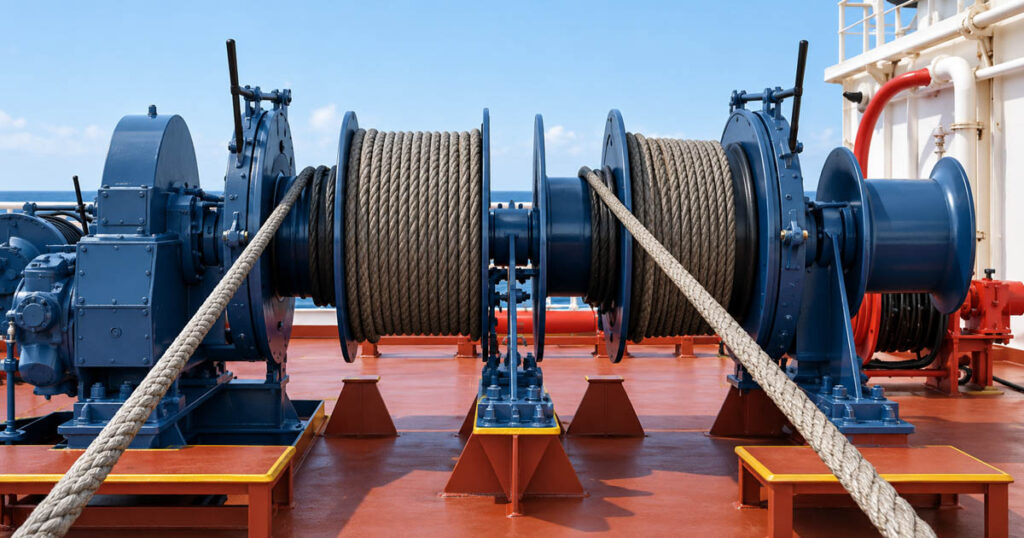
A mooring winch brake marker helps the crew identify the required brake adjustment position.
On some hydraulic winches, the brake is applied using a large handwheel or adjustment mechanism.
A marker may show where to stop tightening after the brake has been tested and set.
However, the marker does not directly measure the current tension in the mooring line.
🧠 Brake rendering: The controlled slipping of a winch brake when line tension exceeds its set holding load.
OCIMF MEG4 recommends a brake rendering setting of 60% of the ship design Minimum Breaking Load (MBL), based on the applicable design and testing conditions. This is not a setting the crew should estimate by hand.
Before relying on a brake marker:
- Check that the marker is clearly visible.
- Confirm the applicable brake-setting instructions.
- Check the stenciled brake test date.
- Look for damage or abnormal conditions around the brake.
- Report any missing, unclear, or displaced marker.
⚠️ Warning: Do not tighten the brake beyond its approved setting simply to stop the line from paying out. An incorrectly adjusted brake may fail to render at the intended load resulting in the mooring line breaking!
🔍 What If There Are Two Layers on the Tension Section?
Two layers on the tension section should be treated as an incorrect working arrangement requiring attention.
But this can be temporary at some point especially when the mooring operation is very demanding.
The crew would correct them when the ship is safely moored and the station is no longer busy.
However, the line may still be carrying considerable tension even when the ship is alongside.
The correction must therefore be planned and supervised.
- Inform the officer in charge.
- Assess the line tension and the ship’s mooring condition.
- Arrange suitable control of the line before any transfer.
- Confirm the brake and winch are properly secured afterward.
❌ Common Mistakes When Using a Split Drum
- Leaving the working load on the storage section. This increases the risk of buried turns and rope damage.
- Allowing multiple layers on the tension section. This changes the effective brake holding performance. Also increases the risk of buried ropes when tension is applied.
- Using too few turns on the tension drum. The part of the rope that passes through the connecting flange may be damaged when tension is applied.
- Tightening the brake beyond its approved marker. More tightening does not necessarily mean safer mooring.
- Attempting to transfer a loaded line to the tension drum. Lines under extreme tension behave as hard as rock. Forcing it on the tension section exposes the crew to injuries..
💡 Pro Tip: Check the Drum Before Final Tightening
Before the ship reaches its final position, check whether the working line is already on the correct section.
Do not wait until the rope is heavily loaded and buried between turns.
It is easier to correct an arrangement before the line takes its final mooring load.
📝 Summary: Split Drum Checks for Deck Crew
| Check | What to look for |
| Storage section | Remaining rope stored correctly |
| Tension section | One working layer |
| Working turns | At least 5 turns up to the first layer only. |
| Brake marker | Correct position according to instructions or marker |
| Rope condition | No crushing or buried turns |
| After mooring | Brake secured, gear disengaged, winch switched off as required |
❓ FAQ About Mooring Winch Split Drums
1. Is a split drum required on every ship?
No. Mooring winches may use split or undivided drums. The selected equipment must meet the ship’s applicable design, class, and operational requirements.
2. Can the storage section have multiple layers of rope?
Yes. The storage section is designed to accommodate the remaining rope. The single-layer recommendation applies to the loaded tension section.
3. Can I leave two layers on the tension section temporarily?
This is usually the case during fast paced mooring operations. Extra layers should be corrected when everything calms down and as safely as possible.
4. Does the brake marker tell me the actual line tension?
No. The marker indicates a brake adjustment position. Actual line tension requires suitable measuring equipment.
5. Should the mooring winch remain in gear after mooring?
For a conventional manually braked arrangement, the winch is normally left with the brake applied and the drive disengaged. Follow the manufacturer’s instructions for the installed system.
🧭 Final Thoughts
A good mooring winch operator understands what the equipment is doing, not just which control to move.
If you notice an incorrect drum arrangement, report it early and make sure any correction is properly supervised.
Before leaving the mooring station:
- ✅ Check that the working section is correctly arranged.
- ✅ Confirm the brake is secured according to instructions.
- ✅ Report any rope damage or abnormal winch condition.
Have you experienced a mooring line getting buried between the drum layers? Share how your crew handled it in the comments.
May the winds be in your favor.
Leave a Reply