


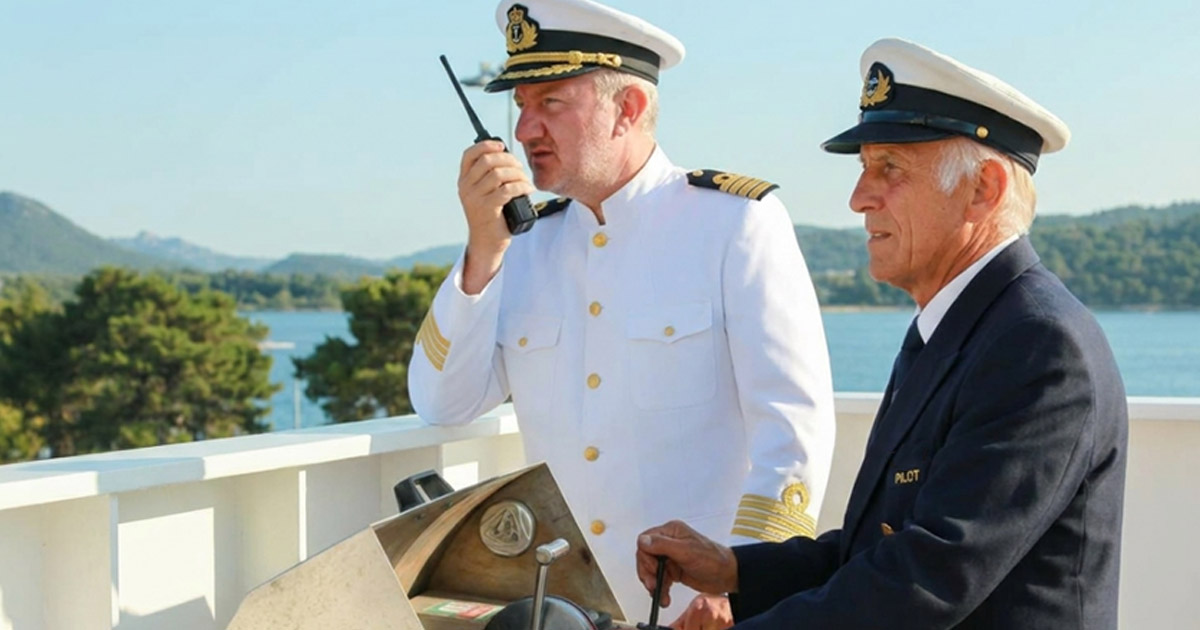
Mooring a vessel is one of the most critical and potentially hazardous operations in seamanship. Clear, concise, and unambiguous communication between the bridge, forward station (bow), aft station (stern), engine room, and tug operators (in some cases) is essential to ensure the safety of the crew, the vessel, and port infrastructure.
Radio communications during mooring follow standardized language adopted across the maritime industry – largely based on the IMO Standard Marine Communication Phrases (SMCP). Understanding these commands can mean the difference between a smooth berth and a dangerous incident.
This guide covers the most commonly heard commands and responses during mooring and unmooring operations.
📻 General Radio Communication Rules
Before diving into specific commands, here are the golden rules of radio communication at sea:
- 🔁 Always acknowledge: confirm every command received before executing (e.g., “Copy, send out spring lines!”)
- 🗣️ Speak clearly and slowly: background noises can be intense
- ✅ Use standard phrases: avoid improvised language or slang
- 🔔 Repeat critical information back: especially numbers and directions (e.g., “Hello Bridge, distance to the buoy ahead is two-five meters!”)
- 📢 Identify your station: always begin transmissions with your station name (e.g., “Bridge, this is Forward Station”)
🔧 Pre-Mooring Preparations
Before the vessel approaches the berth, the bridge contacts all stations to confirm readiness.
🛳️ Bridge Calls Forward & Aft Stations
| Bridge Command | Station Response |
| “Forward Station, this is Bridge. Do you read me?” | “Bridge, this is Forward Station. I read you loud and clear.” |
| “Aft Station, this is the bridge. Radio check.” | “Bridge, Aft Station. Loud and clear, over.” |
| “Forward Station, stand by for arrival.” | “Bridge, Forward Station. Standing by, over.” |
| “All stations, this is Bridge. We are approaching the berth. Stand by mooring lines.” | – “Bridge, Forward Station. Standing by.” – “Bridge, Aft Station. Standing by.” |
Typical Readiness Checks
- ✔️ Heaving lines ready and coiled
- ✔️ Mooring ropes faked out on deck
- ✔️ Winches tested and operational
- ✔️ Bollards clear and accessible
- ✔️ Radio battery is fully charged
- ✔️ Crew wearing PPE – helmets, gloves, safety shoes, coveralls
Bridge to Bow & Stern Station Commands
These are the key commands issued by the Officer of the Watch (OOW) or Master from the bridge to the mooring teams during approach and berthing.
📌 Standby Commands
| Command Heard | Meaning | Response |
| “Forward Station, stand by on the forward spring lines.” | Have all forward spring lines ready to send ashore | “Copy Bridge! This is Aft Station standing by on the forward spring lines.” |
| “Aft Station, stand by on the spring lines.” | Have all aft spring lines ready to send ashore | “Bridge, this is Aft Station. Standing by on the spring lines.” |
| “Forward Station, prepare to make fast the tugboat on the center lead. We will use the tug’s line.” | Forward Station to set up the heaving lines to pick up the tug lines | – “Copy Bridge! This is Forward Station. We will make fast the tugboat on the center lead using the tug’s line.” |
| “All stations, starboard/ port side alongside, 3-2-2, spring lines forward first!” | Bridge informing Forward and Aft Stations that the ship will berth on its starboard (or port) side with a mooring arrangement of 3 headlines, 2 breast lines, and 2 spring lines. The forward springs will be sent out first | – “Bridge, this is Forward Station. Starboard side alongside, 3-2-2 mooring arrangement. We will send out spring lines first. Thank you!” – “Bridge, this is Aft Station. Starboard side alongside, 3-2-2 mooring arrangement. Thank you!” |
📌 Sending Lines Ashore
| Command Heard | Meaning | Response |
| “Send the headlines ashore.” | Give the headlines to the quay or mooring men. | “Copy! Sending out the headlines now.” |
| “Send the lines to the mooring boat one by one.” | Requested by the mooring boat through the Pilot relayed to the Captain to his crew so they can give the lines one at a time. | “Copy! Give one mooring line at a time to the mooring boat.” |
| “First lines ashore, spring lines!” | Called by the mooring station to inform the bridge that the first mooring lines are secured on the shore bollard. | “First lines ashore, spring lines! Thank you!” |
🪢 Line Handling Commands
These are the most frequently heard commands during active mooring. Each has a very specific meaning – using them correctly prevents accidents.
In most cases, the receiving mooring party/ station repeats the command as a form of acknowledgment.
⬆️ Taking In / Heaving Up Lines
| Command | Meaning | Response |
| “Heave up (or Vira) (the spring lines/ head lines/ etc.)!” | Start pulling in / winding in the mooring line on the winch | “Heave up the spring lines!” |
| “Pick up the slack.” | Heave up to lessen the slack – do not take the rope under tension. | “Picking up the slack now, copy.” |
| “Stop heaving Forward.” | Stop pulling in the winches. | “Forward Station heaving stopped.” |
| “Heave tight.” | Pull the line in until it is taut/firm | “Heaving tight now!” |
| “Hold!!” | Don’t let the mooring line pay out. Usually done to stop the ship’s momentum. | “Holding, forward (station)!!” |
| “All stations make fast!” | Secure the line; heave tight, apply the brakes, and disengage the winches. Made when the ship is in position. | – “Make fast forward… All lines fast Forward Station!”– “Make fast aft… All lines fast Aft Station!” |
⬇️ Paying Out / Easing Lines
| Command | Meaning | Response |
| “Slack away!” / “Pay out!” | Let out rope slowly, easing tension | “Slack away, copy!” / “Pay out, copy!” |
| “Slack the headlines (spring lines/ head lines/ etc.)!” | Loosen the tension on the headlines (spring lines/ head lines/ etc.). | “Slack the headlines, copy!” |
| “Let go (forward/ aft/ springs/ headlines/ everything)!” | Slacken the mooring lines enough to allow the mooring men to safely remove the ship’s lines from the shore bollard. | – “Let go everything forward!” – “Let go everything aft!” |
| “Single up the lines fore and aft!” | Cast off the extra lines and only leave one line for each of the headline, breast line, and spring line. The ship is ready for departure. | – “Single up the lines forward!” – “Single up the lines aft!” |
| “Let go forward/ aft tugboat” | Cast off the tug’s line connected to the ship. | – “Let go forward tugboat… Forward tugboat clear!” – “Let go aft tugboat… Tugboat clear aft!” |
🔄 General Line and Other Commands
| Command | Meaning | Response |
| “We will go ten/ one-zero meters ahead!” | The ship will move ten meters ahead. Forward and Aft Stations must adjust their lines accordingly | “We will go ten/ one-zero meters ahead, copy!” |
| “Keep the lines (springs, headlines, breast lines) tight!” | Keep those lines tight. Do not give slack. | “Copy. Keep the lines tight!” |
| “We are in position!” | The ship is in the correct berth position. Fore and Aft Stations must hold their lines tight. The next command should be “All Fast forward and aft” unless some adjustments are needed. | “In position, copy!” |
| “What lines are out?” | Bridge asking for a status update on lines. | “We now have two springs and two breast lines fast on shore. Still sending out the three headlines!” |
| “Make fast forward and aft!” | Secure all the lins by keeping them tight, brakes on, and gears disengaged. | – “Make fast forward… All lines forward made fast!” – “Make fast aft… All lines aft made fast!” |
| “Finish with the engines!” | Master/ Officer’s call to the engine room that the mooring is finished and the engines will no longer be used. | “Finish with the engines, thank you!” |
🔓 Unmooring / Letting Go Commands
When departing the berth, the sequence is essentially reversed.
Typical Departure Sequence
- 🔔 “All stations, this is the bridge. Prepare for departure.”
- Response: “Forward Station, ready.” / “Aft Station, ready.”
- 🔔 “Single up all lines.”
- Response: “Singled up forward.” / “Singled up aft.”
- 🔔 “Let go the headlines and stern lines.”
- Response: “Let go headlines… All headlines on deck.” / “Let go stern lines… All stern lines on deck. Propeller clear!”
- 🔔 “Let go the remaining lines forward.”
- Response: “Let go the remaining lines forward… Two breast lines and two spring lines on deck. All lines on deck forward!”
- 🔔 “Let go the remaining lines aft.”
- Response: “Let go the remaining lines aft… Two aft breasts and two aft springs on deck. All lines on deck aft! Propeller clear!”
- 🔔 “Thank you everyone. We’ll take it from here!”
⚠️ Important: Never let go a line until the bridge gives the order. Lines should be confirmed clear of the propellers.
🚨 Emergency Commands
These are high-urgency commands. When heard, they must be acted upon immediately.
| Command | Action Required | Response |
| 🔴 “Stop heaving! Stop heaving!” | Halt winch operation immediately – risk of parting line | 🔴 “Heaving stopped!” |
| 🔴 “Let go! Let go everything!” | Emergency release of all lines at once. The lines may be intentionally cut using the axe forward | 🔴 “Let go everything!” |
| 🔴 “Hold everything! Do not let go!” | Freeze all operations – hazard detected | 🔴 “Holding everything, copy!” |
| 🔴 “Emergency stop! All winches stop!” | Full halt of all mooring winch operations | 🔴 “All winches stop now!” |
| 🔴 “Line parted, forward breast line!” | A mooring rope has snapped – clear the danger zone. Usually called by the affected mooring station. | 🔴 “Line parted, copy. Please keep away from snapback zones!” |
💡 Safety Note: The snap-back zone of a parted mooring line is extremely dangerous. Always stand clear and never stand on the bight of a rope.
💡 Tips for Clear Radio Communication
✅ Do’s
- 📢 Always say your station first: “Bridge, bow station…”
- 🔁 Repeat back critical commands before executing: “Confirmed, heaving away on number one.”
- 🔢 Use line numbers where assigned to avoid confusion
- 📻 Keep transmissions short and clear – avoid long explanations
- 🌐 Use SMCP-standard phrases recognized internationally
- 🕐 Wait for acknowledgment before assuming your message was received
❌ Don’ts
- 🚫 Don’t use informal or ambiguous language (e.g., “pull it a bit”)
- 🚫 Don’t transmit when another station is speaking
- 🚫 Don’t assume a command without clear confirmation from the bridge
- 🚫 Don’t act on a command that was unclear – ask for a repeat
- 🚫 Don’t leave the radio unattended during mooring operations
📖 Reference Standards
| Standard | Description |
| IMO SMCP | Standard Marine Communication Phrases – the gold standard for maritime radio language |
| STCW Convention | Governs competency requirements for seafarers, including communications |
| SOLAS Chapter V | Safety of navigation – includes requirements for radio watchkeeping |
| ITU Radio Regulations | Governs use of radio frequencies at sea |
⚓ Final Thoughts
Clear communication is one of the foundations of safe mooring operations. Every command transmitted over ship radio must be short, precise, and acknowledged properly.
Whether you are a cadet, AB, deck officer, or master, understanding common mooring commands and responses can improve teamwork, situational awareness, and onboard safety.
Modern ships may have advanced mooring equipment, but safe operations still depend heavily on disciplined communication between the bridge and mooring stations.
Stay alert, communicate clearly, and always respect the dangers of working around mooring lines. ⚓📻
May the winds be in your favor.
Leave a Reply