


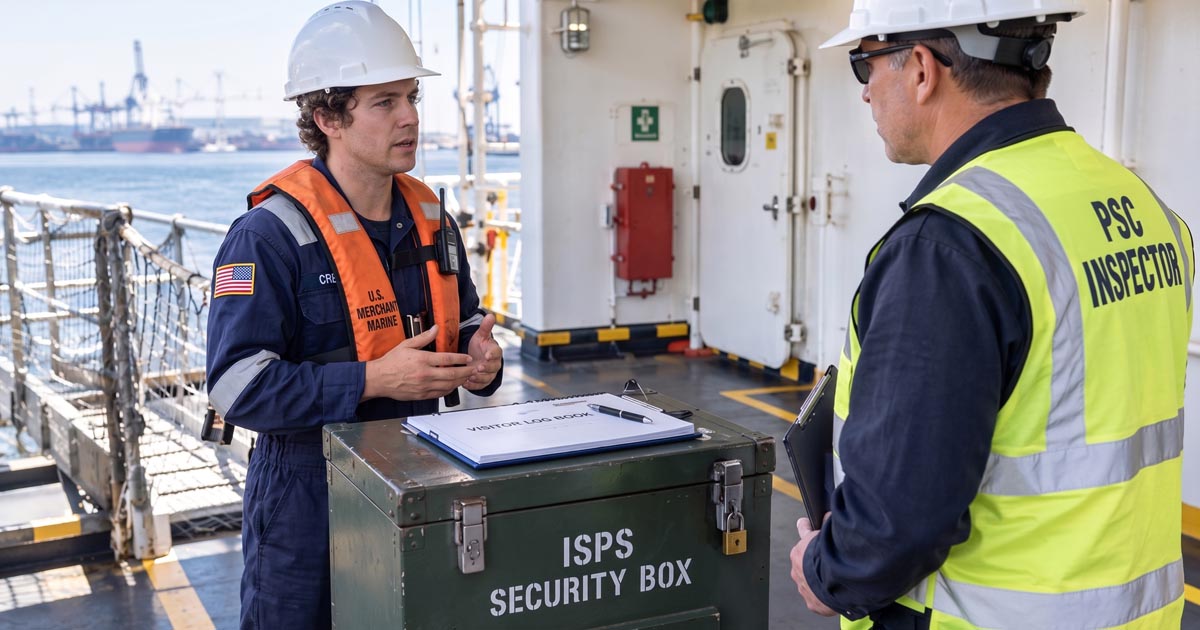
The inspector has just arrived at the gangway. Are you ready for the questions?
For many seafarers, the gangway watch is more than checking visitors and maintaining security.
During a vetting, SIRE 2.0, Port State Control, Coast Guard, or other inspection, the gangway watchman may become one of the first crew members interviewed.
Inspection guidance and real inspection reports show that questions can begin at the gangway and may cover security, emergency duties, alarms, cargo operations, and the crew member’s knowledge of the vessel.
That is why a gangway watchman should know more than simply who is allowed to board.
The best answer is not the most impressive answer. It is the correct answer according to your vessel’s procedures and your assigned duties.
Personal Questions
The inspector may begin with simple questions to establish who you are and how familiar you are with the vessel.
Typical questions include:
1. What is your name?
2. What is your rank or position?
3. How long have you been on board?
4. Where are you from?
5. How was your voyage?
6. What is your normal watchkeeping schedule?
These questions may seem harmless, but they can also help the inspector establish whether you are familiar with your role and surroundings.
Answer naturally and confidently. There is no need to give a long explanation when a short answer is enough.
Crew and Organizational Questions
A gangway watchman may also be asked about key personnel.
For example:
7. Who is your company’s Designated Person Ashore (DPA)?
8. Who is your Ship Security Officer (SSO)?
9. Who is the Safety Officer on board?
10. Who is your Company Security Officer (CSO)?
11. Who do you report a defective safety appliance to?
12. Where can you find the relevant company or shipboard procedure?
These are the kinds of questions that are easy to forget if you have been on board for months without being asked.
Keep the important names and contact details familiar, but remember that the actual company procedure and onboard documentation take precedence.
Safety-Related Questions
Safety questions can be broader and more difficult because the correct response depends partly on the vessel’s equipment, cargo operation, and SMS procedures.
13. What would you do if you saw a major leak at the manifold during discharging operations?
A suitable response should demonstrate that you understand the importance of immediate communication, stopping the source when authorized, preventing pollution, and following the ship’s emergency procedures.
Example response:
“I would immediately report the leak to the cargo control room or responsible officer and follow the vessel’s emergency cargo procedures. I will also press the emergency stop button. I would assess the situation from a safe position, prevent oil from reaching the sea, and follow instructions from the responsible officer.”
Do not memorize a generic answer if your vessel has a different procedure. Know the actual emergency stops, communication methods, spill equipment, and scupper arrangements on your ship.
14. What would you do if you saw a major leak during loading?
The basic principles are similar. Inform the responsible officer or cargo control room. Normally, the terminal provides an emergency stop button and I would use it to prevent further spill.
Example response:
“In the event of a major manifold leak during loading, I will immediately activate the emergency stop device (ESD) to trip shore operations while calling the CCR. I will alert the shore representative on site, assess whether cargo is contained within the drip tray or overflowing onto the deck, and relay the situation to the CCR. I will stand by the manifold area to isolate the manifold valve upon instruction. With scuppers already plugged and spill response gear staged on deck, the priority remains preventing any oil from reaching the water.”
15. How many emergency stops for the cargo pumps do you have, and where are they?
This is a vessel-specific question.
You should know the actual number and location of emergency stops on your ship. Do not memorize the number from another vessel because arrangements vary.
An inspector may expect you to physically identify them.
Example response:
“Our ship has six emergency stops for the cargo pumps: one in the CCR and five on deck. The deck stops are located at the port and starboard manifolds, along the catwalk in front of the accommodation, aft and forward of the manifold crane, and forward between tanks 1 and 2.”
Emergency Questions
16. What would you do if there was a fire on a nearby vessel?
Example response:
“I would immediately report the situation to the cargo control room and follow the vessel’s instructions. If the fire or smoke was clearly visible and the neighboring vessel’s gangway watchman or crew were nearby, I would alert them as appropriate.
I would remain at my assigned post unless instructed otherwise, particularly if cargo operations were in progress.”
17. What would you do if you heard your ship’s fire alarm while on gangway watch?
Example response:
“I would follow the vessel’s emergency procedure and remain aware of my responsibilities at the gangway. If cargo operations were in progress, I would be prepared for instructions concerning cargo stoppage and securing the operation.
I would also prevent visitors from boarding if required and report to my designated muster station or emergency duty as instructed once relieved or when the procedure requires it.”
The exact response should always follow the vessel’s emergency procedures.
18. What is your ship’s general emergency alarm?
You should know your vessel’s actual alarm signal.
For example, many vessels use seven short blasts followed by one long blast on the ship’s whistle, accompanied by the corresponding alarm bells, but alarm arrangements can vary. Always verify the signal used on your own vessel.
Example response:
“Our ship’s general emergency alarm consists of seven short blasts followed by one prolonged blast on both the ship’s whistle and alarm bells. This signal is followed immediately by a public address (PA) announcement detailing the nature of the emergency.”
19. When was your last fire/ abandon ship/ steering gear/ oil spill drill?
Know the actual dates of recent drills and your assigned duties during them.
An answer should be based on the vessel’s records, not a guess.
Example response:
“Our last fire/ abandon ship/ steering gear/ oil spill drill was on {insert the actual date of the said drill}.”
20. What are your emergency duties?
An inspector may ask what your responsibilities are during:
- Fire
- Abandon ship
- Oil spill
- Security incident
Know the duties assigned to you, not simply the duties of the emergency team.
Example response:
“In the event of an oil spill, my duty is deck clean-up using absorbent sawdust, shovels, and empty drums to recover the oil. During an abandon ship scenario, I am assigned to bring the emergency two-way VHF radios and spare batteries to my designated lifeboat. In case of fire, I serve on the technical/support squad, where my responsibility is to isolate ventilation by closing all air intakes, exhausts, dampers, flaps, and mushroom vents, then stand by to set up boundary cooling.”
Your muster list is the best reference for these responsibilities.
Questions About Your Working Hours and Fitness for Duty
An inspector may ask:
21. What time did you start your duty?
22. What time did you finish your last watch?
23. When did you last sleep?
24. How many hours did you sleep?
Example response:
“My previous duty ended at midnight. I slept shortly afterward, woke at 0700, and started my 0800 to 1200 watch.”
Answer honestly. Questions about rest and sleep may also relate to whether you are fit for duty.
Security and ISPS Questions
Security questions are particularly important for a gangway watchman because access control is one of the main responsibilities of the post.
25. Can I go by myself to the accommodation or to the Captain?
The answer depends on the visitor, the vessel’s procedures, and the nature of the visit.
For a routine visitor, such as an agent or surveyor, you may be required to verify identification, record the visitor, issue the appropriate pass, and notify the relevant person before allowing access.
For an inspector, PSC officer, Coast Guard representative, or vetting inspector, follow the vessel’s established procedure. If an escort is required, contact the responsible officer and arrange for someone to receive the visitor.
The important point is never to bypass the vessel’s access-control procedure simply because someone appears official.
26. What would you do if someone gave you a package for the Captain?
Example response:
“If someone attempts to deliver a package for the Captain, I will not accept it immediately. First, I will verify the courier’s identity and reason for boarding, cross-referencing their credentials against the authorized visitor list. If they are not listed, I will notify the Cargo Control Room (CCR) or Officer of the Watch (OOW) regarding the visitor and the unattended parcel. If the individual acts suspiciously or abandons the package, I will not touch or disturb it, immediately report the security breach, and establish a cordon until qualified personnel can inspect it.”
27. What if you saw someone boarding through the ship’s railings instead of the gangway?
Example response:
“I would immediately report the security breach to the CCR / OOW. Since our gangway watch consists of two crew members, one will maintain the post while I approach the intruder. I will instruct him to return to the gangway control point for proper identification and verification, while firmly explaining the severe safety hazards of entering an active cargo deck unauthorized.”
28. What Security Level is your ship right now?
Example response:
“Our ship is currently implementing MARSEC security level one.”
What If You Cannot Answer an Inspector’s Question?
This happens.
Forgetting an answer under pressure does not automatically mean you are incompetent or unprepared. The worst response is to invent an answer simply because you feel pressured.
You can say:
“I’m sorry, Mr. Inspector. I know the procedure, but I cannot recall the exact answer at the moment.”
Or:
“I’m sorry, Mr. Inspector. I am still two months on board and have very busy voyages. I am not certain of the exact procedure but I know where to find it.”
A professional answer acknowledges what you know and what you do not know.
💡 Important: Never confidently give another crewmember’s duties as your own just because you remember them. Inspectors are interested in whether you understand your actual responsibilities.
What Should a Gangway Watchman Know Before Taking the Watch?
Before going on duty, make sure you know the basics:
| Area | Know This |
| Security | Visitor identification and access procedures |
| Personnel | DPA, SSO, Safety Officer and reporting lines |
| Emergency | Alarm signals, muster station and escape route |
| Fire | Your assigned emergency duties |
| Oil spill | Your assigned response duties |
| Cargo | Cargo hazards and relevant precautions |
| Gangway | Safe access and emergency arrangements |
| Communication | Who to contact when something unusual happens |
| Drills | Recent drill dates and your assigned duties |
| Procedures | Where to find the applicable SMS/security procedures |
The exact details will vary from vessel to vessel.
Final Reminder
Being nervous when an inspector suddenly starts asking questions is normal.
But you don’t need to memorize hundreds of answers.
You need to know your job, know your vessel, know your assigned emergency duties, and know where to find the correct procedure when you are unsure.
The gangway watchman may be the first person an inspector speaks to. A calm, professional and knowledgeable response can make a good first impression, while a confident but incorrect answer can create unnecessary problems.
So before taking your next gangway watch, ask yourself:
“If an inspector arrived right now, what would he ask me?”
Would you know what to say?
May the winds be in your favor.
Leave a Reply