



Becoming the Ship Security Officer (SSO) is a critical responsibility on board any merchant vessel.
Under the ISPS Code and SOLAS Chapter XI-2, every ship must have a designated SSO to ensure compliance with international maritime security regulations.
Whether you’re a Third Officer, Second Mate, Chief Mate, or even the Master, you may be appointed as the SSO.
This role cannot be declined lightly because it’s mandatory under international maritime law.
⚓ What Is a Ship Security Officer (SSO)?
The Ship Security Officer is the person on board responsible for the overall security of the ship, accountable directly to the Master, and officially designated by the company.
The SSO is in charge of implementing and maintaining the Ship Security Plan (SSP), coordinating with the Company Security Officer (CSO) and Port Facility Security Officers (PFSOs), and ensuring the crew is prepared for any security-related threat.
🧭 In simpler terms:
The SSO is the ship’s security guardian, responsible for protecting the vessel, cargo, and crew from threats such as piracy, terrorism, stowaways, and unauthorized access whether the ship is underway or docked in port.

👨✈️ Who Can Be Appointed as the Ship Security Officer?
The SSO is not a fixed rank in the shipboard hierarchy.
Instead, the company or the Master assigns the role to a qualified officer- usually someone from the Deck Department who holds the necessary training.
Common designations include:
- ✅ Chief Mate
- ✅ Second Officer
- ✅ Third Officer
- ✅ Even the Master, if deemed necessary
The designation may vary based on:
- The officer’s security training
- Their workload and responsibilities
- Company policy or the Master’s discretion
“I’ve sailed on tankers where the SSO was the Chief Mate, the Second Officer, and even the Third Mate depending on the vessel and Master’s preference.”
📌 Pro Tip: Always check the Ship Security Plan (SSP) or ask the bridge officers to confirm who the current SSO is. Port State Control, vetting inspectors, or Coast Guard officers may ask anyone on board.
🛠️ Duties and Responsibilities of the SSO
The duties of a Ship Security Officer are guided by the ISPS Code, but implementation may differ depending on the ship’s design, type, and operational area.
Here are the standard responsibilities of an SSO:
🔒 Security Oversight
- Conduct regular security inspections to ensure all measures are in place
- Monitor access control and restricted areas
📜 Ship Security Plan (SSP) Management
- Maintain and supervise the implementation of the SSP
- Propose modifications to the SSP when necessary
- Conduct an annual review and update of the plan
📦 Coordination with Stakeholders
- Liaise with the Company Security Officer (CSO)
- Coordinate with Port Facility Security Officers (PFSOs)
- Manage Declarations of Security (DoS) with shore facilities or other ships
👨🏫 Crew Training and Awareness
- Provide security awareness training to the crew
- Ensure crew is familiar with SSAS, anti-piracy measures, and emergency responses
- Promote a culture of vigilance and preparedness
📋 Reporting and Compliance
- Report all security incidents and non-conformities to the CSO
- Implement corrective actions after audits or inspections
- Ensure security equipment is tested, calibrated, and maintained
📌 The Master retains overriding authority in all security matters and can override the SSO when necessary for ship safety.

🎓 How to Qualify as a Ship Security Officer (SSO)
To become a Ship Security Officer, you must meet the mandatory training requirements under the STCW Convention, particularly those that support ISPS Code compliance.
These courses ensure that the designated SSO is competent to handle maritime security threats.
📘 1. Security Awareness Training + Designated Security Duties (SAT with SDSD)
🕐 Duration: 1 day
💸 Cost: Php 900.00 – Php 2,500.00
📜 Output: Certificate of Completion and Certificate of Proficiency (COP)
These are IMO Model Courses 3.26 and 3.27, required for crew assigned with security-related duties.
It covers:
- Recognizing security threats
- Maintaining vigilance on board
- Basics of maritime security protocols under the ISPS Code
This is a prerequisite for advancing to the full SSO course.
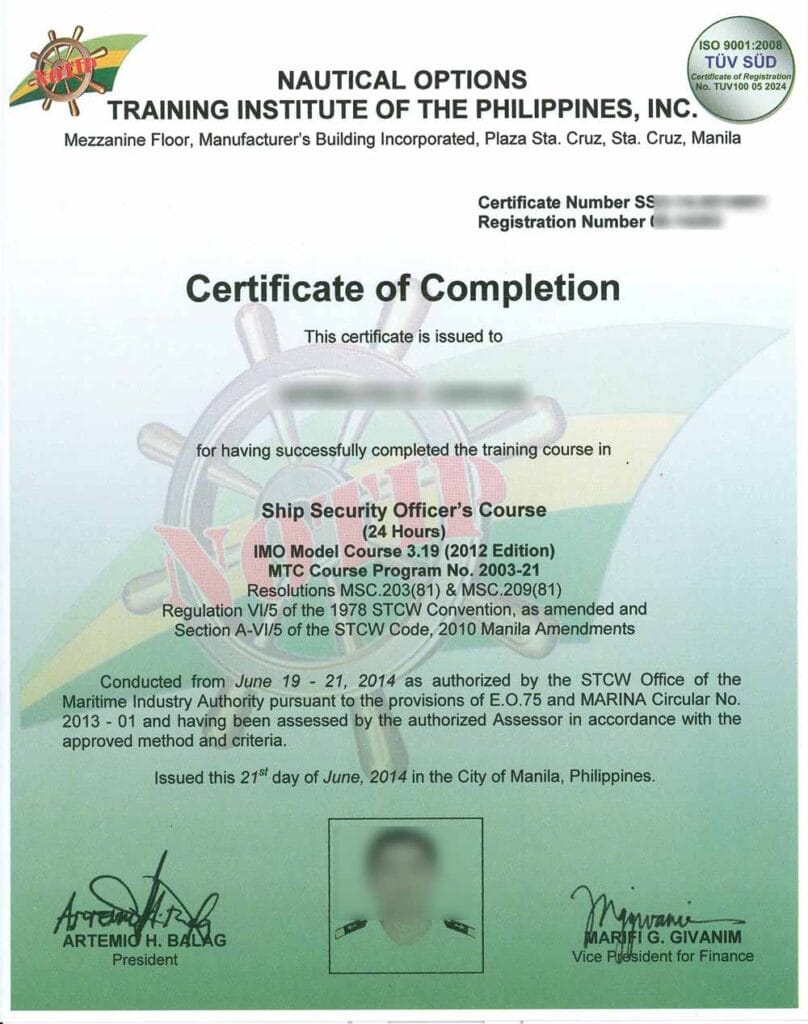
📘 2. Ship Security Officer (SSO) Course
🕐 Duration: Around 3 days
💸 Cost: Php 800.00 – Php 1,800.00
📜 Output: Certificate of Completion and Certificate of Proficiency (COP)
The full SSO course dives into:
- Implementing the Ship Security Plan (SSP)
- Responding to piracy, bomb threats, and stowaways
- Conducting security drills
- Coordinating with CSOs and PFSOs
⚠️ After completion, the COP must be processed to legally qualify for the SSO role onboard.
💼 Do Ship Security Officers Get Extra Salary?
On most merchant ships, taking on the SSO role does not provide additional pay.
It’s considered part of the officer’s normal responsibilities, and compensation stays within the contractual salary.
🛳️ However, on cruise ships, SSOs may receive a dedicated salary range.
According to Glassdoor:
📊 SSO Salary on Cruise Ships: $43,000 – $74,000 per year
(Note: Based on U.S. figures; rates vary globally.)
These roles often involve more complex passenger-related security operations, hence the higher pay scale.
❓ Frequently Asked Questions (FAQ)
🔹 Who assigns the SSO onboard?
The company officially designates the SSO, typically among licensed deck officers. However, the Master has the final authority based on operational needs.
🔹 Is the SSO always a separate position?
No. The role is assigned to an existing officer, like a Chief Mate or Second Officer, depending on training and availability.
🔹 What is a Declaration of Security (DoS)?
A DoS is a formal security agreement between the ship and a shore facility (or another ship) to ensure both parties meet agreed security measures, especially at higher MARSEC levels.
🔹 Do I need to be an officer to become an SSO?
Yes. Only licensed officers can be appointed as SSOs. Ratings may undergo basic security training (SAT/SDSD) but cannot assume the SSO role.
⚓ Final Thoughts: Ready to Take the Helm as SSO?
Becoming a Ship Security Officer means shouldering a critical responsibility– protecting your ship and crew from evolving maritime threats.
While the pay may not always increase, the skills, experience, and trust that come with this role boost your credibility as a professional seafarer.
So if you’re offered this position, embrace it. Prepare through certified ISPS & STCW training, understand the SSP, and work closely with your CSO and PFSOs.
🧭 Let your leadership in shipboard security be as steady as your watchkeeping.
May the winds be in your favor.
Leave a Reply