

A shipboard organization is the backbone of every vessel’s safe and efficient operation.
Much like a national government, ships have a structured hierarchy that assigns specific roles and responsibilities to each crew member.
This hierarchy ensures that operations, from navigation to engine maintenance and catering, run smoothly and without confusion.
Every merchant vessel- whether it’s a tanker, container ship, or bulk carrier, operates under a clear chain of command.
On average, about 20 crew members manage an ocean-going ship, divided into three main departments:
- 🧭 Deck Department
- ⚙️ Engine Department
- 🍽️ Catering (or Steward) Department
Each department has its head and is composed of both licensed officers and ratings.
During operations such as drills, mooring, cargo handling, and emergencies, these departments coordinate their tasks according to predefined roles.
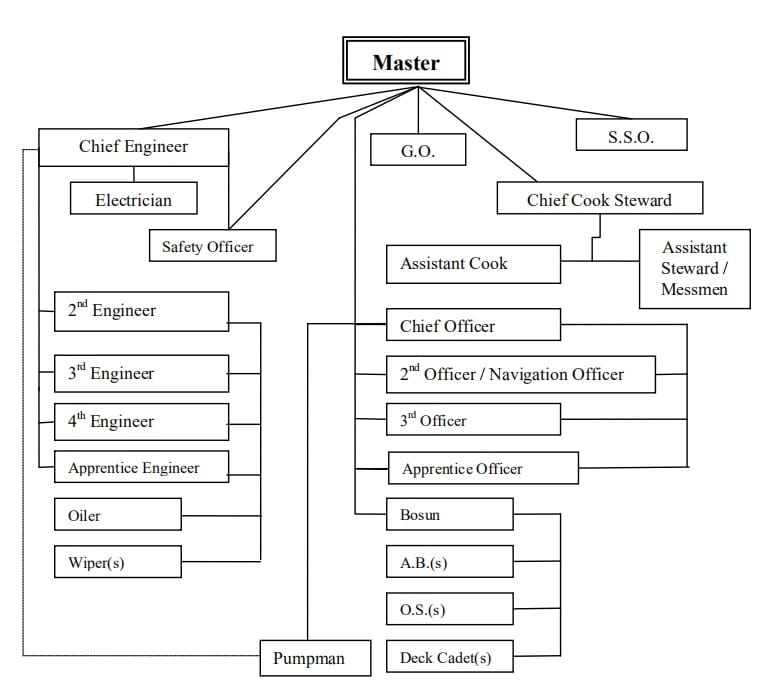
📊 Shipboard Organizational Chart: Hierarchy of Command
The shipboard organizational chart shows the flow of authority onboard.
At the top of the hierarchy is the Master (Captain), followed by department heads and their respective subordinates.
This structure:
- Defines each rank’s duties and responsibilities
- Clarifies reporting lines between officers and ratings
- Reflects salaries based on hierarchy and rank
The chart helps seafarers, especially cadets and new joiners, understand who’s in charge of what, and how tasks are distributed within the vessel’s operations.

🧭 Variations in Shipboard Organizational Structures
While most ships follow a similar three-department structure, variations exist depending on the company, flag state, or vessel type.
Examples:
- Some companies place the Catering Department under the Chief Officer’s supervision.
- Deck and Engine Cadets may be shown as officer-level ranks or positioned at the base of the organizational chart under ratings.
- Smaller vessels may combine duties, such as the Chief Cook also acting as the Steward.
These variations are not incorrect.
Each company structures its crew according to operational efficiency, safety standards, and regulatory compliance (e.g., STCW and ISM Code).
In this guide, we will follow the traditional three-department model, each reporting directly to the Master, who retains ultimate command onboard.
👨✈️ The Master: Highest Authority on Board
At the apex of the shipboard hierarchy is the Master, also known as the Captain.
He holds supreme authority over the vessel, its crew, cargo, and overall operations.
The Master’s responsibilities include:
- Final decision-making on navigation, safety, and emergencies
- Representing the shipowner’s interests while prioritizing crew and cargo safety
- Enforcing compliance with maritime regulations such as SOLAS, MARPOL, STCW, and ISM
Even when company superintendents, charterers, or port inspectors are onboard, the Master remains the highest authority.
If any incident occurs- whether operational or legal, the Master is held accountable unless proven otherwise.
💰 Average Salary: At least $10,000/month
📌 Also called: Captain

🧭 Deck Department: Officers and Navigational Leaders
The Deck Department manages the ship’s navigation, cargo operations, deck maintenance, and emergency preparedness.
All deck officers are licensed and assigned watches.
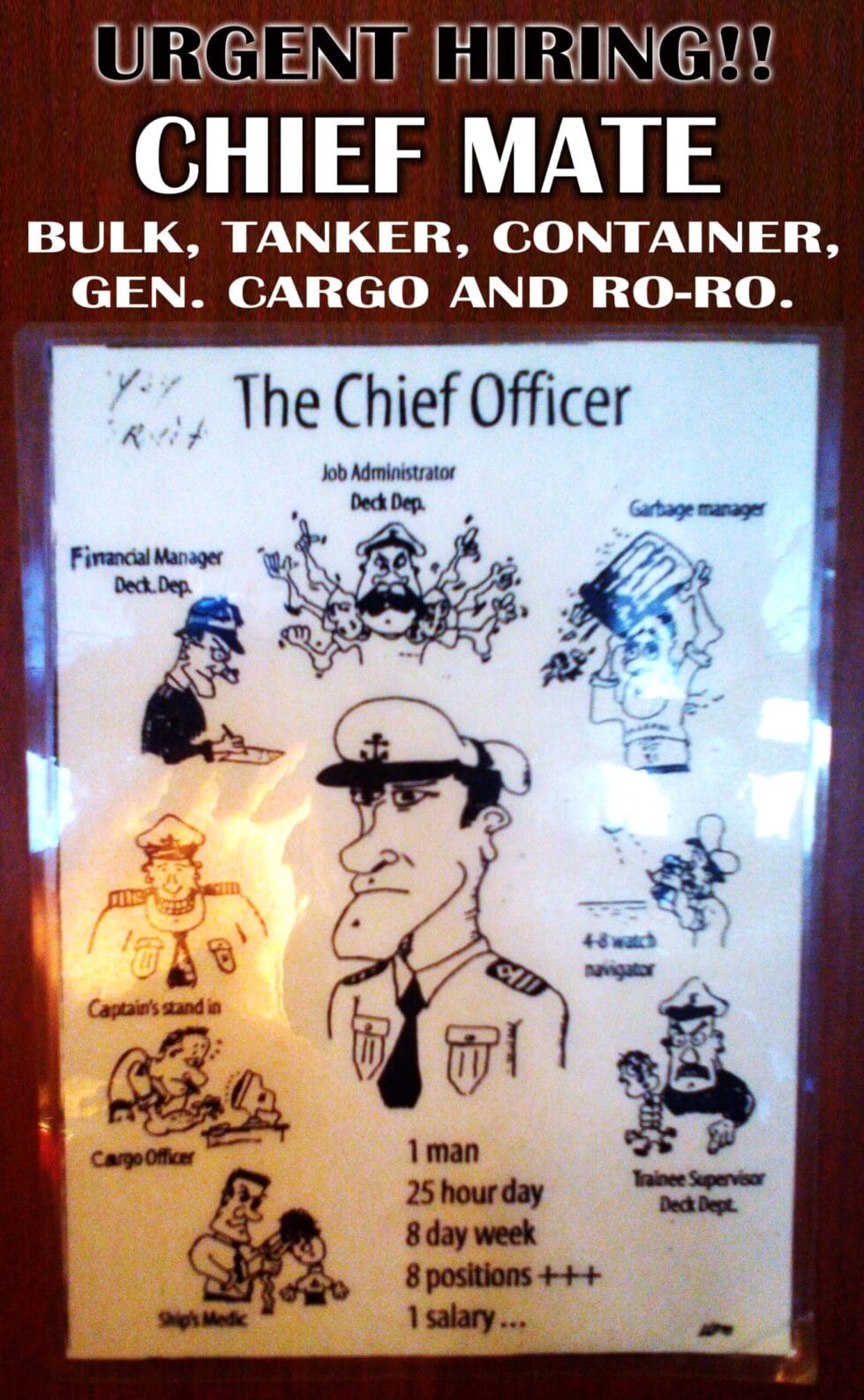
🥇 Chief Officer (Chief Mate / First Officer)
The Chief Officer is second-in-command to the Master and assumes command in case the Captain is incapacitated.
He is the head of the Deck Department and oversees cargo, safety, training, and administration.
Key Responsibilities:
- Manages cargo operations, including stowage, loading, discharging
- Supervises deck maintenance, mooring, ballasting/de-ballasting, and hull inspections
- Acts as:
- Garbage and waste management officer
- Rest hours and discipline officer
- Training officer for cadets and junior crew
Depending on crew size, he may be a day worker or stand 4–8 watches.
💰 Salary Range: $6,000–$12,000/month
📌 Also called: Chief Mate, First Officer
🧭 Second Officer (2/O): Navigational Officer
The Second Officer typically stands the 12–4 watch (AM and PM) or 12–6 watch (AM and PM) port watch and is the vessel’s primary navigator.
Core Duties:
- Prepares and maintains the voyage plan
- Updates nautical charts and publications
- Oversees navigation equipment maintenance and light signal testing
- Participates in mooring, ballasting, and cargo-related duties
- May serve as the Ship Security Officer (SSO) on certain vessels
💰 Salary Range: $2,500–$5,000/month
📌 Also called: Second Mate, 2/O
🧯 Third Officer (3/O): Safety and Emergency Preparedness Officer
The Third Officer usually keeps the 8–12 watch (AM and PM) or 6–12 watch (AM and PM) and is in charge of onboard safety systems.
Primary Roles:
- Maintains lifesaving and firefighting equipment
- Conducts crew familiarization for new joiners
- Assists in updating the Muster List and emergency duties
- Supports cargo, ballasting, and mooring operations
- Prepares safety drills and other reports in cooperation with C/O.
💰 Salary Range: $2,000–$4,800/month
📌 Also called: Third Mate, 3/O
🔍 This deck officer triad forms the core leadership responsible for the vessel’s safe navigation and deck operations.
👷♂️ Bosun (Boatswain): Leader of the Deck Ratings
The Bosun is the senior-most non-officer in the Deck Department and reports directly to the Chief Officer.
He is in charge of executing maintenance tasks and organizing the work of deck ratings.
Duties Include:
- Supervises deck maintenance, hull upkeep, and fittings
- Implements daily work plans from the Chief Officer
- Oversees deck crew operations, including painting, chipping, and rigging
- Assists in garbage handling, discipline, and safety drills
Though not an officer, the Bosun is the go-to person for all deck-related hands-on tasks.
💰 Average Salary: ~$2,000/month
🛢️ Pumpman: Tanker-Specific Deck Specialist
The Pumpman is a specialized rank found mostly on oil and chemical tankers.
He works closely with the Chief Officer during liquid cargo operations.
Key Responsibilities:
- Assists in loading, discharging, COW (crude oil washing)
- Manages inerting, purging, tank cleaning, and gas freeing
- Maintains cargo pipelines, PV valves, IG systems, tank gauging, and cargo hoses
- Collaborates with Bosun and ABs on deck
💰 Salary Range: $2,000–$2,300/month
🤑 Salary Difference of up to $500 more than Bosun
🤑 May earn more than Bosun depending on company and vessel type
🧹 Able-Bodied Seaman (AB): Senior Deck Rating
The AB performs operational and maintenance duties across the deck, working under the supervision of the Bosun and Chief Officer.
Key Roles:
- Steers the vessel during pilotage and maneuvering
- Conducts maintenance: chipping, painting, greasing, tank cleaning
- Assists in cargo ops, mooring, and gangway watch
- Participates in drills, emergency duties, and confined space entries
ABs are usually assigned as watchkeepers alongside deck officers.
💰 Salary: ~$1,550/month
⚓ Ordinary Seaman (OS): Entry-Level Deck Rating
The Ordinary Seaman is a trainee rank in the Deck Department.
They support the ABs and learn core deck tasks under supervision.
Main Duties:
- Assists in general deck maintenance
- Works with experienced ABs for on-the-job learning
- Not allowed to steer or work aloft unless supervised
- Participates in training for promotion to AB
💰 Salary: ~$1,200/month
🎓 Deck Cadet: Navigational Officer Trainee
The Deck Cadet is an unlicensed trainee preparing for officer responsibilities.
His duties vary based on the ship’s training culture and the Training Record Book (TRB).
Training Areas:
- Assists in deck maintenance with ratings
- Gains bridge experience in watchkeeping, steering, and voyage planning
- Shadows officers, Bosun, and Pumpman to understand all roles
- Participates in drills, mooring, cargo, and emergency duties
Whether assigned to bridge or deck tasks, the Cadet’s primary goal is learning through immersion and structured guidance.
💰 Salary: ~$600/month
⚙️ Engine Department: Technical Backbone of the Ship
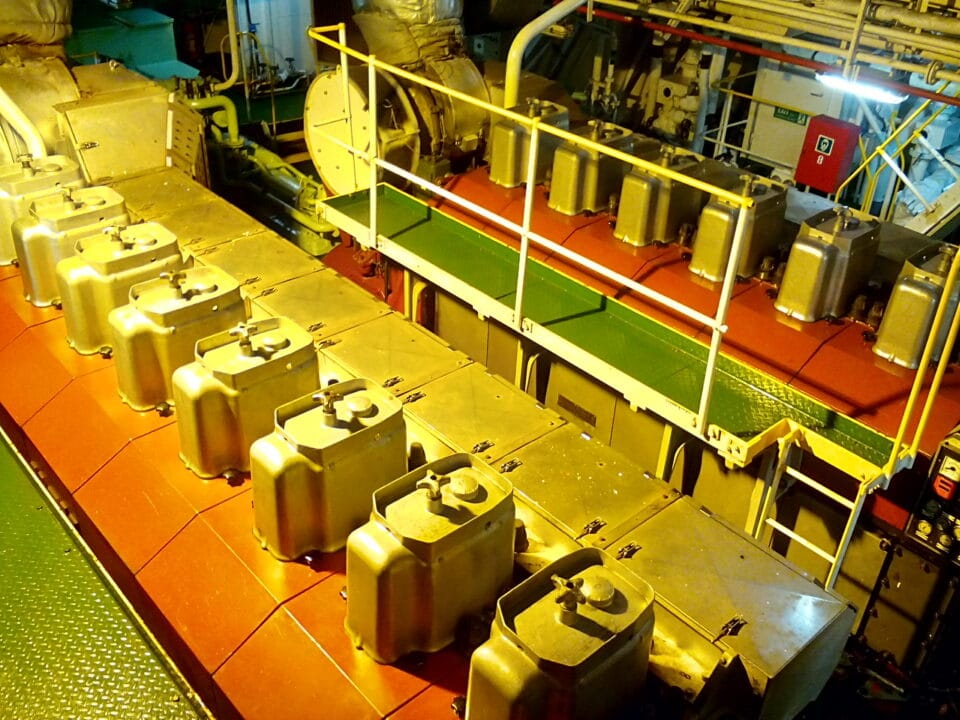
The Engine Department is responsible for the operation, maintenance, and repair of the ship’s propulsion systems, power generation, auxiliary machinery, and critical technical equipment.
Engine officers and ratings ensure that the vessel runs safely, efficiently, and in compliance with international maritime regulations.
From fuel systems to fresh water generators, this department keeps the ship’s heart beating behind the scenes.
🧑🏭 Chief Engineer (C/E): Head of the Engine Department
The Chief Engineer holds the highest-ranking officer position in the Engine Department.
He is in charge of all machinery, systems, and technical operations onboard.
Key Responsibilities:
- Ensures safe, efficient operation of main engine, generators, and all auxiliary systems
- Supervises engine team and assigns duties
- Oversees planned maintenance, spare parts inventory, and engine room safety
- Liaises with the Master regarding technical decisions and emergencies
💰 Average Salary: $9,000–$15,000/month (depending on vessel type and trading route)
🔧 Second Engineer (2/E): Daily Operations Manager
The Second Engineer is the Chief Engineer’s right hand, responsible for the day-to-day technical operations of the engine room.
He is sometimes called First Assistant Engineer (1AE).
Duties Include:
- Directs routine checks and daily engine room rounds
- Manages purifiers, pumps, air compressors, boilers, and cooling systems
- Maintains engine room records and assists in bunkering operations
- Oversees junior engineers and engine ratings
💰 Salary: $6,000–$9,000/month
⚙️ Third Engineer (3/E): Machinery and Watchkeeping Specialist
The Third Engineer supervises several key systems onboard and often keeps an engine room watch.
He is called in some ships as Second Assistant Engineer (2AE).
Common Duties:
- In charge of boilers, freshwater generators, and fuel oil purifiers
- Maintains steering gear, compressors, and sewage systems
- Assists in repairs and emergency drills
- Keeps ER logbooks and reports to 2/E
💰 Salary: $2,500–$6,000/month
🔩 Fourth Engineer (4/E): Entry-Level Licensed Engineer
The Fourth Engineer typically handles auxiliary machinery and assists higher-ranking engineers.
Primary Tasks:
- Maintains sewage treatment plant, incinerator, and air compressors
- Supports maintenance of generators and auxiliary engines
- Takes part in watchkeeping, bunkering, and MARPOL recordkeeping
- Learns under the 3/E and 2/E while handling assigned machinery
💰 Salary: $3,000–$4,500/month
⚡ Electro-Technical Officer (ETO) / Electrician: Specialist in Electrical Systems
The ETO or Electrician manages all electrical, automation, and electronic systems onboard.
Primary Tasks:
- Maintains power generation, distribution, and control systems
- Oversees automation panels, alarms, and PLCs
- Assists bridge officers with navigational electronics
- Troubleshoots lighting, motor control, and HVAC circuits
💰 Salary: $3,500–$5,500/month
🧰 Fitter: Shipboard Metalwork Specialist
The Fitter performs welding, cutting, and fabrication tasks for onboard steelwork and pipe repairs.
Primary Tasks:
- Fabricates brackets, foundations, and spare parts
- Repairs leaking pipelines and structural damage
- Assists with dry docking preparations and emergency repairs
- Works closely with the Second Engineer
💰 Salary: $1,200–$2,000/month
🛢️ Motorman / Oiler: Senior Engine Rating
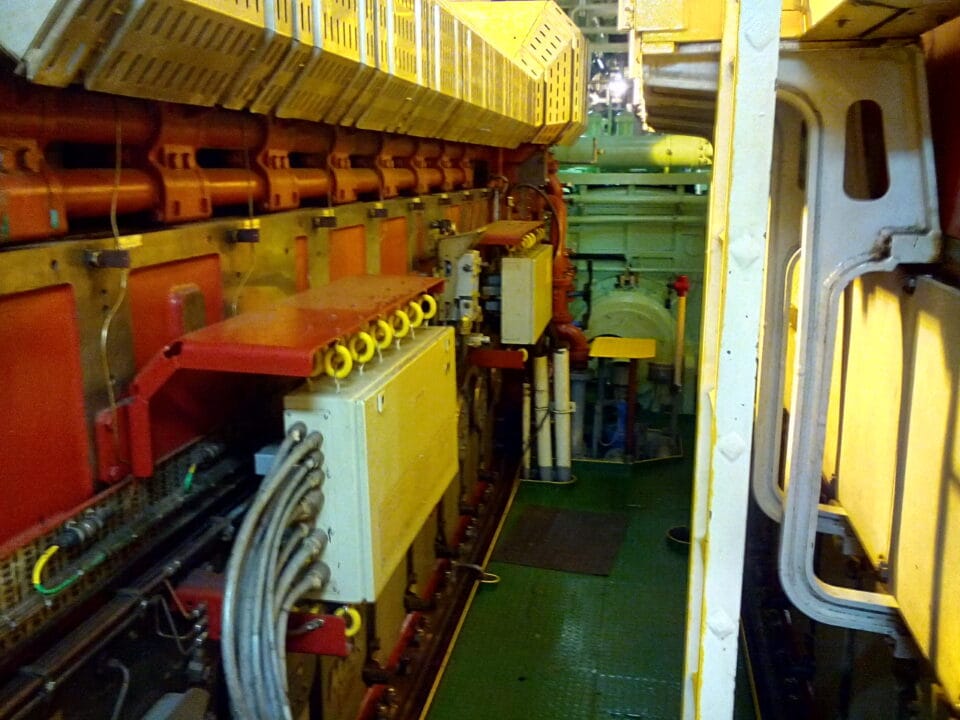
The Motorman assists engineers by operating, monitoring, and maintaining engine room machinery.
Primary Tasks:
- Conducts engine room rounds and logs equipment readings
- Lubricates pumps, compressors, and purifiers
- Assists with fuel oil transfer, bunkering, and maintenance
- Supports troubleshooting during machinery faults
💰 Salary: $1,300–$2.000/month
🧽 Wiper: Junior Engine Rating
The Wiper is an entry-level engine crew who assists in cleaning, maintenance, and machinery support tasks.
Primary Tasks:
- Cleans engine room bilges, platforms, and walkways
- Assists Motormen and Fitters with daily tasks
- Prepares tools and materials for engine maintenance
- Gains hands-on experience to qualify for promotion
💰 Salary: $800–$1,200/month
🎓 Engine Cadet: Future Engineer in Training
The Engine Cadet is an officer trainee preparing for licensed duties in the engine room.
Training Exposure:
- Assists in routine maintenance, toolbox meetings, and machinery overhauls
- Observes and participates in watchkeeping and technical briefings
- Completes tasks from the Training Record Book (TRB) under 2/E supervision
- Rotates between systems for broad technical exposure
💰 Salary: ~$600/month
🔍 Engine officers ensure that all shipboard systems- from propulsion to power generation, run reliably, efficiently, and in compliance with international safety and environmental standards.
🍽️ Galley / Steward Department: The Heart of Crew Welfare
The Steward Department, also known as the Catering Department or Galley Crew, may have the smallest headcount onboard but their impact is massive.
Tasked with preparing nutritious meals and maintaining the crew’s living spaces, this department is the backbone of morale on merchant vessels.
From managing food supplies to serving meals in the messroom, these crew members ensure everyone is well-fed, energized, and living in sanitary conditions- a major contributor to seafarer health, efficiency, and satisfaction.

🧑✈️ Chief Steward: Head of Galley and Provision Management
The Chief Steward is the senior-most member of the galley department, managing all catering operations and crew meal services.
Primary Tasks:
- Directs and supervises meal planning and food preparation
- Oversees cost control, budgeting, and stock management
- Handles requisition and inventory of provisions and supplies
- Coordinates with the Chief Cook and ensures meal quality and hygiene
💰 Salary: $1,500–$2,500/month
👨🍳 Chief Cook: Culinary Head of the Galley
The Chief Cook leads the galley team, plans menus, and ensures food safety and hygiene.
Primary Tasks:
- Prepares daily meals for officers and crew
- Plans menus based on voyage duration and provisions
- Manages food stock, galley hygiene, and waste segregation
- Supervises Messman and ensures safe cooking practices
💰 Salary: $1,200–$2,000/month
🧹 Messman / Steward: Support in Galley and Accommodations
The Messman supports the Chief Cook and maintains cleanliness in dining and crew areas.
Primary Tasks:
- Assists in food preparation and cleaning kitchen equipment
- Serves meals to officers and crew
- Cleans dining messes, toilets, and alleyways
- Collects garbage and performs daily housekeeping
💰 Salary: $700–$1,600/month
📊 Summary Table of Shipboard Ranks, Duties, and Salaries
| Rank/Position | Department | Duties Summary | Approx. Salary (USD/month) |
|---|---|---|---|
| Master | Deck | Overall command, navigation, safety, compliance | $8,000–$12,000 |
| Chief Mate | Deck | Cargo, safety, navigation, watches | $6,000–$9,000 |
| Second Mate | Deck | Navigation, passage plans, medical officer | $4,000–$6,000 |
| Third Mate | Deck | Bridge watches, FFE, LSA, port docs | $3,000–$5,000 |
| Deck Cadet | Deck | Assists deck officers, on-the-job training | $250–$1,000 |
| Chief Engineer | Engine | Heads engine department, technical operation | $8,000–$11,000 |
| Second Engineer | Engine | In charge of daily engine ops and maintenance | $6,000–$9,000 |
| Third Engineer | Engine | Generator maintenance, UMS system, water systems | $4,000–$6,000 |
| Fourth Engineer | Engine | Auxiliary machinery, sewage, air compressors | $3,000–$4,500 |
| Electro-Technical Officer (ETO) | Engine | Electrical systems, automation, electronics | $3,500–$6,000 |
| Fitter | Engine | Steelwork, welding, fabrication | $1,200–$2,000 |
| Oiler/Motorman | Engine | Oil checks, engine rounds, assists engineers | $1,000–$1,800 |
| Wiper | Engine | Cleaning, assisting, entry-level duties | $800–$1,200 |
| Chief Steward | Galley/Steward | Oversees meal planning, provisioning, cost control | $1,500–$2,500 |
| Chief Cook | Galley/Steward | Prepares meals, maintains galley hygiene | $1,200–$2,000 |
| Messman/Steward | Galley/Steward | Assists in food service and accommodation cleaning | $700–$1,200 |
❓ Frequently Asked Questions (FAQs)
⚓ What is the highest rank on a merchant ship?
The highest-ranking officer is the Master (Captain). They hold full authority and are responsible for the vessel’s operation, crew, and cargo.
⚙️ What is the difference between Chief Mate and Chief Engineer?
The Chief Mate leads the deck department (cargo, navigation), while the Chief Engineer heads the engine department (machinery, propulsion).
🍳 Who prepares food for the crew?
The Chief Cook prepares meals. On some ships, the Chief Steward oversees the entire catering operation.
👨🔧 Is an ETO the same as an engineer?
No. An Electro-Technical Officer (ETO) specializes in electrical and automation systems, not main engine or mechanical systems like marine engineers.
💰 What’s the lowest-paid rank on a ship?
Cadets are often the lowest-paid, being a trainee on board.
🧭 Conclusion: Know Your Rank, Chart Your Course
Understanding shipboard ranks and salaries is key for career growth at sea.
Each position, from deck to engine to galley, plays a vital role in keeping the vessel running safely and efficiently.
Whether you’re aiming to become a Master Mariner, a Chief Engineer, or starting as a cadet, knowing what each rank entails will help you navigate your career path with confidence.
👨✈️⚓ Thinking about going to sea or climbing the ranks?
Start with proper training, get your STCW certifications, and join a reputable maritime company.
Your maritime journey begins with knowledge, and you’re already ahead by being here.
May the winds be in your favor.
Leave a Reply