

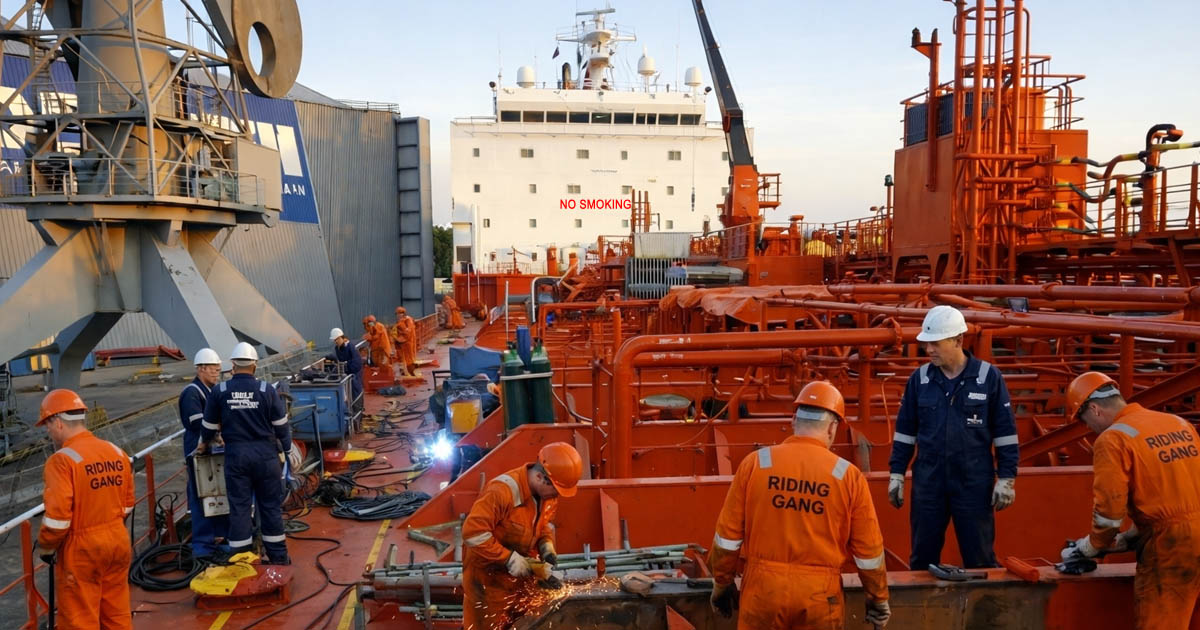
The riding gang, riding squad, or riding crew is one of shipping’s most misunderstood roles and one of its most debated.
Some say they’re unqualified laborers cutting into seafarers’ jobs. Others say they’re certified mariners doing essential work that keeps ships out of costly drydocks.
The truth? It depends entirely on how and why they’re deployed and whether the shipowner is playing by the rules.
If you’ve ever sailed with a riding squad gang or you’re wondering whether this type of work could be the right contract for you, this guide breaks down what riding squads actually are, what the law says in the United States and internationally, and where the real controversy lies.
🔍 What Is a Riding Squad on a Ship?
A riding squad (also called a riding gang or riding crew) is a team of workers deployed aboard a vessel specifically to perform maintenance, repair, and technical tasks separate from the ship’s regular operating crew.
The term covers a wide spectrum.
On one end: a group of certified welders and fitters with seaman’s books and STCW certificates, contracted for three to nine months to chip, paint, weld ballast tanks and other compartments before drydock.
On the other end: a loose group of unlicensed, uncertified laborers brought aboard with no emergency training and no formal seafarer status, used to quietly pad the crew numbers or cut costs.
That range is exactly why riding squads sit in a gray zone in the maritime industry.
Common Tasks Assigned to Riding Squads
- Steel maintenance: chipping, painting, scaling, welding, inside tanks, and in engine room spaces
- Mechanical and electrical repairs: in-voyage technical work beyond what the ship’s crew can handle.
- Pre-drydock preparation: completing repair and coating work before the vessel enters a shipyard, reducing costly yard time.
- Post-drydock residual work: finishing jobs after the vessel departs the yard
- OEM warranty and manufacturer technical work: specialist equipment service from original equipment manufacturers
What riding squads typically do not do: watchkeeping, cargo operations, mooring, anchoring, or any function that requires a licensed officer or rated seafarer. During emergency drills, they serve as supernumeraries.
📖 The Legal Definition: What U.S. Law Says
The United States has one of the clearest legal frameworks for riding gang members in the world, codified in 46 U.S.C. § 8106 under the Coast Guard and Maritime Transportation Act of 2006.
Under 46 U.S.C. § 2101(26), a riding gang member is legally defined as someone who:
- Has not been issued a U.S. Merchant Mariner’s Document (MMD)
- Does not perform watchstanding, automated engine room duty watch, or personnel safety functions
- Does not handle cargo loading/unloading or mooring line operations
- Does not serve as part of the minimum safe crew complement
- Is not a citizen of a country designated as a state sponsor of terrorism
This definition is important: it distinguishes riding gang members from credentialed seafarers. Under U.S. law, they are specifically workers who fall outside the regular crew structure.
Key Requirements Under 46 U.S.C. § 8106
For any U.S.-flag freight vessel on international SOLAS voyages, the shipowner must:
- Verify citizenship or immigration status: Each riding gang member must be a U.S. citizen, a lawful permanent resident, or hold a valid U.S. nonimmigrant work visa
- Conduct background checks: The owner must certify each member has been vetted and found free of credible security risks to the vessel, cargo, ports, or crew
- Drug testing: Riding gang members must be subject to the same random chemical testing as the regular crew
- Safety training: Each member must receive basic safety familiarization and basic safety training meeting STCW standards approved by the U.S. Coast Guard
- Crew list: Every riding gang member must be listed on the official vessel crew list
- 12-person cap: The total number of riding gang members, combined with other non-crew individuals permitted aboard, cannot exceed 12
- 60-day annual limit: Non-U.S. citizen riding gang members may not work more than 60 days per calendar year on a single U.S. vessel
- Supervision: Every riding gang member must be supervised by a licensed officer and must only work alongside credentialed merchant mariners
🌍 What International Bodies Say
The ITF (International Transport Workers’ Federation)
The ITF has a clear and firm position on riding gangs and it’s not entirely favorable toward the way they’re commonly used.
According to the ITF, riding squads have increasingly shifted from specialist temporary workers to permanent substitutes for regular crew.
The federation warns that casual riding squad workers are often not covered by collective bargaining agreements (CBA), are not required to be declared medically fit, and are not trained in emergency procedures.
📋 ITF Policy on Riding Squads
The ITF considers riding squads acceptable only when used for genuine specialist work, such as:
- Major repairs
- Steel renewal projects
- Tank coating
- Specialized maintenance
- Short-term technical work
However, the ITF argues that their use should be limited.
| ITF Position | Details |
| Maximum recommended duration | Approximately 1 month within any 12-month period |
| Purpose | Specialist temporary work only |
| Long-term use | Considered a sign of crew substitution |
| Multiple voyages | Viewed as evidence that riding squads are functioning as regular crew |
The ITF’s minimum standard: all riding squads must be covered by agreements providing at least comparable rates of pay to the regular crew, along with the minimum protections under applicable international labor conventions.
The MLC 2006 (Maritime Labour Convention / ILO)
This is where it gets important for anyone onboard in any capacity.
Under the Maritime Labour Convention 2006- the so-called Seafarers’ Bill of Rights, the definition of “seafarer” is deliberately broad:
“Seafarer means any person who is employed or engaged or works in any capacity on board a ship to which the Convention applies.”
The ITF explicitly confirms this includes riding gang members.
That means riding squad workers on MLC-covered vessels are entitled to the same basic protections as regular seafarers:
- fair terms of employment
- decent living and working conditions
- access to medical care, and
- social protection
The MLC covers all commercial seagoing ships on international voyages, except fishing vessels, naval ships, and traditionally built vessels.
The IMO
The IMO’s position complements the ILO framework: riding gang members should hold at least comparable rights in terms of wages and protection to the regular seafarers on board.
The practical problem, as industry observers note, is that the definition gap between ILO (which classifies them as seafarers for rights purposes) and the technical reality (they aren’t formally credentialed as such in many cases) creates genuine confusion about accountability.
🛳️ The Gray Zone: Not All Riding Squads Are the Same
What many textbooks miss is that not all riding squads operate in a legal or ethical gray area.
On many vessels, riding squad members are genuine seafarers who possess:
- ✅ Seaman’s books
- ✅ Valid STCW certificates
- ✅ Proper employment contracts
- ✅ The same labor protections as regular crew
A Legitimate Riding Squad Setup
On some tankers and bulk carriers, riding squads are hired on 3 to 9-month contracts primarily for maintenance work.
Their duties typically include:
| Allowed Tasks | Not Their Responsibility |
| Rust chipping | Watchkeeping |
| Painting | Mooring operations |
| Tank maintenance | Cargo operations |
| Steel preservation | Anchoring duties |
They work as day workers and muster as supernumeraries during drills.
Why Companies Use Them
Shipping companies often deploy riding squads before drydock to:
- Reduce shipyard costs
- Shorten drydock duration
- Complete maintenance while underway
- Keep surplus seafarers employed between assignments
Where Problems Begin
The arrangement becomes controversial when the term “riding squad” is used to disguise something else:
- ⚠️ Unqualified workers onboard
- ⚠️ Crew substitutes performing regular seafarer duties
- ⚠️ Lower-paid labor replacing properly contracted crew
The distinction is simple: a legitimate riding squad supports the crew with specialized maintenance work, while an abusive one effectively replaces them.
✅ Rights and Protections: What Riding Squad Members Should Expect
Whether you are a seafarer on a certified riding squad contract or a specialist technician deployed for warranty work, you have rights.
Here’s what international and U.S. law say you’re entitled to:.
| Right/Protection | U.S. Vessels (46 U.S.C. § 8106, CFR) | International (IMO/ILO/MLC/ITF) |
| Wages equal to regular crew | ❌ Not explicitly required (only non-discrimination) | ✅ ITF standard (recommended) |
| Basic safety training (STCW) | ✅ Required | ⚠️ Recommended (mandatory if classified as seafarers) |
| Drug/alcohol testing | ✅ Required | ⚠️ Common practice (not always mandatory) |
| Medical fitness standards | ⚠️ Recommended (not always required) | ⚠️ Required for seafarers (MLC); recommended otherwise |
| Safe and decent living conditions | ✅ Required | ✅ Required for seafarers (MLC); recommended otherwise |
| Repatriation rights | ⚠️ Not explicitly required (contract-dependent) | ✅ Required for seafarers (MLC); not for riding squads unless specified |
| Background vetting/crew list | ✅ Required | ✅ Required under ISPS for security |
If you’re sailing on a U.S.-flag vessel as part of a riding gang and your employer is not providing these, you can raise a complaint with the U.S. Coast Guard or the flag state.
If you’re on an internationally flagged vessel, the ITF and MLC complaint mechanisms are available to you.
❓ Frequently Asked Questions (FAQ)
What is the difference between a riding squad and regular crew?
The regular crew operates and navigates the vessel. They stand watches, handle cargo, and perform safety functions. A riding squad is an additional team brought on specifically for maintenance, repairs, or technical work. They do not perform watchkeeping or operational duties.
Do riding squad members need a seaman’s book?
It depends on how they’re employed. Unregistered, non-seafarer riding gang members (as defined under U.S. law) do not hold a Merchant Mariner Document. However, many companies properly employ riding squads as certified seafarers with seaman’s books, STCW certificates, and full contract protections. The second model is the better and safer approach.
Are riding gang members covered by the Maritime Labour Convention (MLC)?
Yes. The MLC’s definition of “seafarer” includes anyone working onboard in any capacity which covers riding gang members. They are entitled to the same minimum protections under MLC 2006 as any other seafarer.
How many riding gang members are allowed on a U.S.-flag vessel?
Under 46 U.S.C. § 8106, the combined total of riding gang members and other non-crew individuals aboard a U.S.-flag freight vessel cannot exceed 12.
Can non-U.S. citizens work as riding gang members on U.S. ships?
Yes, with restrictions. Non-citizen riding gang members are limited to 60 working days per calendar year on a single U.S. vessel, and only for specific permitted work: pre-shipyard preparation, post-shipyard residual repairs, and technical in-voyage repairs beyond the crew’s capability.
What happens if a riding squad member stays too long?
Under U.S. law, if the 60-day limit is reached at sea, the member must be discharged at the next port of call.
Internationally, the ITF flags extended riding squad deployments beyond roughly one month as a potential indicator of misuse and crew substitution.
Are riding squads used before drydock?
Yes! This is one of the most common and legitimate uses. Companies deploy riding squads weeks or months before a scheduled drydock to complete certain tasks. This reduces the vessel’s time in the shipyard, which significantly cuts costs. It also provides employment for surplus crew waiting for their next vessel assignment.
Are riding squads a threat to seafarer jobs? When used legitimately where certified seafarers on proper contracts doing defined tasks- no. When misused as uncertified substitutes for regular crew, yes.
May the winds be in your favor.
Leave a Reply