


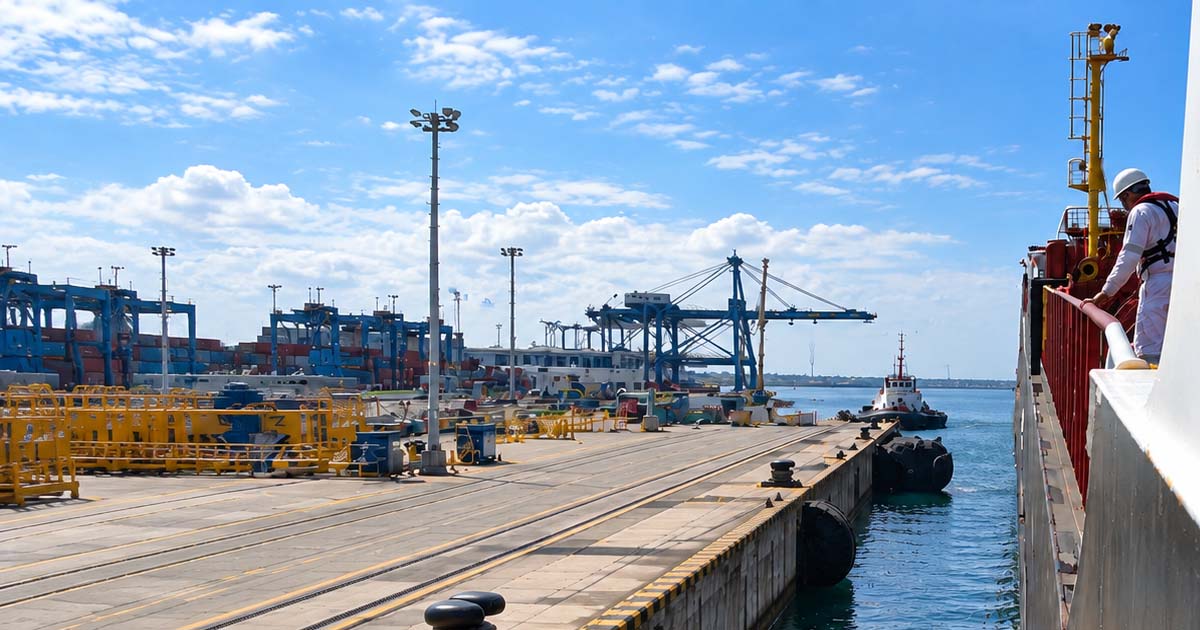
Checking the ship’s side is a normal part of mooring operations.
The officer in charge needs to monitor the mooring lines, the ship’s position, and its distance from the berth.
But looking over the side becomes dangerous when a line is trapped or under heavy tension.
In this guide, we’ll show you what precautions to take, how to recognize a trapped line, and what we learned from a near miss aboard a tanker.
✅ Key Takeaway: You may need to look over the ship’s side during mooring to monitor the lines and the ship’s position. Before doing so, check for trapped or heavily tensioned ropes and avoid their possible path. If a line appears stuck between the hull and a fender, keep clear and report it. A sudden release can cause serious injury.
🚢 Is It Safe to Look Over the Ship’s Side During Mooring?
Looking over the ship’s side is sometimes necessary during mooring, but you must assess the hazards before doing so.
The officer in charge needs to observe what is happening alongside the vessel.
This includes checking:
- Whether the mooring lines are running clear of obstructions.
- Whether a line appears caught against the ship’s side.
- How close the ship is to the berth or jetty.
- Whether the vessel is moving into its intended position.
These observations help the officer understand what is happening at the mooring station. For the wider sequence of shipboard mooring work, see our Ultimate Guide to Mooring Operations.
However, there is a difference between observing the ship’s side and leaning into the path of a potentially dangerous rope.
Before checking over the side, consider the position of the lines and whether they could move toward you.
If you suspect that a line is trapped, do not lean over it for a closer look.
⚠️ Warning: A mooring line does not have to be moving to present a danger. A trapped rope can suddenly release while carrying considerable tension.
⚓ How Can a Mooring Line Get Stuck on the Ship’s Side?
A mooring line can become trapped between the ship’s hull and a terminal fender while the vessel is being positioned alongside.
Consider a tanker approaching its final position at a jetty.
The crew is working on the spring lines to align the ship’s cargo manifold with the shore manifold.
As the vessel moves, a spring line becomes caught between the hull and the fender.
The trapped section cannot move freely, even though the line may appear to be holding normally.
If tension increases, the rope stores more energy.
When the obstruction releases the line, that energy can make the rope move violently.
Depending on the direction of the load and the obstruction, the line may jump upward toward the deck edge.
🧠 Release under tension: A sudden movement that occurs when a trapped or restrained mooring line becomes free while carrying a load.
📌 Note: You cannot reliably determine the tension in a trapped line simply by looking at whether it is moving.
👀 What Precautions Should You Take When Checking the Ship’s Side?
The officer in charge should first assess the mooring lines and surrounding area before looking over the ship’s side.
Use these precautions:
- Observe the lines from a safer position first. Check whether they appear to be running freely toward the shore.
- Look for possible obstructions. Pay attention to lines passing near the hull, fenders, or other structures.
- Consider the ship’s movement. A change in the vessel’s position can affect the load on the lines.
- Keep your body clear of the possible rope path. Avoid leaning farther over the side than necessary.
- Stop if something looks wrong. If a rope appears trapped or behaves unexpectedly, move clear and inform the officer in charge or bridge.
When the line’s condition is uncertain, do not take a closer look by putting your head into a potentially dangerous position.
Use a safer observation point where possible. If the condition still cannot be confirmed, report the uncertainty rather than taking an unnecessary risk.
The objective is not to avoid every observation over the ship’s side. It is to make those observations without exposing yourself to a foreseeable line movement.
⚠️ What Should You Do If a Mooring Line Gets Stuck?
When a mooring line appears trapped against the ship’s side, keep clear and coordinate the next action with the officer in charge and bridge.
Follow these steps:
- Keep clear of the suspected trapped line. Do not lean over the ship’s side to investigate it.
- Warn nearby crew. Make sure nobody approaches the possible path of the rope.
- Inform the officer in charge. Identify the affected line and its suspected location.
- Notify the bridge. Report the situation before further adjustments are made.
- Wait for instructions. Do not attempt to pull, heave, or free the line on your own.
- Coordinate for safety. The officer in charge and bridge must coordinate any necessary adjustment before work continues.
Do not try to release the line by hand or with improvised equipment. Freeing the line may involve slacking the aft breast lines and heaving up the forward breasts.
📌 Note: Clear communication helps the bridge and mooring station coordinate their actions. For standard reporting and responses, see our guide to mooring commands and responses over ship radio.
💬 A Spring Line Near Miss in Sines, Portugal
In 2020, I was aboard a tanker berthing at the port of Sines, Portugal.
We were working on the spring lines to position the vessel alongside and align our ship’s manifold with the shore manifold.
The Second Officer was in charge of the aft mooring station.
During the operation, one of our spring lines became trapped between the ship’s side and the terminal fender.
We thought both spring lines were holding.
The officer leaned over to look at the lines along the ship’s side.
Suddenly, the trapped spring line released and bounced upward with tremendous force.
It struck the edge of his safety helmet.
The impact sent his helmet flying onto the deck. The officer also moved backward, apparently from his reflex reaction.
Fortunately, nobody was injured.
But it was a very close call.
If the rope had struck his chin, face, or head instead of the helmet’s edge, the result could have been a serious injury.
That incident showed me how dangerous a trapped mooring line can be, even when everything appears normal.
❌ Common Mistakes During Mooring Line Inspection
1. Leaning over the ship’s side without checking the line’s condition
Before looking, assess whether the rope could be trapped or move toward your position.
2. Assuming a stationary line has no tension
The rope may be unable to move because an obstruction is holding it.
3. Continuing to heave a line that appears stuck
Stop unsafe handling and report the problem before making further adjustments.
4. Allowing another crew member to approach the same danger
Warn your crewmates immediately when you notice an unsafe position.
5. Relying on your PPE as the main protection
Personal protective equipment does not make a dangerous position safe.
📝 Summary: Checking the Ship’s Side Safely
| Situation | Recommended action |
| Routine observation during mooring | Assess the area and use a safe observation position |
| Line appears trapped near a fender | Keep clear and report it |
| Sudden or unusual line movement | Warn nearby crew |
| Crew member approaching a dangerous position | Stop and warn them |
| Line requires adjustment | Wait for coordinated instructions |
❓ Frequently Asked Questions
Can you look over the ship’s side during mooring?
Yes. Officers sometimes need to check the mooring lines, the ship’s position, and the distance from the berth. The precaution is to assess the lines first and avoid exposing yourself to their possible movement.
Can a mooring line suddenly jump upward?
Yes. A mooring line trapped against the hull or fender can move upward violently when the obstruction releases it under tension.
What if you cannot see whether a mooring line is caught?
Try to observe from a safer position. If you still cannot determine its condition, report the uncertainty to the officer in charge rather than leaning into a dangerous area.
Can a safety helmet protect you from a moving mooring line?
A helmet may reduce injury from some impacts, but it cannot reliably protect against the force of a loaded mooring line. In the Sines near miss, the helmet was struck, but the outcome could have been much worse.
Is this the same as a snap-back accident?
Not exactly. The Sines incident involved a trapped line suddenly releasing upward. A line that parts under tension can create other dangerous movements.
🧭 Final Thoughts
Checking the ship’s side is part of the officer’s job during mooring. The goal is to make those observations without exposing yourself or your crewmates to unnecessary danger.
Experience helps you recognize when an ordinary observation could become a serious risk.
✅ Assess the line’s condition before looking over the side.
✅ Keep clear when a line appears trapped or its movement is uncertain.
✅ Speak up when another crew member is approaching a dangerous position.
Have you encountered a mooring line trapped against the ship’s side? Share what happened and how your crew handled it in the comments.
May the winds be in your favor.
Leave a Reply