


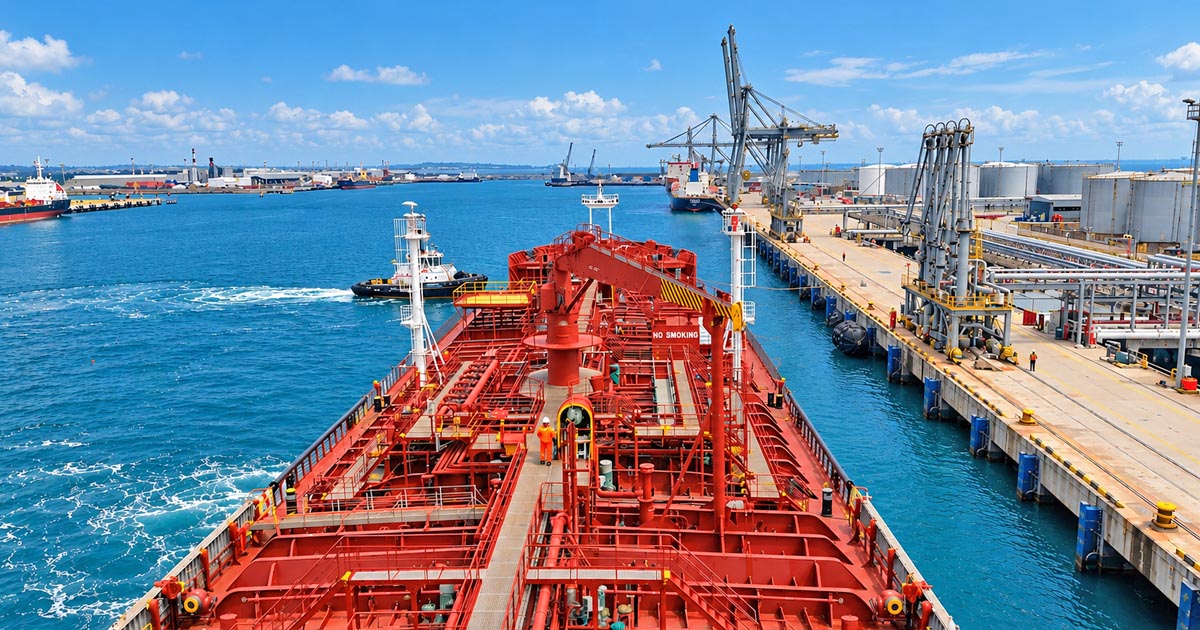
Engine movements can change the tension on mooring lines during mooring operations, especially while a ship is coming alongside.
A rope may tighten, become thinner, or produce unusual sounds as the ship moves.
Experienced deck crew watch and listen for these changes while following orders from the bridge.
In this guide, we’ll show you how engine movements affect mooring lines, what warning signs to recognize, and how to stay alert during berthing.
🚢 How Do Engine Movements Affect Mooring Lines?
Engine movements affect mooring lines by changing the forces acting on the ship while it maneuvers alongside the berth.
During berthing, the master (captain) may order the engine ahead or astern to adjust the ship’s position.
If mooring lines are already connected ashore, the resulting movement can increase or reduce their tension.
🧠 Engine order: An instruction to operate the ship’s propulsion system. During berthing, a short application of ahead or astern power is often called a kick ahead or kick astern.
The effect depends on the ship’s movement and which lines are restraining it.
For example:
- Kick ahead: The ship may begin moving forward, increasing tension on forward spring lines and stern lines resisting that movement.
- Kick astern: The ship may begin moving backward, increasing tension on aft springs lines and head lines resisting that movement..
- Ship stops moving: The lines may still carry considerable tension even when movement is no longer visible.
📌 Note: An engine order does not automatically mean every mooring line becomes tighter. The actual load depends on the ship’s movement, line direction, and other forces acting on the vessel.
👂 What Should You Listen For During Mooring?
During mooring, experienced seafarers listen for changes in rope sounds, winch noises, and the ship’s movement.
A line under increasing tension may give warning signs before the crew can clearly see what is happening.
Such observations include the following:
1. Unusual sounds from mooring ropes
A heavily loaded rope may produce unusual sounds as its fibers and structure react to tension.
These sounds should make you more alert, especially when the ship is still moving.
However, a rope can also fail without giving an audible warning.
2. Loud groaning sound from the mooring winch
A mooring winch brake renders when the load exceeds its set brake holding capacity.
🧠 Brake rendering: The mooring winch drum turns and pays out rope despite the brake being applied.
📌 Rule behind it: IMO’s MSC.1/Circ.1619, which SOLAS II-1/3-8 applies to new ships, says a mooring winch’s brake holding capacity should be less than 100% of the ship design minimum breaking load. The brake rendering load should also be reliably settable. In practice, the brake is meant to render before the line is loaded to its design limit.
In my experience, a mooring line under heavy tension creates a loud groaning sound even before the brake renders.
⚠️ Warning: A loud noise from the winch is not something to ignore. Report unexpected brake movement to the officer in charge. Do not approach the loaded equipment to investigate while it remains under tension.
3. Changes in the ship’s movement
The ship’s movement is another warning sign.
A vessel may appear to move only slightly, but its mooring lines can experience significant changes in load especially if the lines are secured.
Watch the ship’s position relative to the berth from a safe location. If you need to look over the ship’s side, first read our guide on checking the ship’s side during mooring, because a line trapped between the hull and a fender can release suddenly.
Do not rely on sound alone to judge whether the lines are safe.
4. Vibrations from the ship’s engines
When the captain puts the engines ahead or astern, you can usually feel the ship’s vibration change. It’s noticeable at the forward station and stronger aft.
Astern is more pronounced than ahead, whether the ship has a controllable pitch or a fixed pitch propeller.
Keep this in mind during every maneuver. If you have no radio, the vibration tells you what the engines are doing.
🔍 What Does a Mooring Rope Look Like Under Heavy Tension?
A mooring rope under heavy tension may visibly change shape as the load increases.
Watch out for these observations from my deck experience.
The rope becomes thinner.
A thick rope can appear noticeably narrower when stretched under heavy tension.
This change may indicate that the rope is carrying a considerable load.
Water comes out of the rope.
When a wet rope tightens, water trapped within its structure may be squeezed out.
You may see water coming from the rope as tension increases.
The rope becomes as hard as steel.
A mooring rope under heavy tension becomes as hard as rock.
It straightens like a bar, you can’t press or bend it, and it looks thin with the strands stretched tight.
If something knocks against it, the rope bounces back with a sharp twang, like a guitar string, and the vibration runs along its length.
None of these observations is a reliable measure of line tension or remaining breaking strength. Since 1 January 2024, SOLAS II-1/3-8 requires mooring equipment, including lines, to be inspected and maintained, with MSC.1/Circ.1620 as the guideline. Judging a rope’s condition is the job of that routine, not of watching it under load.
⚠️ Warning: Never approach a loaded rope to check whether it has become thinner or is releasing water. Observe only from a safe position.
📻 Why Should You Listen to the Bridge Radio During Mooring?
The bridge radio gives the mooring station advanced information about maneuvers that may affect line tension.
Such maneuvers may be done to position the ship along the berth.
When the master announces a kick ahead or kick astern, the deck crew can prepare for a possible change in load.
The officer in charge should listen carefully and keep the station informed.
A practical sequence is:
- Listen: Hear the engine movement announced by the bridge.
- Anticipate: Identify which lines may experience increased tension.
- Observe: Watch the ship’s movement and the condition of the lines from a safe position.
- Communicate: Report unusual sounds, unexpected movement, or other unsafe conditions.
- Respond: Follow the officer in charge and bridge instructions.
The aim is not to predict every movement perfectly. It is to avoid being surprised when the ship moves.
For the exact phrases used between the bridge and the mooring stations, see our guide to mooring commands and responses over ship radio.
🧠 What Experienced Hands Keep Watching
- The engines: Every engine order shifts the ship, and lines already fast ashore take the new load.
- The rope, not just the winch: Thinning, water squeezing out, and a rock-hard feel all say the line is heavily loaded.
- The ship’s movement: A slack line can come tight in seconds.
- The radio: If you miss the bridge’s instructions, you won’t know what maneuver is coming.
- Your position: Treat the whole mooring deck as a snap-back danger area, even when a line looks slack.
This follows the UK Code of Safe Working Practices for Merchant Seafarers, which says the whole mooring deck may be considered a danger zone, and IMO’s MSC.1/Circ.1620. The danger area changes with the mooring pattern, so a painted line on deck can give a false sense of safety.
A responsible and well experienced seafarer, whether an officer or ratings, normally warns their crewmates nearby whenever he observes these situations unfolding.
📝 Summary: Warning Signs During Mooring
| What you notice | What it may indicate | What to do |
| Kick ahead or astern announced | Ship movement may change line tension | Stay alert, observe, and keep clear. |
| Rope becomes thinner | Rope is stretching under load | Keep clear |
| Water squeezed from rope | Wet rope is tightening | Observe from a safe position |
| Loud groaning at winch | Possible brake rendering | Report immediately |
| Ship moving against secured lines | Changing load on the mooring arrangement | Monitor and inform the officer in charge |
❓ FAQ
Can a mooring line break without making a warning sound?
Yes. A mooring line may fail suddenly without any noticeable sound beforehand. Never use noise as your only indication of danger.
Does kick ahead always tighten the stern lines?
No. The effect depends on the direction of the lines and how the ship actually moves. Other forces may also influence the load.
Why does water come out of a mooring rope under tension?
Water trapped within a wet rope can be squeezed out as the rope stretches and its structure compresses. This does not tell you how close the rope is to breaking.
Can a mooring winch brake render even when applied?
Yes. A brake may render under excessive load. Unexpected drum movement should be reported and handled according to the ship’s procedures.
Should the crew adjust a mooring line whenever the engine moves?
No. An engine movement is a reason to pay attention, not permission to operate the winch. The crew should act only under the officer in charge’s instructions.
🧭 Final Thoughts
Good mooring awareness comes from paying attention to the ship, the equipment, and the people working around you. Sound and visible movement provide useful information, but they cannot replace safe positioning and clear communication.
- ✅ Keep your attention on the operation, not just your assigned equipment.
- ✅ Warn crewmates when you notice something unsafe.
- ✅ Report unexpected changes before they develop into a bigger problem.
Have you heard a mooring winch brake render or noticed a rope changing shape under tension? Share your experience in the comments.
May the winds be in your favor.
Leave a Reply