

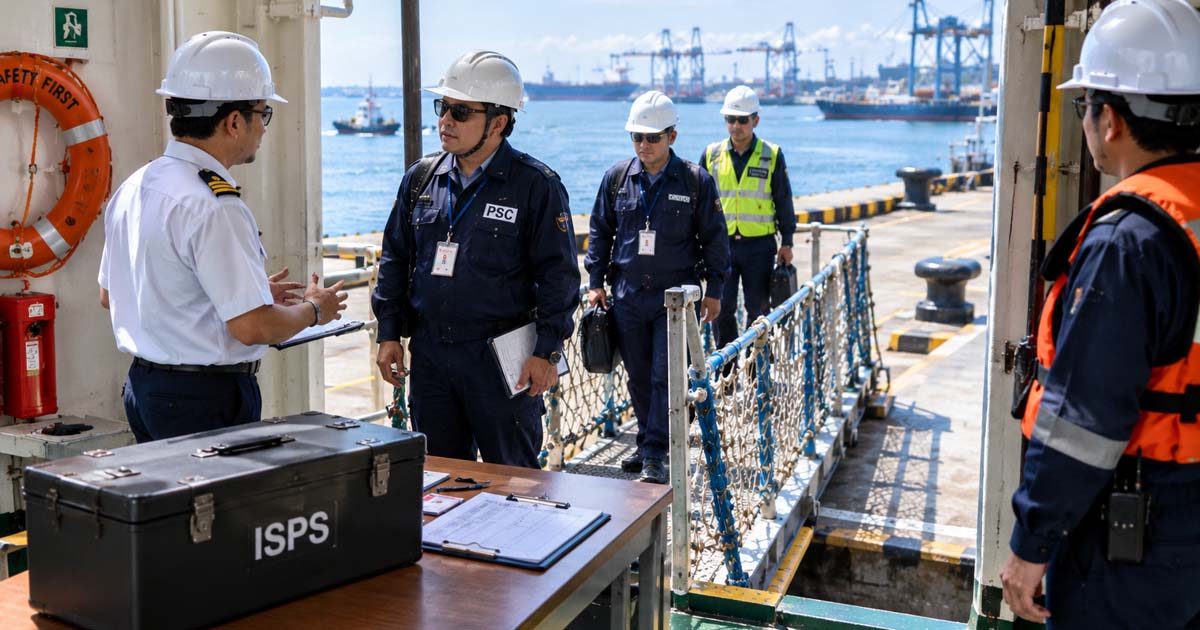
The gangway watchman is the vessel’s first line of defense and primary point of contact.
While standard visitors like agents or loading masters usually board directly to conduct routine business, handling vetting inspectors, Port State Control (PSC) officers, and unannounced technicians demands heightened vigilance.
How a watchman handles these visitors sets the tone for port inspections and directly protects the ship from ISPS security lapses and observations.
Here’s how an experienced and responsible gangway watch manages visitors even before they board the ship.
1. Recognize Who Is Approaching
Not all visitors act the same way while approaching.
Agents, loading masters, and surveyors typically walk straight to the gangway to start their business. Inspectors behave differently.
Watch for these pier-side patterns:
- Hull inspection: walking the length of the ship to check for rust streaks, deformation, or an oil sheen along the waterline
- Draft check: looking aft or forward to read the draft marks
- Anchor check: pausing near the bow to inspect the anchor and hawsepipe
- Scupper check: looking for water discharge that may indicate loose scupper plugs
- Accommodation ladder: inspecting if the accommodation ladder or gangway is safe and follows safety arrangements.
If you observe this behavior, contact the CCR or officer of the watch (OOW) before the person boards:
“Chief, I think this is the inspector — he’s not on board yet, but he’s checking the hull from the pier. Please have someone ready to escort him if he’s the one we’re expecting.”
If no inspection was scheduled, report it anyway:
“Chief, are we expecting any PSC, vetting, or internal inspection today? There’s a man on the pier who’s checking our hull, propeller, mooring lines, and draft.
This gives the bridge team lead time to inform the galley and engine room and assign an escort before the inspector even reaches the gangway.
Important: As a gangway watch, inspectors may ask you questions about safety and your role during emergencies. Be prepared to answer this.
2. Identify and Verify
Every visitor — regardless of role — follows the same verification sequence once they reach the gangway:
- Greet and ask for a name. A simple “Good morning, sir. May I know your name and purpose of visit?” sets a professional, non-confrontational tone.
- Ask for designation and ID. Confirm whether they are an agent, surveyor, loading master, or inspector.
- Cross-check against the visitor list. The ship’s officers typically issue a list of expected visitors with names and designations; this is your primary tool for filtering out impostors.
- Inspect the ID carefully. Compare the photo to the visitor’s face and the printed name to the visitor list. Take the time this requires as rushing this step defeats its purpose.
- Complete the logbook yourself. The watchman, not the visitor — writes the name (matching ID spelling exactly), issues a ship’s ID tag, and records the time in. The visitor then signs.
- Issue safety equipment as required. On tankers, this includes a personal gas detector in addition to a helmet, per the vessel’s Safety Management System (SMS).
Important: From my experience, an inspector was allowed to write his name in the visitor’s logbook. He wrote “MICKY MOUSE.” The watchman saw it but still allowed the inspector to board. The ship received an observation after that.
Visitor Verification Reference
Escort requirements also depend on the ship’s MARSEC Level.
At Security Level 1, not every visitor necessarily requires an escort, depending on the ship’s security procedures.
At Security Level 2 and above, additional security measures include escorting visitors.
| Visitor Type | Typical Behavior | Escort Required? | Notes |
| Agent / Loading Master | Walks directly to gangway | No (point the way) | Routine business visitor |
| PSC / Vetting Inspector | Checks hull, draft, anchor from pier | Yes (SOP) | High reputational stakes |
| Surveyor / Cargo Sampler | Direct approach, carries equipment | Usually no | Confirm designation on list |
| Immigration / Police | Uniformed, may arrive in groups | Varies by port | Some ports bypass standard logging — see note below |
| Unexpected / Unlisted Visitor | Claims a role not on the list | Hold at gangway | Verify with OOW before allowing access |
⚓ Regional note: In some jurisdictions, uniformed immigration or police officers do not consistently follow standard ID-and-logbook procedures — a pattern observed on multiple port calls. Where this occurs, rigid enforcement can trigger a more adversarial inspection.
3. Notify the CCR or Officer of the Watch
After verification, notify the appropriate ship’s officer.
For example:
“CCR, Port State Control inspector on board.”
Or:
“CCR, loading master on board.”
For an inspector, the notification is particularly important because the Master, Chief Officer, or another designated officer may need to meet and escort the inspector.
4. What If the Visitor Is Not on the List?
If someone arrives claiming a role — a technician, for example — that isn’t on the expected visitor list:
- Hold the person at the gangway.
- Call the OOW to confirm whether the company arranged for this visit.
- Ask low-key screening questions while waiting: “Where are you traveling from? Did you get enough rest before coming here? Do you have another assignment after this ship?” This gathers useful information without appearing confrontational.
- Wait for the officer’s decision.
In some cases the visitor is allowed to wait in the coffee room while the captain verifies with the agent or company.
In others, particularly at ports with a history of impersonation attempts, the officer may instruct the watchman not to allow boarding at all as part of the ISPS Code.
5. Escort the Visitor Without Abandoning the Gangway
Where a dedicated escort isn’t immediately available for non-inspector visitors, the watchman may direct them verbally along the marked walkway — while staying near the gangway.
If a visitor strays from the marked path (away from mooring lines, snapback zones, and cargo operations), call out and redirect them immediately to the proper route.
Important: For inspectors and vetting personnel, an escort is standard operating procedure per the ship’s SMS, since these visits carry higher documentation and safety stakes.
6. Monitor the Visitor’s Movement
Once a visitor is authorized aboard, the watchman should remain aware of where that person is supposed to go.
Visitors should not casually enter restricted areas or take unauthorized routes.
This becomes particularly important when the ship is conducting cargo operations or when areas of the deck present specific hazards.
The gangway watchman is still responsible for the access point, so the visitor’s movement should be monitored without abandoning the gangway.
7. Handle Departure Properly
When the CCR advises that a visitor is leaving, the watchman monitors the accommodation exit, confirms the visitor follows the marked safe route, then:
- Collects the ship’s ID tag
- Retrieves any issued gas detector or helmet
- Logs the departure time
If a visitor doesn’t appear within a reasonable time after notification, follow up with the OOW rather than assuming they’ve already left.
The visitor log is an important security record.
Procedures commonly require people to be recorded both when boarding and when leaving the vessel.
❓ FAQ
What should a gangway watchman do if an inspector arrives without prior notice?
Hold the visitor at the gangway, verify ID against the visitor list, and notify the OOW or CCR immediately. Do not allow boarding until the visit is confirmed.
Why is pier-side behavior a useful signal for identifying inspectors?
Inspectors may visually check the hull, draft, and anchor before boarding — a pattern distinct from agents or loading masters, who typically walk directly to the gangway. It’s an early-warning heuristic, not formal identification.
Who writes the visitor’s name in the logbook — the visitor or the watchman?
The watchman records the name, following the spelling on the presented ID, then has the visitor sign.
What If the Visitor’s Face Does Not Match His ID?
If the visitor’s face does not match the photograph on his ID, or his ID is blurry, simply ask him for another ID. If he really has no other ID, politely keep the visitor on hold, call the OOW, inform him of the situation, and wait for his advice.
What if a visitor forces his entry to the ship?
If an unlisted visitor forces his way onto the ship, immediately inform the OOW. The OOW may send additional crew to respond while the person is still on deck. The Captain or Chief Officer may also contact port security and inform them of the security breach. Port security may then send security personnel to deal with the situation.
What’s your best and worst experience as a gangway watchman?
May the winds be in your favor.
Leave a Reply