

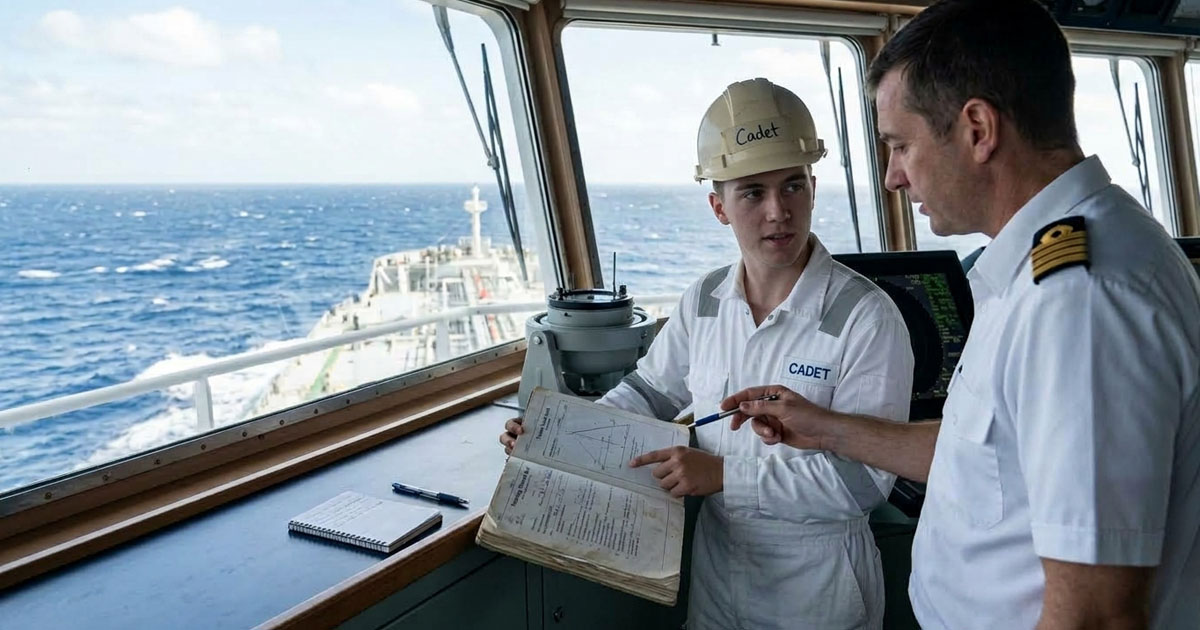
Your first ship is where classroom knowledge starts becoming practical competence. It is also where many cadets develop habits that can either help or hurt their future careers.
Some mistakes are obvious, such as ignoring PPE or keeping a poor Training Record Book (TRB). Others are less obvious, such as pretending to understand an instruction, waiting for someone to tell you what to do, or learning only the officer’s job.
The following 24 mistakes cover the learning, training, safety and practical experiences that can make a major difference during a cadetship.
Learning and Communication
1. Being Afraid to Ask Questions
Some cadets are afraid to ask questions because they think an officer will assume they are stupid or unprepared. The officer asks the whole crew for questions during the drill.
You don’t know something but are afraid of being mocked or laughed at in front of the whole crew so you keep quiet. You slowly build this habit and know less and less about important things!
Ask when you genuinely do not know something. Even if you are truly laughed at, you get to know something that you wouldn’t forget.
2. Asking Questions They Should Already Know
The opposite problem also exists. A cadet who repeatedly asks very basic questions that should already be covered by their school training can give the impression that they are not retaining fundamental knowledge.
The goal is not to avoid questions. It is to build on what you already know. Ask questions that connect your basic knowledge to actual shipboard situations.
3. Pretending to Understand
Saying “Yes, I know” when you do not actually understand is one of the most dangerous habits a cadet can develop.
If an officer gives you an instruction, repeat it in your own words when appropriate. Clarify equipment, locations, or procedures you are unsure about.
For example, if you are told to take bearings using a pelorus and are unsure which equipment is being referred to, clarify before starting.
Understanding an instruction is more important than looking knowledgeable.
4. Waiting to Be Told What to Do
A cadet should follow instructions, but that does not mean standing around until someone provides every next step.
If you see an appropriate task that you have already been trained to perform, you can ask whether you may take it on.
For example, if an officer is busy during navigation and you have previously been trained to take a fix, offer to assist under supervision.
Initiative does not mean acting without permission. It means being observant, prepared and willing to contribute.
5. Thinking School Knowledge Is Enough
Maritime school gives you the foundation, but shipboard work requires you to connect that knowledge with real equipment, procedures, and situations.
Knowing the theory of navigation, cargo work, or safety equipment is different from applying it on a working vessel.
Treat every operation as an opportunity to understand how classroom knowledge works in practice.
6. Poor Communication in English
International ships often have multinational crews, making clear communication essential. A cadet should not assume that others understand an unclear explanation.
Practice explaining what you mean in simple, precise English. Confirm important instructions rather than relying on assumptions.
Maritime communication is not about sounding sophisticated. It is about making sure the other person understands you.
I met a lot of cadets who hide when the Chief Mate or Captain is around, not because they don’t know anything, but because they can’t explain it very well in English, though they certainly can in their native language.
Training and Career Development
7. Leaving the Training Record Book Until the End of Contract
A TRB is not paperwork to complete during the final weeks of your contract. It records practical training and progress toward completing an approved onboard training programme. IMO guidance describes the record book as a way to document practical training and experience at sea.
Work on it throughout the contract. Keep track of completed tasks, identify gaps and approach the appropriate officer while there is still time to obtain the required training and assessment.
Cadets often neglect this until days before their disembarkation which is not a good practice since the officers may not be available for Q & A and signatures due to busy schedules.
8. Chasing Signatures Instead of Learning
A signature should document training that actually happened. It should not be the objective of the training.
If you focus only on getting an officer to sign a task, you can finish the TRB without developing the competence the task was intended to build.
Understand the procedure, perform it properly under supervision and then have your progress documented.
9. Waiting Until Promotion to Learn the Next Rank’s Job
Some cadets think they will learn an officer’s responsibilities after they are promoted. That is a poor approach to professional development.
As a cadet, you should seek supervised exposure to the duties you will eventually be expected to perform.
You are not there to assume an officer’s responsibilities prematurely, but you should use your training period to understand what those responsibilities involve.
Understanding what a deck cadet actually does and how the role develops into an officer position can also help you identify which skills you should be building during your cadetship.
See our guide to what a deck cadet does and how much he earns.
10. Learning Only the Officer’s Job
Becoming an officer does not make the practical work of ratings irrelevant.
A future officer who understands how an AB, bosun or other rating actually performs a job is better positioned to give realistic instructions and recognize whether work is being carried out properly.
Learn practical seamanship as well as bridge duties.
If you are still deciding which side of the shipboard career you want to pursue, understanding the differences between deck and engine officer work can also help you make better use of your training opportunities.
11. Failing to Seek Training Opportunities
Cadets sometimes assume that officers will automatically expose them to everything they need to learn. In reality, you also need to communicate what you want to learn.
Ask to accompany an officer on appropriate safety rounds. Ask to observe maintenance or inspections. Volunteer to participate in drills and demonstrations when appropriate. Try to be the squad leader of Squad 1 during a drill.
IMO guidance emphasizes that onboard training should be planned, structured and supervised, rather than treated as an accidental by-product of sea service.
12. Being Afraid to Explain or Teach
One of the best ways to discover whether you actually understand something is to explain it.
If an officer gives you the opportunity to explain how to use safety equipment, participate in a demonstration or teach another crew member under supervision, take it seriously.
Explaining and performing the donning of breathing apparatus, for example, forces you to organize the knowledge in your own mind.
Teaching does not replace supervised training. It strengthens it especially if the crew asks real questions after your demo.
Safety and Professional Discipline
13. Neglecting Your Rest Hours
Being eager to learn can become counterproductive if you constantly sacrifice rest to prove that you are hardworking.
The Maritime Labour Convention requires minimum rest periods of 10 hours in any 24-hour period and 77 hours in any seven-day period, subject to its applicable provisions. The standards also recognize the safety risks associated with fatigue.
Your goal is not to see how long you can stay awake. A rested cadet is more capable of learning, following instructions and working safely.
14. Tolerating Unsafe Practices Because Everyone Else Does It
Seeing experienced crew members take shortcuts can make unsafe behavior look normal.
That does not make it safe. If crewmembers are crossing over tensioned mooring ropes even though the SMS says it’s dangerous, don’t follow it.
A cadet should develop the habit of following the vessel’s safety procedures rather than copying unsafe behavior simply because others are doing it.
15. Failing to Report Unsafe Acts or Conditions Because Your Crew Friend Did It
Ignoring a hazard does not make it disappear.
Maybe you discovered your crewmate friend did something unsafe. An unsafe condition that goes unreported can be repeated until somebody is injured or an incident occurs.
Use the vessel’s established reporting system and inform the appropriate officer when you identify a genuine safety concern. The objective should be preventing recurrence.
16. Naming the Crew Member in a Near Miss or Non-conformity Report
You see a crewmate in a near-miss situation or not wearing the right PPE.
Whether he’s a friend, an engineer or an officer, you go straight to the chief officer with, “AB Smith did this.” Reporting it was right. Naming him is where it goes wrong.
A lot of companies want a no-blame reporting culture, and many set up anonymous hazard or near-miss forms for it.
Crew report more when they don’t fear retaliation, and a named report can turn a hazard into an accusation.
Write it around the act: “A crew member stepped over a tensioned mooring line during a mooring rounds check.”
Leave out who.
But if someone is in danger right now, speak up and stop the job first. The form is for after that.
17. Staying Silent About Bullying or Harassment
A cadet may hesitate to report bullying because they are afraid of making the situation worse or being labeled as difficult.
Do not simply accept serious harassment in silence.
Keep appropriate records of incidents and raise the matter through the vessel’s designated reporting channels.
If the immediate person you would normally approach is involved, use another appropriate onboard or company channel. You can even talk to another trusted crew and share this matter to get something out of your chest.
Your safety and wellbeing matter too.
18. Using Incorrect or Inadequate PPE
PPE is not optional simply because other people are working without it.
If your required equipment is damaged, missing or unsuitable, report it and obtain the correct replacement. Do not improvise with inadequate protection simply to avoid delaying the job.
Develop the habit of checking the hazards, required PPE and condition of your equipment before starting work.
Building Practical Experience
19. Failing to Keep a Learning Notebook
A cadet can see dozens of unfamiliar pieces of equipment, procedures and situations in a single day. Relying on memory means many of those observations will disappear.
Carry a small notebook and record things you want to understand later: equipment names, unfamiliar operations, questions, observations and lessons from near misses or unusual situations.
You do not need to interrupt a busy operation to ask every question immediately. Record it and ask when the situation allows.
20. Failing to Preserve What You Learn
A small notebook is useful, but it can also be lost, damaged by rain or spray, or simply become unreadable after months of shipboard use.
Transfer important lessons into a more permanent master notebook or personal knowledge system. Add explanations, sketches, calculations and diagrams when useful.
This turns individual shipboard experiences into knowledge you can carry to your next vessel.
21. Hiding From Work After You Learn It
Once a cadet learns how to perform a task, it can be tempting to avoid it the next time it comes around.
I saw many cadets eager to learn the job of a third officer during the first few months. As soon as they know how to do it, they try to avoid offering help to the officer they once asked for guidance.
That wastes an opportunity.
Repetition develops speed, judgment, and confidence. If an officer or rating has taught you something, continue participating when you are needed and when the task is appropriate for your training and level of supervision.
22. Not Learning From the Unlicensed Crew
Cadets sometimes spend most of their time around officers because they want to become officers themselves.
That can cause them to miss a huge amount of practical knowledge. Bosuns, ABs and other ratings often have years of experience with mooring, maintenance, cargo-related work, equipment and practical seamanship.
Learn from them. Understanding their work will also help you become a more effective officer later.
For example, understanding the difference between the duties and responsibilities of an Ordinary Seaman and an Able Seaman can give a cadet a better appreciation of the practical experience within the deck department.
23. Keeping Yourself Isolated From the Crew
A cadet does not need to become friends with everyone onboard, but maintaining respectful working relationships matters.
Talk to people outside your immediate department when appropriate. You can learn different techniques, experiences, and perspectives from people with different ranks and backgrounds.
Those relationships can also continue after the contract. Maritime careers are built across ships, companies and countries, and former crewmates can remain part of your professional network.
Professional relationships can also matter when you are looking for your next opportunity.
Recommendations and promotion-related documentation can become part of a seafarer’s career progression, so maintaining good professional relationships after your contract can have practical value.
See our guide to seafarer promotion letters and recommendations
24. Neglecting Personal and Cabin Hygiene
Your cabin is your responsibility. Leaving it dirty, disorganized or unhygienic creates an unnecessary problem, particularly when inspections occur.
Personal hygiene also matters in a shared living and working environment. Keep your cabin clean, take care of yourself and respect the people who live and work around you.
Professionalism onboard is not limited to navigation, cargo work or technical skills. It is also reflected in everyday habits.
Make Your First Ship a Real Learning Experience
Your first cadetship is more than sea time that you need to complete before becoming an officer.
It is an opportunity to develop the habits, practical knowledge and professional judgment that will stay with you throughout your career.
Do not be afraid to ask when you genuinely do not know. Do not pretend to understand when you do not. Keep your TRB current, protect your rest hours, follow safety procedures and learn from both officers and ratings.
Most importantly, take responsibility for your learning.
A cadet who finishes a contract with a completed record book has completed paperwork. A cadet who finishes with practical knowledge, better judgment and a deeper understanding of shipboard work has gained something much more valuable.
May the winds be in your favor.
Leave a Reply