


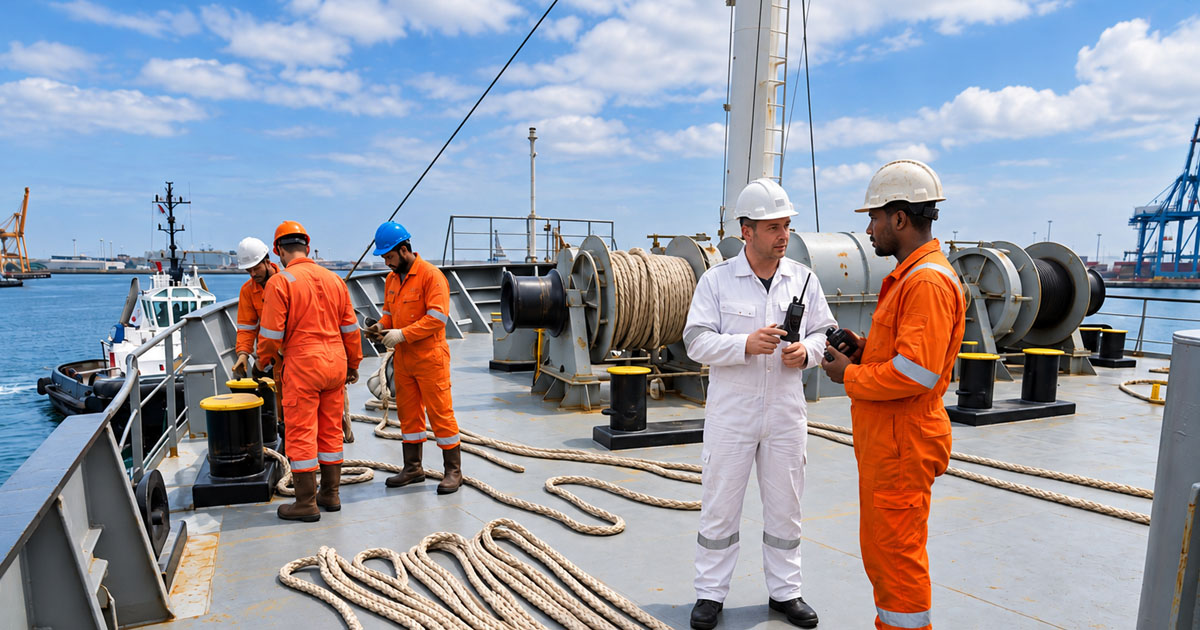
“Standby forward and aft” is a command from the bridge that sends the mooring crew to their assigned stations.
The forward station is at the bow. The aft station is at the stern.
Each team prepares for the upcoming mooring operation and waits for further instructions.
In this guide, we’ll show you what the command means, who reports to each station, what equipment to prepare, and what to confirm with the bridge.
🚢 What Does “Standby Forward and Aft” Mean on a Ship?
“Standby forward and aft” means the bridge wants the mooring teams at their assigned stations, ready for the upcoming operation.
The master (captain) usually gives this command as the ship approaches the berth.
🧠 Mooring station: The designated area where the crew operates mooring equipment and handles lines during berthing or unberthing.
There are two main stations:
- Forward station: Located at the bow, where the forward mooring team prepares.
- Aft station: Located at the stern, where the aft mooring team prepares.
The command does not mean you should immediately start sending lines ashore.
It means you must report to your station, prepare the equipment, and wait for further orders.
📌 Note: Crew members should already know their assigned mooring stations through the ship’s duty arrangements and pre-mooring briefing.
👷 Who Reports to the Forward and Aft Mooring Stations?
Each mooring station normally has an officer in charge and assigned deck crew.
In most of my experience, the duty officer is stationed aft while another officer is stationed forward which is usually the incoming or off duty officer depending on the the agreement or company policy
The station teams may include:
| Crew member | Main responsibility |
| Officer in charge | Supervises the station and communicates with the bridge |
| Boatswain (bosun) | Helps organize and direct deck crew |
| Pumpman | Assists with assigned mooring duties |
| Deck ratings | Prepare and operate equipment as instructed |
| Cadet | Assists under supervision |
| Additional crew | Helps when assigned and available |
The exact number of personnel depends on the ship’s manning and assigned duties.
Which officer goes forward and which goes aft?
The officer assignments depend on the vessel’s arrangements.
The officer on watch may be assigned to the aft station because he is closer to the bridge. Normally, he is relieved by the Chief Officer during the “fore and aft” call.
This also makes it easier for that officer to return to the bridge if needed.
The officer assigned forward would normally be the off duty officer or the incoming officer, depending on the time and if the agreement is according to the +2 -2 System.
However, this is not a universal assignment.
Plus Two – Minus Two System is a watch arrangement where the officer’s watch is extended two hours either before his duty or after his duty. For example, if maneuvering starts at 6 pm, the 8-12 watch will be called (8pm – 2 hours = 6 pm). If maneuvering is at 1:30pm, the 8-12 watch will still be called (12pm + 2 hours = 14:00 or 2 pm)
What about the watchman?
The watchman may initially be assigned to steering duties on the bridge.
Depending on the situation, the master may later send that crew member to assist with mooring aft.
Watchman may also follow the Plus 2 – Minus 2 System.
📻 How Many Radios Should a Mooring Station Have?
Each mooring station should have at least two working radios available with the second one serving as back up.
The officer in charge carries one radio, while another crew member carries the second.
A third radio is also useful when available but two may cause surprised feedback when one is using it close to the other.
Why prepare more than one?
- Backup: Another radio is available if the officer’s battery becomes low or the radio stops working.
- Communication: The officer can maintain contact with the bridge.
- Awareness: Other crew members can hear instructions and anticipate upcoming work.
For example, the boatswain or pumpman may carry the additional radio.
Before the operation, check that the radios are working and use the assigned communication channel.
⚠️ Warning: A failed radio can interrupt communication between the bridge and the mooring station. Report communication problems and restore reliable contact before continuing any task that requires bridge coordination.
📋 What Should You Confirm With the Bridge?
The mooring station should confirm the berthing side and mooring arrangement if the bridge has not already provided them.
These details help the crew understand what equipment and lines must be prepared.
1. Which side will be alongside?
The bridge should tell the station whether the ship will berth port side or starboard side alongside.
This is important so the crew can lay out enough length of the mooring ropes on the correct side.
If the information has not been given, ask before preparing the station.
2. What is the mooring arrangement?
The bridge should also provide the required mooring arrangement.
This tells the crew which lines will be needed, how many they will prepare, or if they need to take out loose ropes from the rope store..
The arrangement is expressed using numbers such as 3-2-2, 4-2, or 4-2-2.
3. Are there any changes to the plan?
The officer in charge should pay attention to updates from the bridge.
If an instruction is unclear, ask for confirmation rather than guessing.
Sometimes, what the bridge wants may not be practical per the jetty’s layout so you have to communicate this clearly to the bridge so they know how to compensate for it.
For example, a 3-2-2 forward and aft arrangement may not be feasible forward since the breast lines are extremely short. In that case a 4-3 arrangement could be agreed.
For the correct communication between the bridge and mooring stations, see our mooring commands and responses over ship radio.
⚙️ What Should the Crew Do After Reporting to the Mooring Station?
After reporting to the mooring station, the crew should prepare for the operation under the officer in charge.
A practical standby sequence is:
- Report to your assigned station. Make sure the officer in charge knows you are present.
- Confirm your duties. Know which equipment or task you have been assigned.
- Check communications. Prepare the station radios and confirm contact with the bridge.
- Confirm the berthing information. Check which side will be alongside and what arrangement is required.
- Prepare the equipment needed for mooring. Heaving lines, messenger lines, rope stoppers, hooks, winches and other tools should be ready to use.
- Lay out the ropes on deck with enough slack. This ensures you can easily send them to the mooring gang when they ask for it.
- Prepare for the next instruction. Remain attentive and avoid starting line-handling operations without authorization especially if it involves tug boats.
📌 Note: The officer in charge should make sure the station is ready and report any problem that could delay the operation such as mooring winch failing to start or having not enough crew on the station.
❌ Common Mistakes During Mooring Station Standby
- Going to the wrong station: Report only to your assigned position unless instructed otherwise.
- Preparing without knowing the berthing side: Confirm the information before arranging equipment.
- Relying on one radio: A dead battery or faulty unit may leave the station without a backup. The accommodation could be more than 100 meters away just to get batteries or spare radios.
- Assuming everyone knows their duties: The officer should confirm assignments before work begins.
- Starting operations too early: Standby is preparation, not permission to send lines.
📝 Summary: Standby Forward and Aft Checklist
| Check | What to confirm |
| Crew | Assigned personnel are at their stations |
| Supervision | An officer is in charge of each station |
| Radios | At least two working radios per station |
| Berthing side | Port or starboard side alongside |
| Mooring arrangement | Bridge instructions received |
| Readiness | Crew know their tasks and await orders |
❓ FAQ
Does “standby forward and aft” mean the ship is already alongside?
No. The command is commonly given before the ship reaches the berth. The crew must be ready when mooring work begins.
Does every crew member go to a mooring station?
No. Only personnel assigned to mooring duties report to the stations. Others may have responsibilities on the bridge or elsewhere.
Can a cadet be assigned to a mooring station?
Yes. A cadet may assist the team under supervision. The assigned officer determines which tasks the cadet can safely perform.
Can the bridge change the crew’s station assignments?
Yes. The master may adjust assignments according to operational needs. Crew members should follow the updated instructions.
What if a mooring station is not ready?
The officer in charge should inform the bridge about the problem. The bridge can then coordinate the next action before the affected work proceeds.
May the winds be in your favor.
Leave a Reply