


In today’s busy shipping lanes, thousands of ships cross congested waters, narrow straits, and high-risk areas every day.
To keep navigation safe and efficient, Vessel Traffic Services (VTS) play a vital role in monitoring, coordinating, and managing vessel movements.
For deck officers, cadets, and masters, understanding VTS operations is essential for complying with international regulations, maintain safe and efficient navigation, and avoiding costly mistakes at sea.
This guide explains what VTS is, why it exists, when participation is mandatory, and how it supports safer voyages for all seafarers worldwide. ⚓
📡 What is Vessel Traffic Service (VTS)?
Vessel Traffic Services (VTS) are shore-based systems established by coastal authorities to monitor and manage vessel movements within designated areas.
Think of VTS as the maritime equivalent of air traffic control, but for ships.
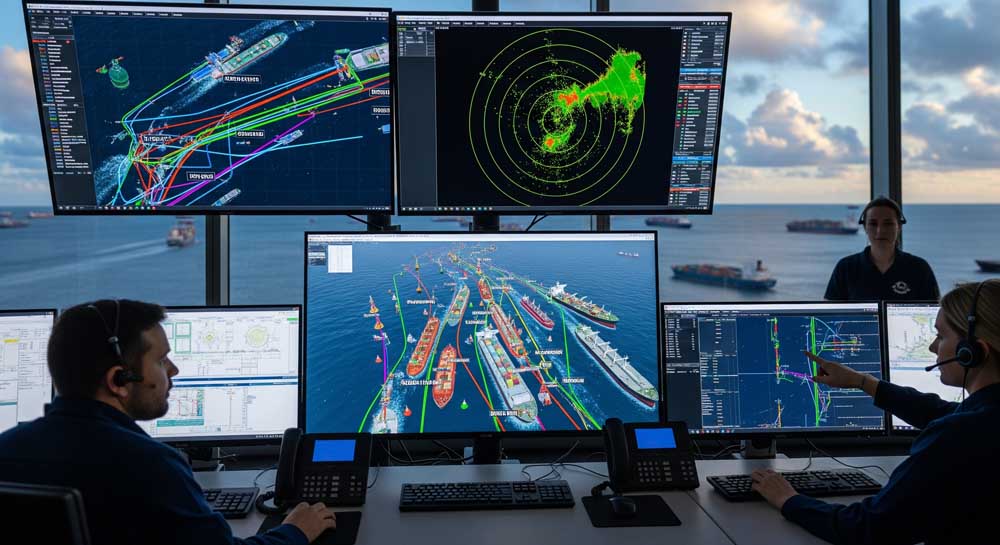
Using advanced technologies, VTS centers build a real-time traffic image to support navigational safety and coordinate vessel operations.
These technologies typically include:
- Radar – Detects vessel positions and movement
- Automatic Identification System (AIS) – Tracks ship identity and voyage data
- CCTV Surveillance – Monitors traffic at critical chokepoints
- VHF Radio Communication – Enables direct coordination with vessels
By combining these systems, VTS operators can provide timely updates, resolve conflicts, and guide ships safely through congested waters, ports, and high-risk zones.
🎯 Purpose & Functions of VTS
According to IMO Resolution A.1158(32), a VTS is defined as:
“A service implemented by a Government with the capability to interact with vessel traffic and respond to developing situations within a VTS area to improve safety and efficiency of navigation, contribute to the safety of life at sea, and support the protection of the environment.”
In simpler terms, VTS exists to keep ships safe, prevent accidents, and protect the marine environment.
Its core functions can be grouped into three key areas:
🛰️ 1. Provide Timely & Relevant Information
VTS supplies vital data to assist bridge teams in decision-making and voyage planning that may influence ship movements.
This may include:
- Position, identity, intention and movements of ships
- Maritime safety information and navigational warnings
- Traffic limitations, such as restricted maneuvrability of ships
- Local regulations and reporting formalities
- ISPS Code security requirements
- Coordination with allied services like pilotage and search-and-rescue
⚓ 2. Monitor & Manage Ship Traffic
VTS helps to ensure the safety and efficiency of ship movements by organizing traffic flow.
This includes:
- Planning ship movements in advance
- Organizing ships under way
- organizing space allocation
- Establishing a system of traffic clearances
- Establishing a system of voyage or passage plans
- Providing route advice
- Ensuring compliance with and enforcement of regulatory provisions.
🚨 3. Respond to Developing Unsafe Situations
When unexpected events occur, VTS provides guidance and emergency support.
Examples include:
- A vessel unsure of its route or position
- A ship deviating from the planned track
- A ship requiring guidance to an anchoring position
- Navigation equipment failure onboard
- Collision or grounding risks
- Severe meteorological conditions (e.g., poor visibility, strong winds)
- Support during emergency response operations
By actively managing these situations, VTS reduces risks and improves bridge resource management (BRM) for deck officers.
🗺️ Types of VTS and Their Roles
The International Association of Marine Aids to Navigation and Lighthouse Authorities (IALA) classifies VTS into three main types based on the level of service they provide:
| Type of VTS | Function | When It’s Typically Used |
|---|---|---|
| INS – Information Service | Provides timely and relevant information to assist shipboard decision-making. | Used in low-to-moderate traffic areas where vessels mainly need situational awareness. |
| TOS – Traffic Organization Service | Manages and sequences ship movements to prevent dangerous maritime traffic situations. | Common in busy ports, narrow straits, and TSS (Traffic Separation Schemes). |
| NAS – Navigational Assistance Service | Offers direct navigational advice or instructions to vessels in difficulty or danger. | Activated in emergencies or high-risk navigational situations. |
Most VTS centers provide a combination of these services depending on local needs.
For example, a port VTS may primarily function as a TOS, while also offering INS updates for inbound and outbound ships.
Tip for Deck Officers: Always check the Admiralty List of Radio Signals (ALRS Vol. 6 / NP 286) to identify VTS centers, call signs, working channels, and reporting procedures.
⚠️ When Is Participation in VTS Mandatory?
Under SOLAS Chapter V, Regulation 12, vessels must participate in a VTS when:
- The VTS is mandated by the coastal State
- The ship enters a compulsory VTS area
- The vessel is requested to report or follow instructions by the VTS authority
Failure to comply can result in:
- Fines or penalties
- Detention by port authorities
- Delays in port clearance and entry
Some heavily regulated zones require strict reporting compliance, such as:
- Singapore Strait
- Dover Strait
- US ports and waterways
Master’s Checklist Before Entering a VTS Area:
✅ Maintain continuous VHF watch on the assigned channel
✅ Submit accurate and timely position reports
✅ Follow VTS instructions immediately
✅ Check Notices to Mariners and updated Admiralty publications
Pro Tip for Deck Officers: Always verify VTS coverage and reporting details from the Admiralty List of Radio Signals (ALRS Vol. 6 / NP 286) before approaching a controlled VTS zone.
📘 Key VTS Tools & Publications Every Seafarer Must Know
To comply with VTS procedures and ensure safe passage through controlled waters, every deck officer should familiarize themselves with these essential resources:
| Resource | Purpose | Where to Find It |
|---|---|---|
| IALA VTS Manual | Comprehensive guide on VTS principles, operations, and best practices. | IALA official website |
| Admiralty List of Radio Signals (ALRS) – Vol. 6 | Lists global VTS centers, call signs, working channels, and reporting procedures. | UKHO |
| Sailing Directions / Pilot Books | Provide local VTS rules, entry points, and traffic schemes. | Admiralty, NGA, or local hydrographic offices |
| Notices to Mariners (NTM) | Updates on VTS reporting requirements, channels, and regulations. | National hydrographic authorities |
| ECDIS & ENC Updates | Displays VTS areas, limits, and contact details directly on navigational charts. | Onboard navigation systems |
Tip: Second Officers should always keep these publications updated as part of their voyage planning to avoid operational delays and reporting errors.
🧭 Why Understanding VTS Is Critical for Deck Officers
VTS is not just about following instructions, it’s about integrated safety management. Deck officers, especially OIC-NW and Masters, must:
- Anticipate traffic congestion before entering ports
- Know who to call, when to call, and which VHF channel to use
- Integrate data from AIS, radar, ECDIS, and VHF for accurate situational awareness
- Manage Bridge Resource Management (BRM) effectively under VTS guidance
- Stay prepared for contingency situations where VTS support can save lives
Ignoring VTS instructions can result in collisions, groundings, or SOLAS violations, all of which are reportable incidents under IMO guidelines.
FAQs on Vessel Traffic Services (VTS)
1. Is VTS mandatory for all ships?
Not always. VTS participation depends on local regulations. However, in compulsory VTS zones, compliance is legally required under SOLAS.
2. Which ships are usually required to report to VTS?
Typically:
- All ships over 300 GT
- Passenger vessels
- Tankers and chemical carriers
- Vessels carrying dangerous goods
- Any vessel entering a mandatory reporting area
Always confirm reporting rules in the ALRS NP 286 or port guidelines.
3. How do I know if I’m entering a VTS area?
Check:
- ENCs & ECDIS overlays
- Admiralty publications like ALRS Vol. 6
- Local port guidelines and sailing directions
- Listen to VHF radio broadcast as some ships are already submitting their reports.
4. Does VTS replace the master’s authority?
No. VTS provides advice, organization, and support, but the Master remains responsible for safe navigation under COLREGS and STCW.
5. What happens if you fail to report to a compulsory VTS station?
Consequences may include:
- Port entry denial
- Monetary fines
- Administrative detention
- Flag and port State control implications
Conclusion 🚢
Vessel Traffic Services (VTS) are essential for modern navigation.
They keep ships safe, ensure compliance with SOLAS and IMO regulations, and protect both lives and the marine environment.
For deck officers, cadets, and masters, mastering VTS reporting procedures is not optional– it’s a vital skill for safe and efficient bridge operations.
⚓ Stay updated. Stay compliant. Stay safe.
Before entering controlled waters, always review ALRS NP 286, local Notices to Mariners, and the latest VTS procedures to avoid costly mistakes.
May the winds be in your favor.
Leave a Reply