

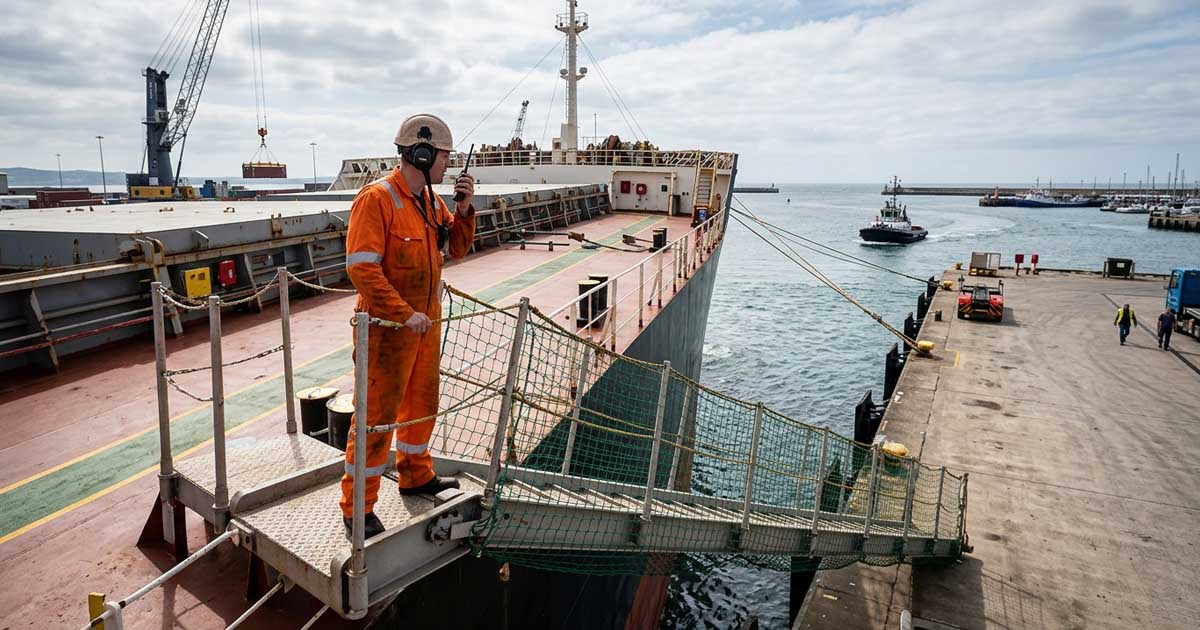
A gangway watchman is often seen as the person who checks visitors coming aboard.
But a good gangway watch is about much more than controlling access.
Standing at the gangway also provides a useful vantage point for noticing when something is going wrong. A parting mooring line, a ship moving away from the berth, oil on the water, or an unauthorized person on the quay can all become important observations before anyone walks up the gangway.
This article covers what to watch when nobody is boarding. For the visitor side of the job (ID checks, logbook, escorts), see how to perform an effective gangway watch.
Use Your Ears as Well as Your Eyes
You will not see the whole ship from the gangway, but you can hear it.
A mooring line that parts on the forecastle can be heard from midships. So can shouting at a mooring station or an unusual bang on deck.
Treat these as something to report to the OOW, not background noise. If you are not sure what you heard, call anyway.
A false alarm costs a minute. A missed one costs far more.
1. Mooring Lines and Ship Movement
Look at the mooring lines regularly.
Are some lines becoming unusually slack? Are others under noticeably higher tension? Is the vessel moving away from the quay at the bow or stern?
These changes can develop because of:
- Rising or falling tide
- Cargo loading or discharge
- Ballasting or deballasting
- Wind
- Current
- Passing vessels creating suction or wake
- Uneven tension in the mooring arrangement
This matters because a vessel can gradually move away from the berth without an obvious emergency at first. In one BMA investigation, a vessel at a tidal berth moved as the tide fell and several forward mooring lines eventually parted.
Important: A gangway watchman does not normally adjust the mooring lines independently. The important job is to recognize the change and report it promptly to the OOW or responsible officer.
2. Tide and Gangway Position
The tide is directly connected to the safety of the gangway. Keep the tide table at the gangway and read it.
In ports with a range of 3 to 6 metres, the ship moves a long way against the jetty. The gangway angle changes, the landing area can become unsafe, and lines that were right at low water can be too tight or too slack a few hours later.
The table lets you act early.
Tell the OOW before the tide has moved much, so the lines are tended before one snaps or before too much slack lets the ship drift off.
Check the accommodation ladder or gangway at the same time: the angle, the footing at the bottom, and the safety net underneath.
In general, a watchman should therefore be aware of:
- Current tidal stage
- Expected rise or fall
- Gangway angle and position
- Distance between ship and quay
- Whether the gangway is approaching an unsafe condition
- Whether mooring lines are responding normally to the changing water level
Note: The gangway watchman should report developing problems rather than waiting until the gangway becomes unsafe.
3. Cargo Operations
The gangway may be some distance from the cargo working area, but the watchman should still remain aware of what is happening around the vessel.
Depending on the ship and terminal, this may include:
- Cargo cranes operating overhead
- Loading arms or cargo hoses
- Cargo trucks and terminal equipment
- Stevedore movements
- Hatch covers and cargo holds being opened
- Manifold operations on tankers
- Unusual cargo-related activity
The watchman does not replace the cargo watch officer. Instead, he provides another set of eyes.
For example, if a crane, hose, vehicle or group of shore personnel appears to be moving into an unsafe area near the gangway, the watchman should alert the appropriate officer.
4. Ballast and Draft Changes
Ballasting and deballasting can change the vessel’s draft, trim and position relative to the berth.
You may notice these changes without knowing the exact figures.
For example, the ship’s side may appear to rise or sink relative to the quay. The gangway angle may change. A mooring line that was previously tight may become slack.
This is where practical seamanship matters. A watchman who understands the relationship between tide, cargo operations, ballast and mooring lines can recognize that a change is developing and report it early.
5. Weather and Sea Conditions
Do not ignore a sudden change in weather simply because the vessel is alongside.
Strong wind can push a ship away from the berth. Rain can reduce visibility and make access equipment slippery. Thunderstorms can create sudden changes in wind and operating conditions.
Watch for:
- Increasing wind
- Heavy rain
- Poor visibility
- Strong current
- Waves or swell entering the berth
- Surge from passing ships
- Lightning or approaching storms
The watchman should also know where he can take temporary shelter without abandoning the access point and should follow the ship’s procedures.
If conditions affect the gangway, moorings or safety of people boarding the ship, inform the OOW.
For example, our ship was berthed in the port of Algeciras. We occasionally experience wave surges caused by fast crafts entering and leaving the port. At times, it gets so bad that the ship even moves a meter away from the jetty!
6. Pollution and Water Around the Ship
The water around the vessel is another important part of the watch.
Look for unusual:
- Oil sheen
- Discoloration of the water
- Cargo residues
- Unexpected discharge
- Water coming from the ship’s side
- Ballast or other overboard discharge
A watchman is in a better position than someone inside the accommodation to notice something happening alongside the hull.
If you see something unusual, report it immediately. Do not assume that someone else has already noticed it.
7. The Quay and Surrounding Waters
Your watch should extend beyond the gangway itself.
Look around the berth for:
- Small boats approaching the ship
- Unusual persons near the ship’s side
- People attempting to access the vessel outside the designated gangway
- Personnel near mooring lines
- Open shell doors or other access points
- Vehicles or equipment approaching the gangway
- Another vessel coming alongside
- Alarms from the terminal or other ships
- Floating objects or debris
Security guidance also emphasizes maintaining awareness of the quayside and areas around mooring lines and access points.
You may not be able to see every part of the vessel. That is why listening is also part of situational awareness.
8. Listen for Unusual Sounds and Movements
This is something that comes with experience.
You may hear something before you see it.
A sudden loud snap could indicate a mooring line failure. A metallic bang could indicate contact with the berth or equipment. An unusual alarm, rushing water, pump’s irregular sound, machinery noise or repeated impact deserves attention.
You may also notice that the vessel is moving differently.
For example, the ship suddenly surges against the berth after a passing vessel creates a wake. You may see the bow opening away from the quay while the stern remains close.
These are not things to ignore simply because nobody is currently approaching the gangway.
9. Keep Security Awareness in the Background
Situational awareness also has a security dimension.
The gangway watchman should know who is expected, remain alert to unauthorized access and watch for unusual behavior around the vessel. The ISPS framework specifically addresses access control and security measures for ships and port facilities.
If someone approaches the vessel who is not on the expected visitor information, do not simply assume they are legitimate.
Verify with the responsible officer and follow the vessel’s Ship Security Plan.
This connects directly with our guides on handling inspectors and unexpected visitors and questions inspectors may ask a gangway watchman.
You can also read our guide to the ISPS Code and maritime security and ship security levels for the wider security framework.
Think Beyond the Gangway
The best gangway watchman does not stare at the gangway for hours waiting for someone to arrive.
He watches the gangway, ship, berth and surrounding environment as one system.
A simple mental checklist is:
Moorings → Tide → Ship’s position → Cargo → Ballast → Weather → Water → Quay → Security → Unusual sounds or movements
You do not need to interfere with every operation you observe. Your job is to notice changes, recognize what may be abnormal and communicate them to the OOW or responsible officer quickly.
That extra awareness can give the ship valuable time to react before a small change becomes a serious problem.
After all, a gangway watch is not just about watching who comes aboard. It is about knowing what is happening around the ship while you are there.
May the winds be in your favor.
Leave a Reply