

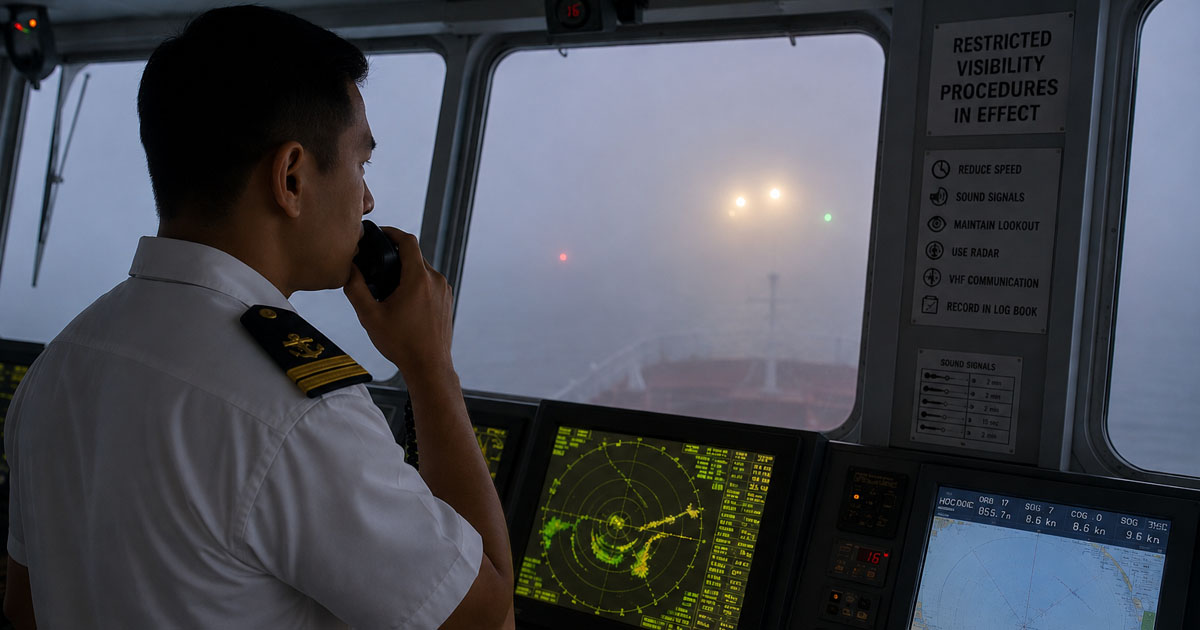
When restricted visibility is encountered or expected, the Officer of the Watch (OOW) must act early.
The immediate priorities are to inform the Master, establish a proper lookout, proceed at a safe speed, have the engines ready for immediate manoeuvre, use radar/ARPA effectively, exhibit navigation lights, and sound the required fog signals.
Do not wait until visibility has deteriorated to the point where nearby vessels, navigation marks, or hazards can no longer be seen.
Your ship’s Safety Management System (SMS) and Master’s standing orders may require additional actions such as increasing bridge manning, changing to hand steering, starting another steering gear power unit, shortening position-fixing intervals, or completing a restricted-visibility checklist.
What Is Restricted Visibility?
COLREG Rule 3 defines restricted visibility as any condition in which visibility is restricted by fog, mist, falling snow, heavy rainstorms, sandstorms, or other similar causes.
There is no fixed visibility distance in the COLREGs at which conditions automatically become restricted visibility.
Instead, the Master and/or company’s SMS should provide clear guidance to the OOW on the visibility range to be treated as restricted.
If no reliable targets are available to judge the visibility and the OOW believes visibility is restricted, the Maritime Coastguard Agency (MCA) guidance says it should be assumed to be restricted and appropriate action taken.
Practitioner note: Some companies specify a numerical trigger such as 3 or 4 nautical miles. Always use the limit stated in your own SMS or Master’s standing orders rather than assuming there is a universal industry threshold.
Restricted Visibility Checklist
The following actions should be considered as soon as restricted visibility is encountered or expected.
1. Inform the Master
Call the Master immediately as required by the Master’s standing orders and SMS.
Do not wait until traffic becomes difficult to manage. Restricted visibility itself is a recognised condition requiring the OOW to notify the Master under established STCW watchkeeping guidance.
2. Notify the Engine Room and Have Engines Ready
Inform the engine room as required by the vessel’s procedures and ensure the main engine is ready for immediate manoeuvre.
This is not merely good practice. COLREG Rule 19(b) specifically requires a power-driven vessel navigating in restricted visibility to have her engines ready for immediate manoeuvre.
3. Proceed at a Safe Speed
Reassess the vessel’s speed immediately.
Rule 19 requires every vessel to proceed at a safe speed adapted to the prevailing circumstances and conditions of restricted visibility.
Safe speed is not a predetermined number and must remain under continuous review.
Consider:
- visibility range;
- traffic density;
- stopping distance and manoeuvring characteristics;
- proximity of navigational hazards;
- sea and weather conditions; and
- radar performance and limitations.
Reduce speed whenever necessary. The objective is to retain enough time and distance to detect risk and take effective avoiding action.
4. Set Up and Use Radar/ARPA Properly
Ensure the radar and ARPA are correctly set up and actively used.
Do not simply switch the equipment on.
- Adjust gain, sea clutter and rain clutter as necessary.
- Use appropriate range scales.
- Carry out periodic long-range scanning for early detection.
- Acquire relevant targets.
- Monitor CPA and TCPA.
- Systematically observe approaching vessels.
- Cross-check ARPA information rather than accepting it blindly.
COLREG Rule 7 requires proper use of radar, including long-range scanning and radar plotting or equivalent systematic observation.
MCA guidance emphasizes that ARPA can only systematically monitor targets that have actually been acquired.
5. Post an Additional Lookout
Post a dedicated lookout in addition to the OOW.
Rule 5 requires a proper lookout by sight, hearing and all available means. During restricted visibility, hearing becomes particularly important because a fog signal may provide warning of a vessel that cannot yet be seen.
MCA guidance specifically considers posting additional lookouts prudent during restricted visibility.
Increase bridge manning further if required by the Master’s standing orders, SMS, traffic situation or navigational circumstances.
6. Change to Hand Steering When Required
Have a helmsman available and change from autopilot to hand steering when required by the circumstances and the ship’s procedures.
In congested waters, STCW watchkeeping guidance specifically calls for reverting to hand steering immediately when restricted visibility is encountered or expected.
The change should be made early enough that the helmsman and bridge team are fully settled before a close-quarters situation develops.
If required by the vessel’s procedures, operate the additional steering gear power unit. The ICS Bridge Procedures Guide recommends a second steering gear power unit in restricted waters or restricted visibility so the units can operate simultaneously.
7. Exhibit Navigation Lights
Ensure the required navigation lights are switched on and operating correctly.
The prescribed navigation lights must also be exhibited during restricted visibility between sunrise and sunset, not just at night.
Check for failures or alarms and follow the ship’s procedures if a required light is defective.
8. Sound the Correct Fog Signal
Start sounding the appropriate signal required by COLREG Rule 35.
For the most common situations:
| Vessel status | Restricted-visibility signal |
| Power-driven vessel making way | One prolonged blast at intervals of not more than 2 minutes |
| Power-driven vessel underway but stopped and making no way | Two prolonged blasts, about 2 seconds apart, at intervals of not more than 2 minutes |
| NUC, RAM, CBD, sailing, fishing, towing/pushing | One prolonged followed by two short blasts at intervals of not more than 2 minutes |
Rule 35 applies in or near an area of restricted visibility, whether by day or night.
Use the signal applicable to your vessel’s actual condition.
9. Shorten the Position-Fixing Interval
Shorten the position-fixing interval in accordance with the passage plan, Master’s standing orders and SMS.
The purpose is simple: you need to know the ship’s position more frequently so that any deviation from the planned track is detected early.
This becomes particularly important near:
- shoal water;
- coastlines;
- narrow channels;
- traffic separation schemes;
- alteration points; and
- other navigational hazards.
Use all appropriate means available and cross-check electronic position information where practicable rather than relying on a single source.
If navigating in or near shallow water, operate and monitor the echo sounder as appropriate.
10. Monitor VHF — But Do Not Navigate by VHF
Maintain the required listening watch, including VHF Channel 16 and the applicable VTS or local working channel.
VHF can improve situational awareness, but it should not replace COLREG-compliant collision avoidance.
Radar observations, visual and auditory lookout, and the applicable steering and sailing rules remain the basis for assessing collision risk.
11. Continuously Assess Collision Risk
When another vessel is detected by radar alone, determine whether a close-quarters situation is developing and whether risk of collision exists.
Under Rule 19, there are no stand-on and give-way vessels when the vessels are not in sight of one another. If risk exists, both vessels are responsible for taking appropriate avoiding action.
If avoiding action involves an alteration of course, Rule 19 says that, so far as possible, avoid:
- altering to port for a vessel forward of the beam, other than a vessel being overtaken; and
- altering toward a vessel abeam or abaft the beam.
Continue monitoring CPA, TCPA and the target’s movement after taking action to confirm that the situation is actually improving.
12. Be Ready to Stop or Take All Way Off
The vessel must remain ready to reduce speed further, stop or manoeuvre as circumstances require.
Rule 19 contains an especially important requirement when you hear another vessel’s fog signal apparently forward of the beam, or when a close-quarters situation with a vessel forward of the beam cannot be avoided.
Unless risk of collision has been determined not to exist, the vessel should reduce speed to the minimum at which she can be kept on her course, take all way off if necessary, and navigate with extreme caution until the danger has passed.
13. Consider Anchoring if Necessary
If the vessel’s position is in doubt, navigation cannot safely continue, or the developing situation makes proceeding unsafe, consider whether anchoring is a safe option.
This depends on having:
- suitable depth;
- sufficient sea room;
- appropriate holding ground;
- adequate clearance from traffic and hazards; and
- conditions that permit anchoring safely.
The ICS restricted-visibility checklist specifically includes considering anchoring when in doubt and when suitable depth is available.
14. Complete the Ship’s SMS Requirements
Finally, complete the vessel’s restricted-visibility checklist and other SMS requirements.
Depending on the company, this may include:
- changing bridge manning status;
- completing or updating a risk assessment;
- making additional engine-room notifications;
- closing specified watertight doors or openings;
- stopping noisy deck work that interferes with maintaining an auditory lookout;
- recording equipment status; and
- making the required bridge logbook entries.
These are ship- and company-specific procedures, so they should not be confused with requirements that come directly from COLREG.
Restricted Visibility Quick Checklist
| Action | Check |
| Master informed | ☐ |
| Engine room informed as required | ☐ |
| Engines ready for immediate manoeuvre | ☐ |
| Safe speed established | ☐ |
| Radar/ARPA properly set and monitored | ☐ |
| Targets acquired and CPA/TCPA monitored | ☐ |
| Additional lookout posted | ☐ |
| Helmsman available / hand steering as required | ☐ |
| Steering gear configuration checked | ☐ |
| Navigation lights exhibited | ☐ |
| Correct Rule 35 sound signal commenced | ☐ |
| Position-fixing interval shortened | ☐ |
| Echo sounder used where appropriate | ☐ |
| VHF listening watch maintained | ☐ |
| Collision risk continuously assessed | ☐ |
| SMS / Master’s standing orders followed | ☐ |
| Relevant logbook entries made | ☐ |
Restricted visibility is not the time to wait for the situation to become obviously dangerous.
Call the Master early, establish the correct bridge manning, slow down as necessary, use radar systematically, maintain a proper lookout and keep the vessel ready to manoeuvre immediately.
Above all, comply with the COLREGs and follow your vessel’s SMS and Master’s standing orders.
May the winds be in your favor.
Leave a Reply