


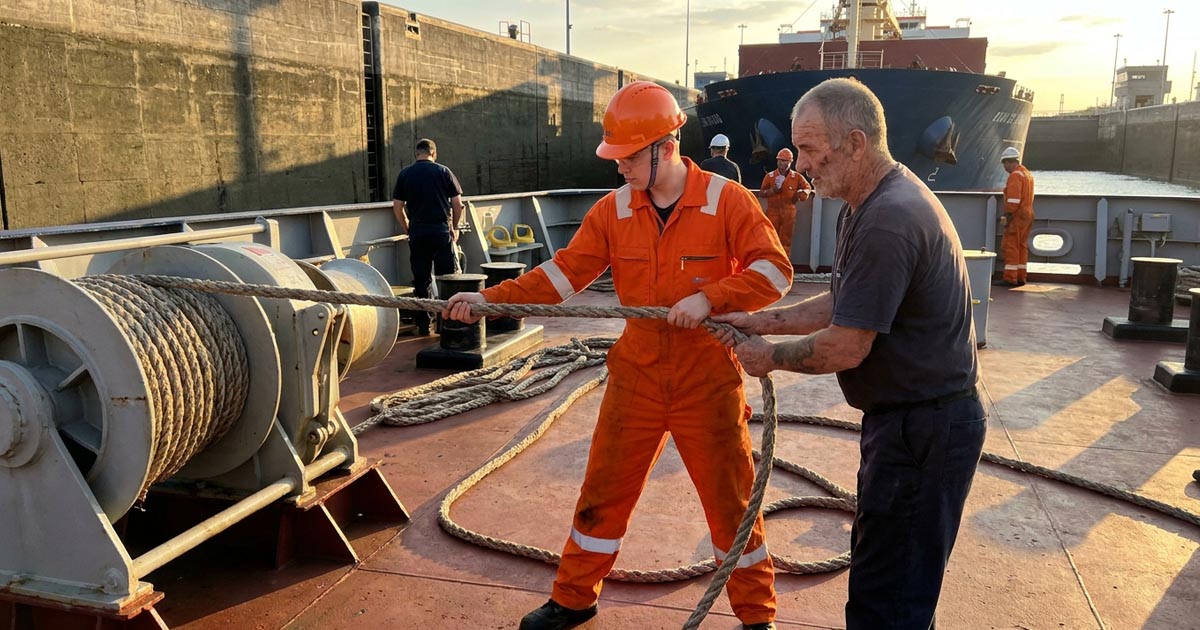
When I was a cadet, I watched a ship’s bow drift off the berth in the middle of a lock.
The lock had just opened. Other vessels were starting to move. The mooring lines that were supposed to hold us were not doing their job.
Before the bow opened, I had listened to the bosun try to explain something to the officer in charge of the forward station.
The officer had arranged the lines with multiple bends, leading them around several fairleads.
The bosun said the arrangement would not hold much. The officer continued with his plan anyway.
The bow opened.
I do not tell this story to claim that officers are foolish. The officer was not lazy or careless.
He had almost certainly spent very little time actually doing deck work, so he could not properly evaluate the warning he was receiving.
To him it sounded like an opinion. To someone who had enough experience, it would have sounded like information.
That difference is why deck cadets should learn the ratings’ jobs.
You cannot evaluate advice about work you have never done
A cadet can spend most of the day on the bridge learning navigation, observing officers, and filling in the Training Record Book.
That time is valuable.
But the deck is where an officer’s plans meet reality, and it is surprisingly easy to reach officer rank without ever having felt the gap between the two.
An officer who has never chipped rust, spliced a line, greased a winch, or rigged a pilot ladder has to take the crew’s word for how those jobs actually go.
Sometimes the crew is right. Sometimes they are protecting themselves or hiding a problem. Without your own experience, you have no reliable way to tell which is which.
I have seen both sides. I have watched a deck rating give a realistic estimate that an officer accepted, and the job went smoothly.
I have also watched an officer overrule practical advice without understanding the reason. In those cases the ratings usually saw the problem coming long before the officer did.
Bad weather exposes the gap quickly
Anchoring or heaving up in normal weather looks straightforward. Almost anyone can follow the basic sequence.
The same operations in strong wind, swell, or restricted visibility are different.
Small decisions matter more: where people stand, how the crew is positioned, how quickly someone reacts when the windlass behaves unexpectedly.
I have seen officers with limited deck time struggle during these operations. In several cases it was an experienced bosun who stepped in and steadied things.
The officer with real time on deck recognizes what “when something changes” looks and feels like.
The officer without that background is often working from memory of a procedure while the situation moves faster than the procedure can be applied.
The pumpman who stripped the tank
One of the clearest examples I have seen of practical experience outweighing rank involved a ballast tank that would not strip to nil.
The second officer and the chief mate had been trying to get the last of the water out and could not manage it.
When the third officer took over the watch, he pumped out a good deal more. The chief mate asked how.
The third officer had been a pumpman before he was promoted. He knew the suction side of every ballast pump on that ship and how it behaves in certain conditions.
He used trim and list deliberately to move the remaining water toward the suction. It was a practical solution, not a theoretical one.
He could also judge the condition of a pump by listening to it. That kind of knowledge comes from years spent next to the machinery, not from a course or a manual.
His theoretical understanding was no better than the chief mate’s. He simply had more time next to the equipment.
Job estimates and workmanship come from doing the work
Officers who have spent real time on deck tend to know how long jobs actually take.
If a task that normally takes four hours is reported as taking two full days, they notice. They do not immediately assume the crew is lying.
They ask better questions:
- Were the tools adequate?
- Was the job larger than it first appeared?
- It’s been two days and this paint isn’t dry yet! Did you not add the curing agent?
Officers without that background may have a harder time.
They either assign work that is too large for the available time, forcing people to rush or cut corners, or they accept slow progress without questioning it because they have nothing solid to compare it against.
The same experience helps you recognize good and poor workmanship.
Once you have done a job yourself, you develop a reference point.
You can tell when a maintenance task was rushed, when equipment was not properly secured, when a mooring arrangement was poorly prepared, or when a repair was only partially completed.
You can also distinguish between a rating who is struggling and one who is simply avoiding effort.
Those situations require different responses.
You start managing people differently
Doing the physical work yourself changes how you treat the people who do it every day.
Manual deck work is hard. It becomes harder when the crew is tired, the weather deteriorates, the ship is rolling, or an operation runs for hours.
An officer who has felt that fatigue plans differently.
He thinks about rest hours, manpower, concurrent jobs, and whether the available time is realistic.
An officer who has never done the work may treat the crew primarily as a resource to be used.
That approach often leads to complaints and, more importantly, to unsafe work, because tired people make mistakes.
Good supervision includes noticing who is struggling and why. You can only do that reliably if you know what the struggle actually looks like.
Safety judgment becomes sharper
Everyone knows that mooring lines are dangerous.
Knowing it from a training course or a risk assessment is different from standing near a line under strain and watching how quickly the situation can change.
An officer who has done that work gives better advice and stronger safety emphasis before a job starts:
- DON NOT hold the stopper when applying it to a tensioned rope. Secure it with a quick release!
- Before approaching the tug’s line, WAIT for my signal!
- Each of you must bring a knife during mooring.
- In addition to mine, one of you should have another radio so you can listen to the command and take proper initiative. It will also act as a spare radio in case mine goes kaput for some reasons.
- You must bring extra flashlights as well since we will arrive at night time, and engaging/disengaging the gears might be tricky. Besides, your flashlight will act as my spare just in case.
Practical experience does not replace risk assessments, the safety management system, or company procedures.
It helps you see the hazards those documents describe more clearly.
The same applies to working aloft, pilot ladder operations, deck machinery, enclosed spaces, and maintenance under time pressure.
What to do as a cadet
Do not treat the deck as something to escape as soon as possible.
Ask the bosun if you can join specific jobs and pay attention to what each one teaches:
- Mooring stations. Watch how lines are arranged and why. Ask what the bosun would change in a poor layout, then remember the answer.
- Rust chipping and coating. Learn how long a proper job takes and what a rushed or incomplete one looks like.
- Splicing and rope work. You will learn what a sound splice looks and feels like, and how to inspect one.
- Deck machinery maintenance. Winches and windlasses teach you what normal operation looks and sounds like, so you notice when it is not.
- Pilot ladder rigging. Learn it by doing it under proper supervision. It is safety-critical.
- Anchoring, heaving up, and bad-weather deck work. Stay close to the bosun and ask what he is watching for.
Engaging like that helps you learn much faster as a cadet as well.
Important: Do this with supervision, the correct PPE, and within what your ship’s procedures and the training program allow. Your goal is not to replace an able seaman. It is to understand the work well enough to judge it later.
Learn it before you have to supervise it
Someday you may be the officer standing on deck deciding how a job gets done.
When that happens, the crew will know quickly whether you understand the work or are simply reading from a page.
The lock mooring taught me something I still think about.
The bosun was not being difficult. He was trying to prevent a problem, and the officer could not hear the warning. Do not be that officer.
Spend time on deck. Listen to the people who do the work every day. When you eventually give instructions, they will be instructions people can trust.
May the winds be in your favor.
Leave a Reply