


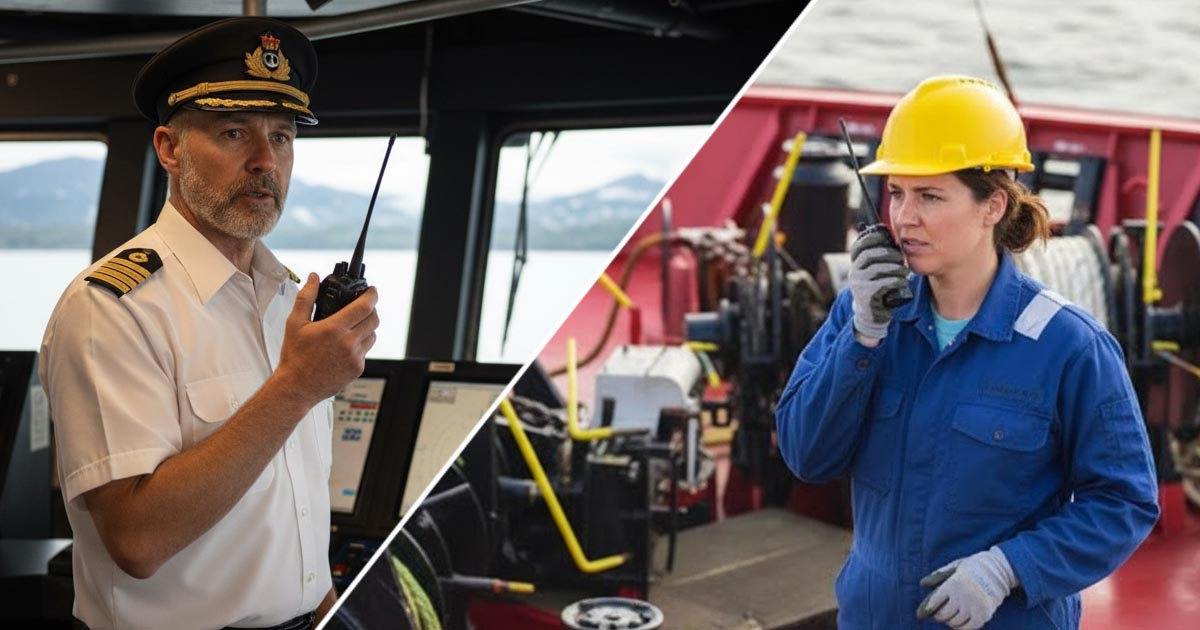
Anchoring a vessel is one of the most critical seamanship operations.
Success depends on clear, precise, and standardized communication between two teams: the Bridge Team and the Anchor Party (forecastle team).
A simple misunderstanding can escalate into a dangerous incident- such as anchor dragging, chain damage, or loss of control.
This guide explains the protocols, commands, and best practices used worldwide to ensure safe anchoring.
👥 Bridge-to-Forecastle Communication Roles
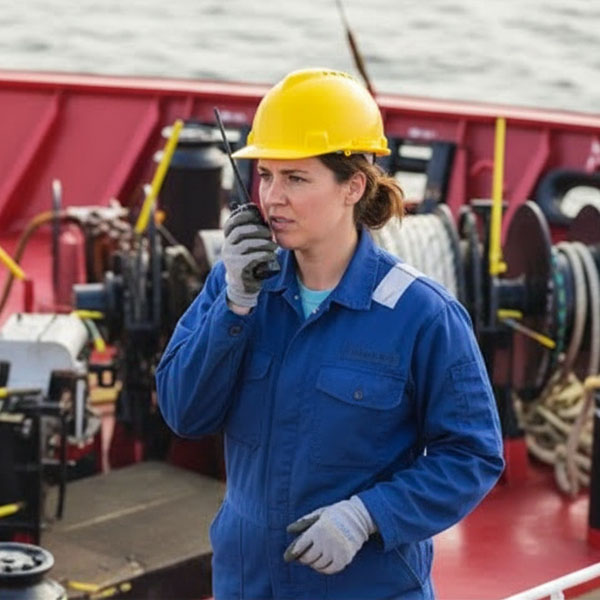
🔹 Forward Station (Anchor Party)
Located on the forecastle, this team physically operates the anchor equipment and must maintain real-time communication with the bridge.
Their responsibilities include:
- Operating the anchor windlass and monitoring the brake and stopper.
- Watching the anchor chain for tension, fouling, kinking, or piling up.
- Reporting the exact number of shackles paid out and their direction (chain leading reports).
- Updating the bridge about the anchor status: “paying out,” “holding,” or “dragging.”
🔹 Bridge Team (Master or Officer of the Watch)
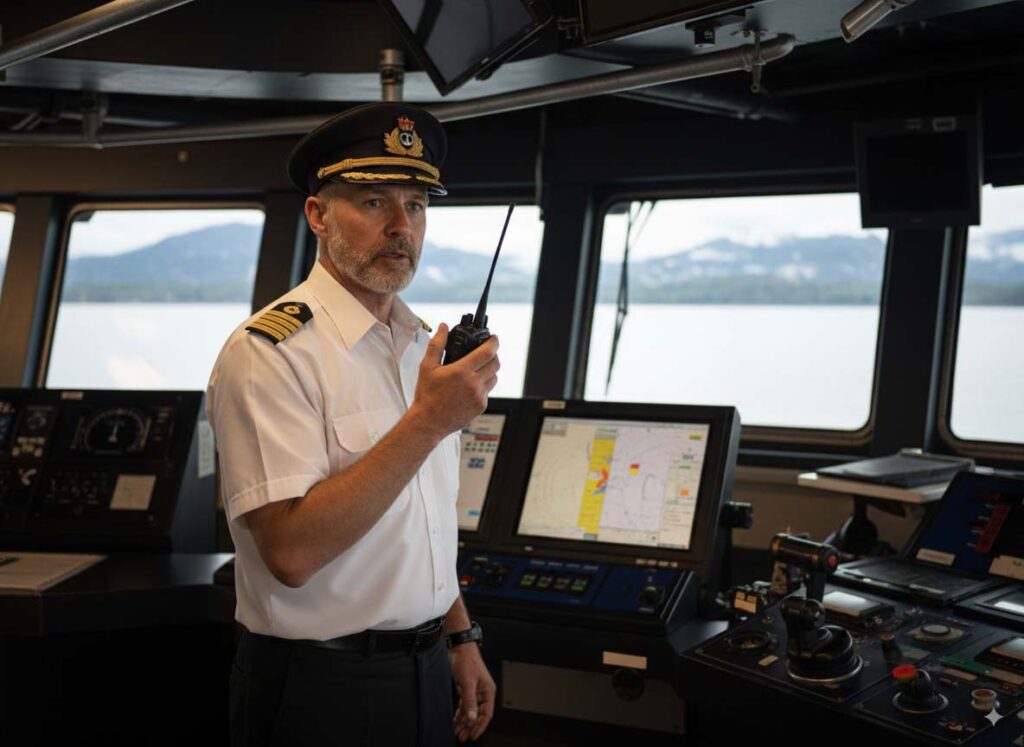
The bridge manages the vessel’s movement and positioning.
Their duties include:
- Controlling engine and rudder movements to assist anchoring.
- Monitoring the ship’s position via GPS, radar, and other navigational aids.
- Receiving and acknowledging reports from the anchor party.
- Ordering when to pay out, hold, or heave in the anchor chain.
- Reacting quickly to chain reports (e.g., giving astern propulsion when chain is leading aft).
- Reporting to the VTS Control System of their anchoring intention and when they are finished.
- Calculating the swinging circle and the scope.
📡 Standard Communication Methods
Reliable communication between the bridge team and the anchor party is paramount, especially in noisy or high-stress environments.
- UHF Radios or Walkie-Talkies 📞
- Primary method for bridge–fo’c’sle communication.
- Always use a dedicated channel and state the vessel’s name to avoid confusion with nearby ships.
- Ship’s Internal Telephone System ☎️
- A backup method that includes sound-powered telephones (work even without electricity).
- Other options include talk-back units common on larger vessels.
- Hand or Light Signals 🙅
- Universal backup method when radios fail or background noise is too high.
- Standard signals for heave up, lower, and stop are recognized globally.
📢 Standard Anchoring Commands and Chain Reports
During anchoring, communication follows a set of standardized commands and reports.
These ensure that both the Bridge Team and Anchor Party understand the vessel’s exact anchoring status.
Here are the most common phrases used worldwide:
- “Standby for anchoring.”
→ The anchor party stands by at the forecastle and prepares the anchor for dropping. - “Anchor is ready to let go.”
→ Lashings and stopper removed, windlass disengaged, anchor held only by the brake. - “Anchor is one meter above the water.”
→ Anchor lowered close to the surface, waiting for the order to let go. - “Anchor is on the bottom.”
→ Anchor has touched the seabed, a key moment for bridge positioning. - “One shackle on deck.”
→ Reports how many shackles (1 shackle = 15 fathoms = 90 feet ≈ 27.432 meters) have been paid out. - “Anchor is holding.”
→ Chain is under tension, anchor dug in, vessel secured. - “Chain is leading 12 o’clock (ahead)”
→ Chain stretched forward from hawse pipe, showing ship’s position relative to anchor. - “Chain is leading 6 o’clock (astern)”
→ Vessel has passed her anchor, chain stretched aft. Requires astern engine adjustments. - “Anchor aweigh!”
→ Anchor lifted clear of the seabed during heaving up.
📝 Example Communication: Dropping the Anchor
Here’s a step-by-step walkthrough dialogue showing how the Bridge Team and Anchor Party communicate during anchoring:
Bridge Team:
“Chief Mate, please standby for anchoring and proceed forward.”
Note: Chief Mate and Bosun (or another deckhand) proceed to the forecastle.
Anchor Party:
“Bridge, forward anchoring team standing by. Anchor engaged, brake on, lashings and stopper removed.”
Note: Only the brake is holding the anchor. Anchor winch is running.
Bridge Team:
“Chief, lower the anchor one meter above the water. Prepare for gravity drop.”
Note: Gravity drop = anchor released by weight of chain, windlass disengaged, brake controls the fall.
Anchor Party:
“Bridge, anchor is now one meter above water, winch disengaged, brake holding. We are ready to let go.”
(After a few minutes)
Bridge Team:
“Forward Station, drop the anchor!”
Note: The ship is in precise anchoring position. Clear order to let go.
Anchor Party:
“Copy Bridge. Anchor let go… three shackles on deck, chain up-and-down, stopped paying out.”
Note: Chief Mate loosens brake. Gravity payout is swift. Reports include number of shackles, chain position, and status.
(In practice, payout is paused at ~3 to 4 shackles, depending on depth, then continued carefully to prevent piling or kinking.)
Bridge Team:
“Thank you, Chief. Please continue.”
Anchor Party:
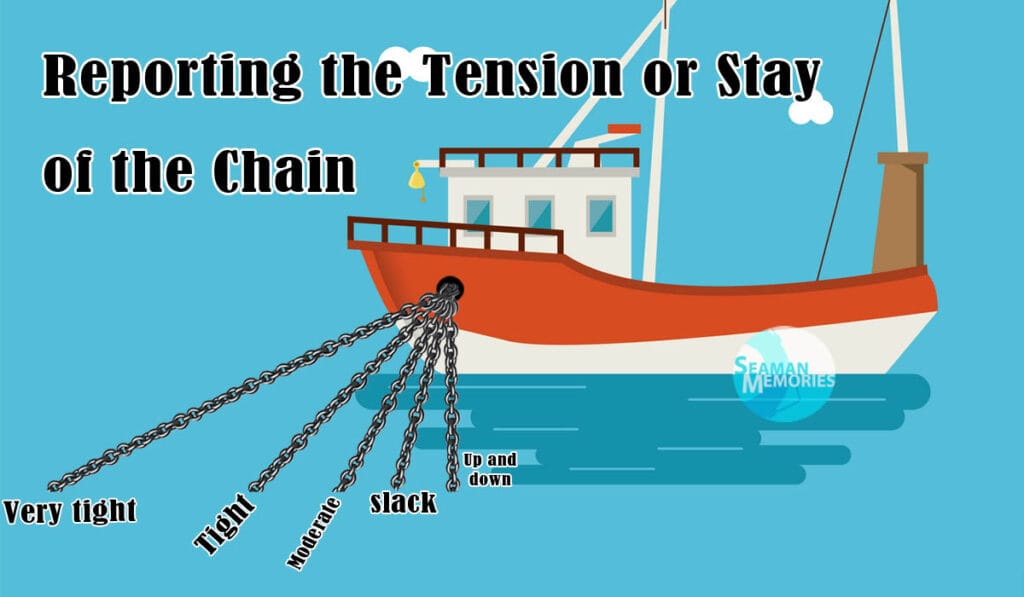
“Chain leading 10 o’clock, moderately tight, passing 4 shackles on deck, brake open, continuing to pay out.”
Note: If chain angle and shackle doesn’t change, the anchor party reports every 30 seconds.
Bridge Team:
“Thank you Chief. We will stop at 8 shackles on deck.”
Anchor Party:
“Copy Captain. Five shackles on deck now, chain 11 o’clock 🕚️, slack.”
Bridge Team:
“Okay.”
Anchor Party:
“Chain almost up-and-down now. Five shackles in the water.”
Bridge Team:
“Thank you. I’m giving a little astern on the engines.”
Anchor Party:
“Chain leading 12 o’clock, slack… becoming moderately tight.”
Bridge Team:
“Very well, engine stopped.”
Anchor Party:
“Six shackles on deck. Chain leading 11 o’clock, moderately tight, brake open.”
Bridge Team:
“Very well. Continue.”
Anchor Party:
“Seven shackles on deck. Chain still leading 11 o’clock, moderately tight, brake open.”
Bridge Team:
“Thank you! Put 8 shackles on deck and engage the brake.”
Anchor Party:
“Copy Bridge. Eight shackles on deck, brake engaged and holding. Chain leading 11 o’clock, tight.”
Bridge Team:
“Okay. How’s the chain now?”
Anchor Party:
“Chain still tight at 11 o’clock, brake holding…. Now becoming moderate tight, leading 12 o’clock, slowly slackening.”
Bridge Team:
“Thank you. Secure forward. Don’t forget to put the flag marker on the chain and hoist the anchor ball.”
Anchor Party:
“Copy Captain… Forward secured. Brake holding, chain stopper engaged, flag marker placed, and anchor ball raised. Chain leading 11 o’clock, slack. Finish with forward!”

❓ Anchoring FAQ
Q1: What is a “shackle” of anchor chain?
A shackle ⛓️ is a unit of length for anchor chains. Standard measurement is 15 fathoms (90 feet or 27.432 meters). Chains are marked at each shackle so the Anchor Party can report accurately.
Q2: What does “five shackles on deck” mean?
It means five shackles of chain have been paid out and are visible from the deck to the hawse pipe, leading into the water 💦.
Q3: What does “seven shackles in the water” mean?
This specifies that the seventh shackle has been deployed and submerged. The phrase indicates the seventh shackle marker 🔗 is already released beneath the surface.
Q4: What does “up-and-down” mean in chain reporting?
↕️ Up-and-down means the anchor chain is hanging vertically beneath the hawse pipe. This usually indicates:
- The anchor is directly under the hawse pipe and about to come aweigh, or
- The chain is slack and piled beneath the hawse pipe with no horizontal pull.
Q5: Why are chain-leading reports important?
The chain’s direction (e.g., leading 12 o’clock ahead, 6 o’clock astern 🕕️) tells the bridge how the ship is lying at anchor.
It helps detect if the vessel is:
- Swinging normally with wind or tide
- Dragging anchor
- Under excessive chain strain
Q6: What are the risks of poor anchoring communication?
Miscommunication can result in:
- Anchor dragging into restricted areas
- Damage to chain or windlass
- Collision 🛳️💥 or grounding if the vessel is not properly secured
Q7: How do hand signals replace radios during anchoring?
When radios fail, hand or light signals are used. These are standardized internationally:
- Arm raised and rotated = heave up
- Arm lowered sharply = drop/lower
- Hand (or fist) flat outward = stop
💡 Conclusion
Safe anchoring depends on disciplined communication between the Bridge Team and Anchor Party.
Standardized reports such as “shackles on deck,” “chain leading,” and “up-and-down” give the bridge real-time information to control the ship effectively.
By adhering to protocols, using reliable equipment, and practicing clear dialogue, seafarers can:
- Prevent anchor dragging ⚓
- Protect crew and vessel 👨✈️
- Ensure environmental safety 🌊
Anchoring is more than just dropping the hook- it’s a team operation built on precision communication.
📌 Call to Action
👉 If you’re a cadet or junior officer, practice these commands regularly.
👉 Masters and Chief Officers should standardize bridge-to-fo’c’sle communication onboard to build confidence and reduce risks.
👉 For more seamanship guides, check out our Navigation & Ship Knowledge resources at Captain’s Mode.
Leave a Reply