



A ship’s air draft (also spelled air draught) is the vertical distance from the waterline to the highest point of the vessel– usually the top of the radar mast, funnel, or bridge structure.
It determines whether a vessel can safely pass under bridges, power lines, and other overhead obstructions.
While most seafarers are familiar with the ship’s draft (the depth below the waterline), the air draft is equally critical above the waterline– especially when navigating through harbors, rivers, or canals with limited vertical clearance.
📏 Air Draft = Height from Waterline to Ship’s Highest Point
🛰️ Air Draft vs. Draft: What’s the Difference?
| Term | Definition |
|---|---|
| Draft | Distance from the waterline down to the keel (underwater) |
| Air Draft | Distance from the waterline up to the highest point (above water) |
🌉 Why Air Draft Matters
Failing to consider air draft can result in structural damage, delays, or even accidents involving bridges, cables or other overhead obstructions.
Thus, air draft calculation is normally included in the ship’s voyage plan.
Port authorities and ship navigators use this data to:
- Plan safe routes through restricted vertical spaces
- Schedule bridge openings for passing ships
- Alert aviation authorities if towing large structures near flight paths
- Avoid collisions with suspended obstructions
🚨 Real-World Example:
A seafarer towing a massive oil platform (air draft ≈ 100 meters) through the Singapore Strait once caused Changi Airport to delay aircraft landings for an hour- just to allow safe passage.
This highlights how air draft isn’t just a maritime concern, but also affects aviation and port operations.
🔍 Who Is Responsible for Checking Air Draft?
On board, the Second Officer typically handles voyage planning, which includes verifying vertical clearances and calculating the air draft.
Data sources include:
- Ship’s Particulars document (for vessel height)
- Chief Mate’s draft readings (forward and aft)
- Bridge equipment (radar mast position, antenna height, etc.)

📐 How to Calculate a Ship’s Air Draft (Even Keel & Trimmed Conditions)
Understanding how to calculate your ship’s air draft is crucial for safe navigation through overhead-restricted waterways.
The good news? It’s straightforward – no need for complex formulas or celestial calculations!
There are two main scenarios you’ll face when calculating air draft:
⚓ 1. When the Ship is on an Even Keel
An even keel means the ship’s forward and aft drafts are equal – the vessel floats level in the water.
✅ Formula:
Air Draft (AD) = Height of Vessel (HoV) - Aft Draft (Da)or
AD = HoV - Da
You can find:
- Height of Vessel in the Ship’s Particulars
- Draft readings from the Chief Mate
📝 Note: The Height of Vessel is measure from the ships keel to the topmost mast or antenna.
📌 Example:
- Height of Vessel (HoV): 42.5 meters
- Forward Draft (Df): 10.3 meters
- Aft Draft (Da): 10.3 meters (even keel)
Solution:
AD = HoV - DaAD = 42.5 - 10.3 = 32.2 meters
AD = 32.2 meters
📝 This means your ship has 32.2 meters of clearance from the waterline to the highest point. Check this value against any overhead restrictions along your route.

⚓ 2. When the Ship is Not on Even Keel (Trimmed Condition)
When your ship is trimmed– typically by the stern, the aft draft is greater than the forward draft.
This means the radar mast (highest point) is no longer aligned vertically over the aft perpendicular, so we apply a correction called:
📐 Air Draft Correction (ADCorr)
✅ Formula:
Air Draft = (HoV - Da) + [(Trim × Distance from Aft Perpendicular to Highest Point) ÷ LBP]Where:
- Trim = Da (Draft aft) – Df (Draft forward)
- LBP = Length Between Perpendiculars
- Ap–Rp = Distance from Aft Perpendicular to Relevant Point (usually radar mast)
📌 Example:
- Forward Draft (Df): 10.3 meters
- Aft Draft (Da): 12.9 meters
- Trim = 12.9 – 10.3 = 2.6 meters
- Height of Vessel (HoV): 42.5 meters
- LBP (Length Between Perpendiculars): 178 meters
- Distance from Aft Perpendicular to Radar Mast: 20.3 meters
Step 1: Calculate Air Draft Correction
ADCorr = (Trim × Ap–Rp) / LBP
ADCorr = (2.6 × 20.3) / 178
ADCorr = 0.3 meters
Step 2: Apply to Main Formula
Air Draft = (42.5 - 12.9) + 0.3
Air Draft = 29.9 meters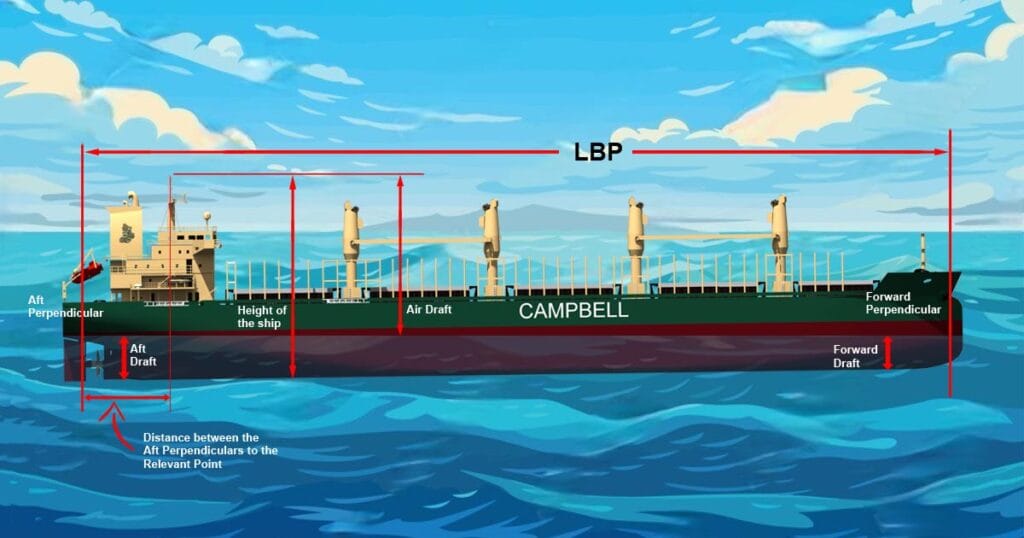
➕ Alternate Compact Formula:
If you want to streamline the calculation:
AD = (HoV - Da) + [(Trim × Ap–Rp) / LBP) ]Using the same values:
AD = (42.5 - 12.9) + [(2.6 × 20.3) / 178)]
AD = 29.9 meters
⚠️ When to Apply the Correction
Only apply the Air Draft Correction if the highest point (e.g., radar mast) is not located directly above the aft perpendicular- usually due to trim or mast placement.
🚢 What to Do With the Air Draft
Once calculated, the air draft must be compared with known vertical clearance limits at:
- Bridges 🌉
- Power lines ⚡
- Overhead cranes
- Flight paths ✈️ (in rare but critical cases like oil rig tows)
If your air draft is greater than the available clearance- re-route or adjust ballast/trim.
📎 Frequently Asked Questions (FAQ)
❓ What is the difference between draft and air draft?
Draft is the depth of the ship below the waterline; air draft is the height above the waterline up to the highest structure.
❓ How is air draft measured on board?
Using draft readings (forward and aft) and vessel height from the Ship’s Particulars, calculated by the Second Officer.
❓ Why does trim affect air draft?
Because the ship’s highest point shifts in relation to the waterline when trimmed, requiring a correction for accurate clearance.
❓ Can air draft affect flight operations?
Yes- especially during offshore platform tows or ultra-high container stacks passing near airport zones.
🧭 Final Thoughts
Knowing how to calculate your vessel’s air draft isn’t just technical trivia – it’s a core safety responsibility for any navigating officer.
Whether you’re approaching a low-clearance bridge, sailing upriver, or towing a massive structure, a simple miscalculation could spell major operational delays or even catastrophic damage.
📌 Always double-check your figures, apply the right correction, and review port clearance data before transit.
📣 Call to Action
👉 Bookmark this guide and share it with your fellow seafarers!
For more shipboard calculations and bridge procedures, visit Captain’s Mode– your trusted maritime resource ⚓
May the winds be in your favor.
Leave a Reply