

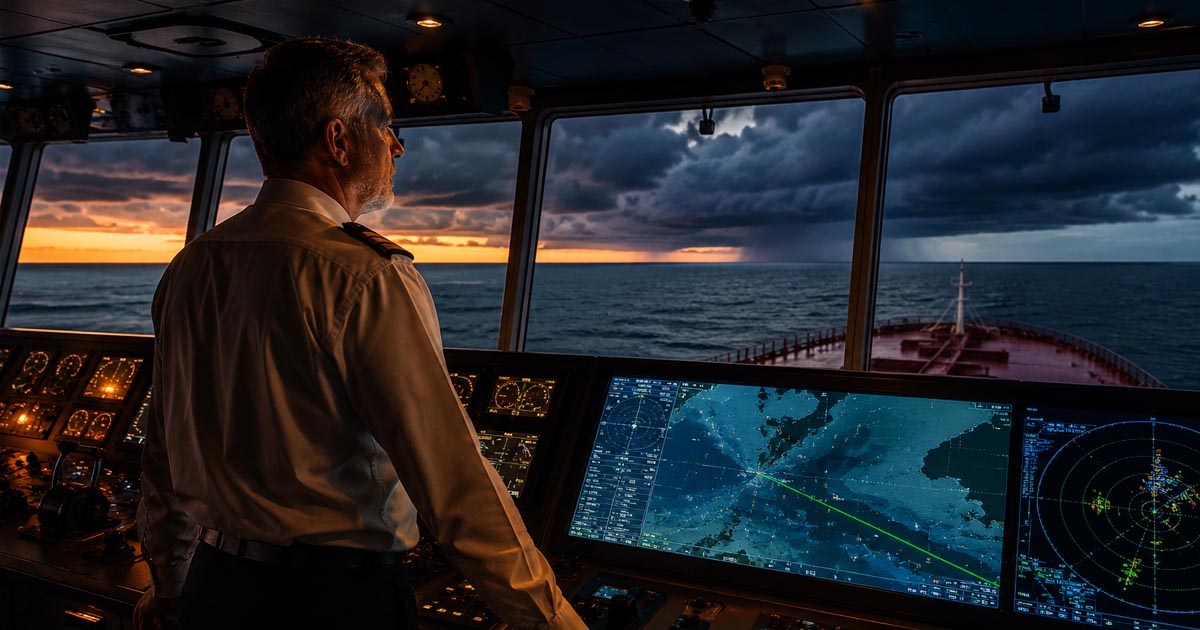
TL;DR: No. AI will change what seafarers do – not eliminate the need for them.
Quick Answer
AI is not going to replace most seafarers in the foreseeable future.
Autonomous shipping is real. It is growing. But so are the barriers – physical, regulatory, legal, and technical – that make fully crewless ocean-going vessels impractical at scale.
Here is what will change: routine tasks get automated, manual paperwork shrinks, and some vessels may run with slightly leaner crews.
Here is what won’t change: the need for qualified, experienced people to handle the unpredictable realities of life at sea.
The IMO’s newly adopted MASS Code (May 2026, effective July 2026) confirms this direction. It creates a framework for autonomous operations while explicitly emphasizing safety and continued human oversight.
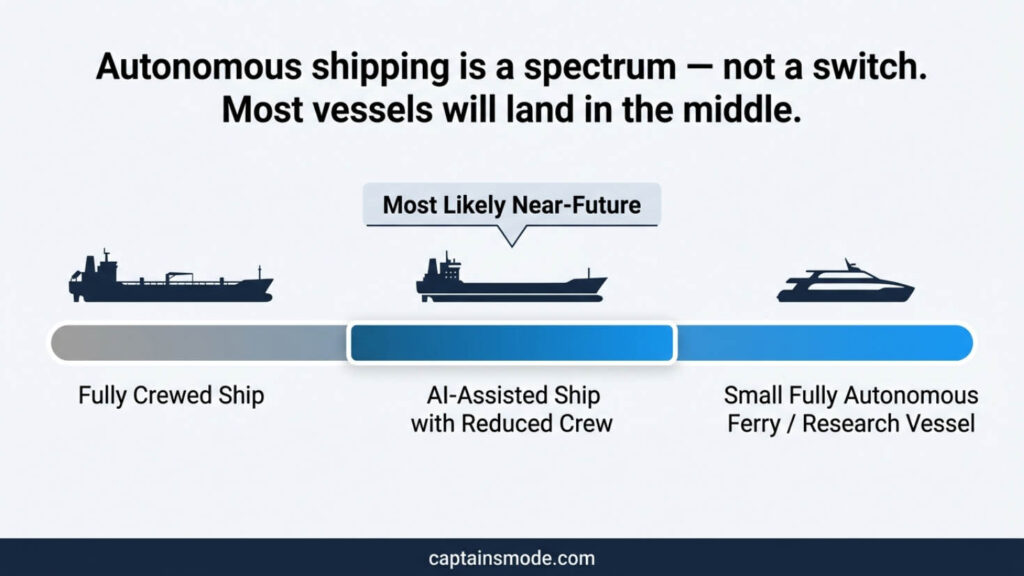
Most likely outcome: AI-assisted ships with smarter, leaner crews. Not crewless vessels dominating global trade.
🚢 Why This Question Matters
AI is reshaping every industry. It is natural for seafarers and those considering maritime careers to ask where they stand.
Headlines about self-navigating ships and autonomous vessels make it easy to assume the worst.
But important context is being left out of most of those headlines.
The maritime industry already faces a projected shortfall of around 90,000 officers globally. That is not a crisis caused by too many workers. That is a workforce that is already too small for current demand let alone future growth.
In that context, AI looks less like a job-killer and more like a tool to bridge a growing labor gap. The industry needs more qualified seafarers, not fewer.
🌊 Why Maritime Work Is Hard to Fully Automate
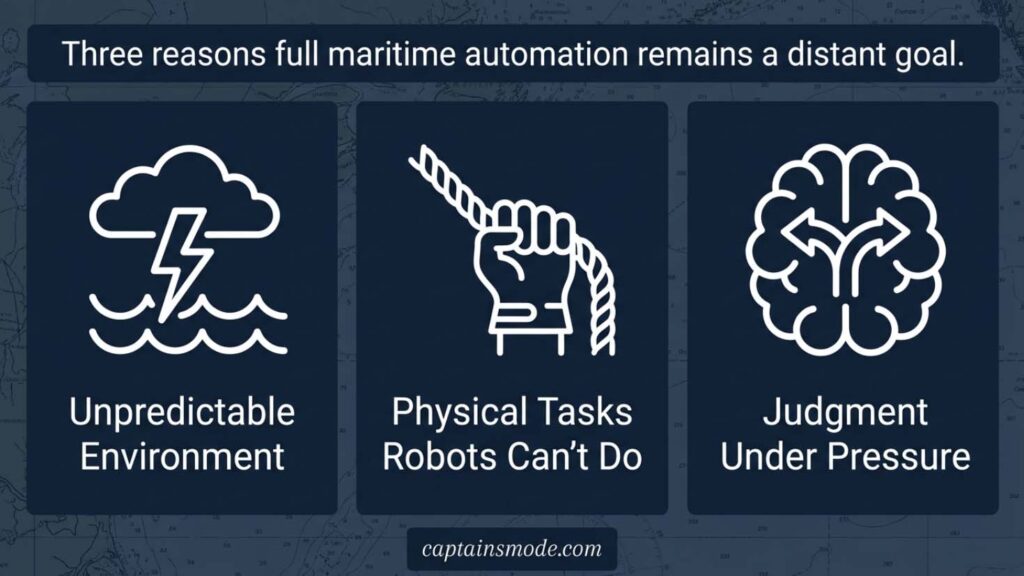
Ships are not factories. They are not offices. They operate in one of the most unpredictable environments on the planet!
That matters enormously when evaluating what AI can actually replace.
The Environment Does Not Cooperate
- Weather changes fast and without warning
- Traffic in TSS lanes and port approaches gets congested and unpredictable
- Equipment fails at 0300H in the middle of the Pacific
- Ports have inconsistent infrastructure and local quirks
- No two voyages are identical
AI performs well in structured, predictable environments. The open ocean is neither.
Physical Tasks Still Require Humans
Think about what happens during a routine port call:
- Mooring lines are deployed and adjusted by hand
- Gangways, hoses, and cargo gear are rigged manually
- Hull inspections involve entering enclosed and confined spaces
- Firefighting requires people in BA sets physically inside a space
- Emergency repairs happen under conditions no robot handles reliably
These are not rare events. They are daily operational reality on any working ship.
Judgment Is Not the Same as Data Processing
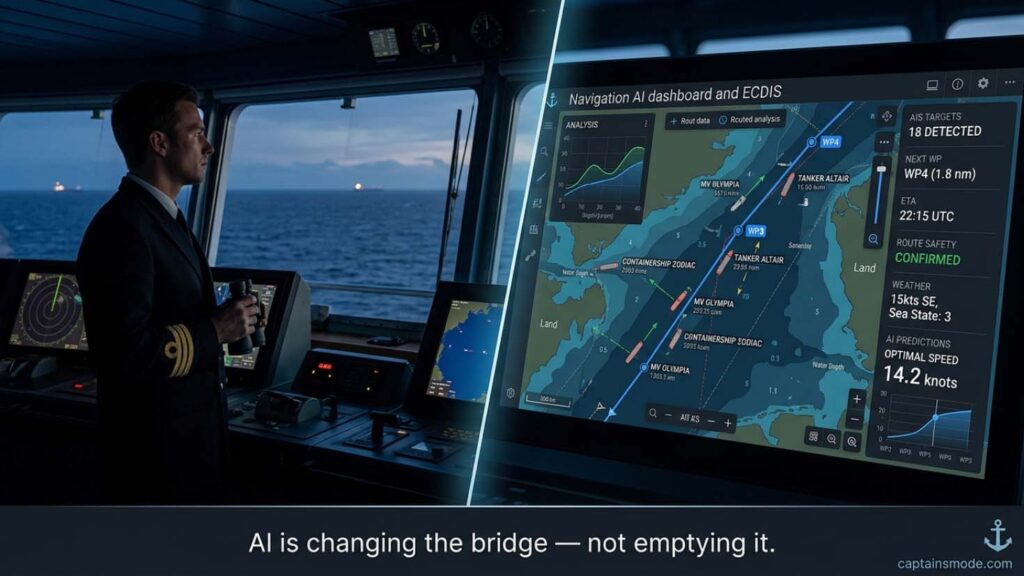
AI can process thousands of AIS targets simultaneously. It can flag a developing close-quarters situation.
But deciding what to do in that situation – weighing COLREGs, erratic vessel behavior, environmental factors, and consequences – still requires a trained human brain.
A vessel on a collision course in restricted visibility, behaving unexpectedly, is not a data problem. It is a judgment call.
Key takeaway: Ships are complex, physical, dynamic systems operating in hostile environments. Full automation is achievable in controlled test settings. At sea, it remains genuinely difficult.
🤖 What AI Is Already Doing on Ships Today
AI tools are onboard right now. They are genuinely useful. And they are functioning as crew assistants, not crew replacements.
| AI Application | What It Does | Key Players |
| Collision avoidance | Computer vision detects objects radar misses | Orca AI |
| Predictive maintenance | Monitors machinery health, predicts failures | Rolls-Royce, Wärtsilä |
| Route optimization | Calculates fuel-efficient routes using weather and current data | Multiple vendors |
| Automated reporting | Pre-fills logs, noon reports, compliance documents | Fleet management platforms |
| Cargo monitoring | Tracks cargo conditions and reefer performance | Integrated ship systems |
| Fleet performance | Shore-side AI dashboards track KPIs across a fleet | Maersk, Wärtsilä |
None of these tools empty the deck, bridge, or the engine room.
They reduce administrative workload. They improve decision-making. They give crews better information, faster.
That is a good thing especially for seafarers already stretched thin.
🛳️ The Reality of Maritime Autonomous Surface Ships (MASS)
MASS – Maritime Autonomous Surface Ships – are vessels that can operate with reduced or no crew. They may be remotely controlled from shore or guided by onboard AI systems.
They are real. They are being tested. They are not yet a threat to the mainstream maritime workforce.
What the IMO MASS Code Actually Says
The IMO adopted the MASS Code in May 2026. It came into effect (non-mandatorily) on July 1, 2026.
Key points from the Code:
- It provides a framework for testing and operating autonomous vessels safely
- It emphasizes human oversight throughout the development process
- It acknowledges an explicit “experience-building phase” – the industry is still learning
- It does not mandate crewless ships or set timelines for full autonomy
This is a regulatory green light for careful, phased development not a signal that seafarers are being phased out.
Remote Control ≠ Full Autonomy
Most operational “autonomous” vessels today are remotely operated.
A qualified person monitors and controls them from a shore control center. That person is still a seafarer – just working from land instead of a bridge.
The Barriers That Remain
| Barrier | Why It Slows Full Autonomy |
| Regulatory | SOLAS, STCW, and flag state laws still require crew on most vessel types |
| Liability | Legal responsibility for autonomous ship accidents is unresolved |
| Cybersecurity | Remote vessels are high-value targets for hacking and sabotage |
| Emergency response | Fire, flooding, and medical emergencies need humans on board |
| Port infrastructure | Most global ports cannot handle crewless vessel arrivals |
| Insurance | Underwriters remain cautious without sufficient loss history data |
Full autonomy for large ocean-going ships is not around the corner. The barriers are not primarily technical. They are legal, operational, and institutional.
⚠️ Which Seafaring Jobs Are Most (and Least) Vulnerable?
Not all roles carry the same risk. Here is an honest breakdown based on what AI can and cannot realistically automate.
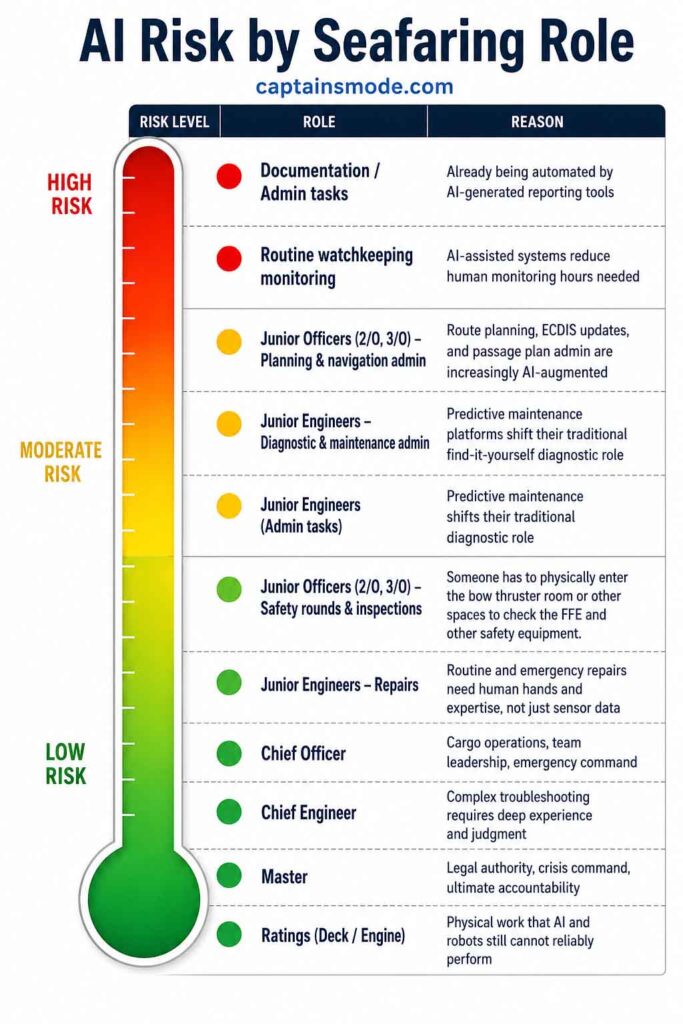
| Risk Level | Role | Reason |
| 🔴 High | Documentation / Admin tasks | Already being automated by AI-generated reporting tools |
| 🔴 High | Routine watchkeeping monitoring | AI-assisted systems reduce human monitoring hours needed |
| 🟡 Moderate | Junior Officers (2/O, 3/O) – Planning & navigation admin | Route planning, ECDIS updates, and passage plan admin are increasingly AI-augmented |
| 🟡 Moderate | Junior Engineers – Diagnostic & maintenance admin | Predictive maintenance platforms shift their traditional find-it-yourself diagnostic role |
| 🟡 Moderate | Junior Engineers (Admin tasks) | Predictive maintenance shifts their traditional diagnostic role |
| 🟢 Low | Junior Officers (2/O, 3/O) – Safety rounds & inspections | Someone has to physically enter the bow thruster room or other spaces to check the FFE and other safety equipment. |
| 🟢 Low | Junior Engineers – Repairs | Routine and emergency repairs need human hands and expertise, not just sensor data |
| 🟢 Low | Chief Officer | Cargo operations, team leadership, emergency command |
| 🟢 Low | Chief Engineer | Complex troubleshooting requires deep experience and judgment |
| 🟢 Low | Master | Legal authority, crisis command, ultimate accountability |
| 🟢 Low | Ratings (Deck / Engine) | Physical work that AI and robots still cannot reliably perform |
Can AI Replace a Ship Captain?
This is the question most people actually want answered.
What AI does well in a captain’s role:
- Optimizing routes based on weather and fuel data
- Processing ECDIS, AIS, and radar faster than any human
- Running collision avoidance calculations continuously
- Monitoring multiple systems simultaneously
What AI cannot do:
- Hold a Certificate of Competency under STCW
- Bear legal responsibility when things go wrong
- Use expert judgement backed by years of experience
- Make ethical decisions during a maritime casualty
- Lead a crew under extreme stress and fear
- Communicate with pilots, VTS, other ships, and port authorities with contextual judgment
- Sign off on legally binding documents
The Master is not just a navigator.
The Master is the legal representative of the shipowner, the safety commander, and the final decision-maker in every emergency. No algorithm carries that weight.
Bottom line: AI will help captains make better decisions. It will not replace them.
🔭 The Most Likely Future for Seafarers
Here is a realistic timeline – stripped of both hype and unnecessary fear.
Short Term: Now to 5–10 Years
- Routine paperwork is largely automated across the industry
- Predictive maintenance becomes standard on well-managed fleets
- Some short-sea and ferry routes trial reduced crews with shore-side support
- Demand for tech-savvy, data-literate officers increases significantly
- Shore-based remote operator roles emerge as a new maritime career path
Medium Term: 10–20 Years
- Small, specialized vessels on fixed routes may operate with skeleton crews
- Conventional ship crew sizes decrease modestly – not dramatically
- Officers spend more time analyzing data and less time generating it
- New certifications for autonomous system oversight become standard
Long Term: Beyond 20 Years
- Large container ships, tankers, and bulk carriers remain crewed
- Regulation, insurance, emergency response, and port infrastructure continue to require human presence
- The job looks very different – far more technical, far less administrative
The seafarer who adapts – who learns the tools, understands the data, and develops stronger technical and leadership competencies – will be in demand, not in danger.
The industry’s existing officer shortage makes that almost certain.
✅ Final Verdict
AI will not replace seafarers. It will change what they do.
Routine tasks, administrative burdens, and monitoring duties that consume crew time today will increasingly be handled by machines.
That is not a threat. For anyone who has spent time doing manual noon reports and maintenance logs, it is a relief.
What remains irreplaceable: physical presence, human judgment, legal accountability, and the ability to respond to the unexpected. The ocean demands all of these, on every single voyage.
The future belongs to seafarers who work with AI – not those who wait to be replaced by it.
❓ Frequently Asked Questions
Will AI replace ship captains?
No. The Master holds legal responsibility, commands the crew in emergencies, and makes judgment calls no AI system is authorized or equipped to make. AI will assist captains. It will not replace them.
Can autonomous ships operate without any crew?
A small number of vessels on short, controlled routes already do. But for the vast majority of ocean-going ships, regulation, insurance requirements, emergency response needs, and port infrastructure still demand crew on board.
What is a Maritime Autonomous Surface Ship (MASS)?
A MASS is a vessel that can operate with reduced or zero crew, either remotely controlled from shore or guided by onboard AI. The IMO adopted a non-mandatory MASS Code in May 2026, providing a framework for their safe development and testing.
Which maritime jobs are most at risk from AI?
Documentation, administrative tasks, and routine monitoring face the most automation pressure. Roles requiring physical presence, complex judgment, or legal accountability – Master, Chief Engineer, ratings – are least at risk.
Will crew sizes decrease because of AI?
Modestly, and over time – particularly on short-sea and specialized vessels. Large ocean-going ships are unlikely to see dramatic crew reductions in the near term due to regulatory and operational requirements.
How is AI currently used in the shipping industry?
AI is deployed for predictive maintenance, route and weather optimization, collision avoidance, automated reporting, cargo monitoring, and fleet performance tracking. These tools assist crews. They do not replace them.
Will deck officers still be needed in the future?
Yes. The role will evolve toward greater technical competency and data literacy. But deck officers remain essential for navigation decisions, cargo operations, emergency response, and crew leadership.
Can AI perform ship maintenance and repairs?
Not reliably. AI can predict when maintenance is needed. But actual repairs- especially in confined spaces, at sea, or under emergency conditions, still require skilled human hands.
May the winds be in your favor.
Leave a Reply