


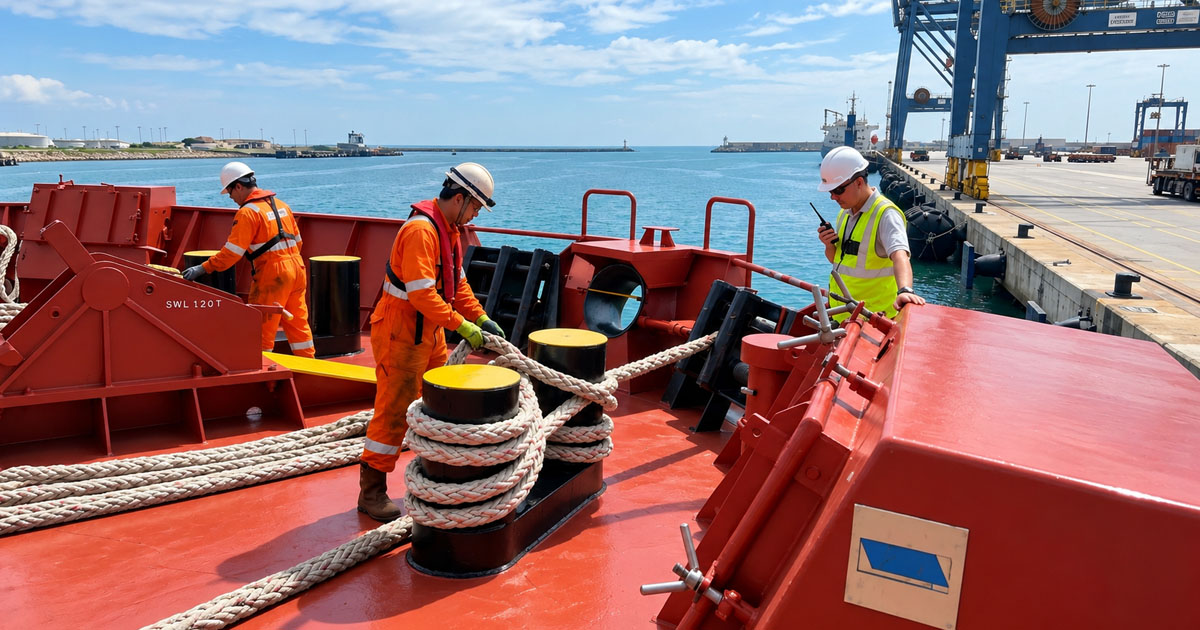
Sending mooring lines ashore means transferring the ship’s ropes to the shore mooring gang during berthing.
The crew may throw a heaving line directly ashore or use a mooring boat to carry the ropes.
The main challenge is controlling the slack, preventing the ropes from tangling, and coordinating with the shore gang while the ship is still moving.
In this guide, we’ll show you how to send mooring lines ashore, coordinate with the shore gang, control rope slack, and report when the lines are fast.
✅ Key Takeaway: To send mooring lines ashore, wait for the master’s order, communicated through the officer in charge at the mooring station. Pass the heaving line or lower the ropes for the mooring boat. Control the slack while the shore gang secures the lines. Once secured, adjust their tension as directed and report their status to the bridge.
🧠 How Are Mooring Lines Sent Ashore?
Mooring lines are sent ashore using a heaving line, a messenger line when needed, or a mooring boat, depending on the berth arrangement.
A heaving line is a light rope used to transfer a heavier line to the shore mooring gang.
For particularly heavy mooring ropes or wires, a messenger line may be used between the heaving line and the main mooring line.
The shore gang pulls the heaving line, followed by the messenger, to bring the heavier mooring line toward the bollard.
A mooring boat may be used when the line must be secured to a dolphin, when the bollard is farther away, or when boat assistance is provided.
Throughout the transfer, the ship’s crew controls the payout.
For an overview of the equipment involved, read the Ultimate Guide to Mooring Operations.
📌 Note: Before sending the ropes, the mooring station should have the required lines and equipment ready.
⚓ Which Mooring Lines Should Be Sent Ashore First?
The master, in consultation with the pilot, decides which mooring lines go ashore first based on the ship’s position, terminal layout, and berthing operation.
In my experience, spring lines are often sent first to help position the ship alongside the jetty. Breast lines follow, then the head/ stern lines.
However, the sequence can change depending on the berth arrangements and the master’s maneuvering plan.
Since we have two spring line locations, a forward spring may be sent first to help check the ship’s movement, particularly on smaller vessels. In other cases, forward and aft springs may be sent together.
The mooring station must follow the bridge’s instructions rather than deciding the sequence independently.
If the ship is close enough to send a line but no order has been given, the officer in charge can inform the bridge.
Aft station: “Captain, we will now send the springs aft.”
The master may reply:
Bridge: “Go ahead.”
Once permission is received, the crew can proceed.
🔍 Insight: There is no single line sequence for every berth. The master decides the order based on the circumstances and the pilot’s advice.
🚢 How to Send Mooring Lines Ashore Step by Step
The ship’s crew transfers each mooring line under the direction of the officer in charge, while coordinating with the bridge and shore mooring gang.
Step 1: Wait for the Master’s Instruction
The bridge tells the forward or aft mooring station when to send the ropes.
Sometimes, the master allows the crew to throw the heaving line as soon as the shore gang is within reach.
If a mooring boat is involved, the master may instruct the station to lower the lines to a specified height above the water, such as one meter, for collection.
The requested height depends on the operation and the mooring boat.
❗ Important: Do not begin transferring the ropes until the operation has been authorized.
Step 2: Prepare the Heaving Lines
Keep heaving lines ready for the mooring rope being sent ashore.
It is good seamanship to keep a spare nearby because the distance or arrangement may require additional length.
Attach the heaving line securely to the mooring rope’s eye, using the ship’s approved method.
The connection must hold during transfer but should not become unnecessarily difficult to release.
Experienced able seafarers (ABs) are usually familiar with this task.
Step 3: Pass the Heaving Line to the Shore Gang
When the ship is close enough and permission has been given, throw the heaving line toward the shore mooring gang.
The shore personnel receive the light line and use it to pull the heavier mooring rope ashore.
Keep the rope controlled as the shore gang begins pulling.
If a mooring boat is used, the ship’s crew lowers the mooring line for the boat to collect.
The boat then carries the rope toward the designated shore bollard.
Step 4: Pay Out the Mooring Rope Slowly
As the shore gang pulls, the ship’s crew pays out the mooring rope.
Do not release excessive slack at once.
Too much slack may cause the rope to tangle, drift in the water, or become fouled on terminal structures.
The officer in charge watches the rope and signals the winch operator to adjust the payout.
The aim is to provide enough rope for the shore gang without allowing unnecessary slack to accumulate in the water.
Provide enough slack for the receiving crew while maintaining control of the line.
⚠️ Warning: Too little slack can also be dangerous. It may make the rope difficult for the mooring boat to pull or place excessive physical strain on the shore crew when they secure it on the bollard.
Step 5: Wait for the Shore Gang to Secure the Line
The shore mooring gang places the rope’s eye over the designated bollard.
The ship’s crew continues monitoring the line while the shore personnel complete the connection.
Once the shore gang signals that the rope is secured and ready, the officer in charge can direct the winch operator to heave, in coordination with the bridge.
⚠️ Warning: Never begin heaving a line before receiving confirmation that the shore gang has secured it and personnel are clear.
If the bridge orders heaving before shore confirmation, inform the bridge that the line is not yet ready. Do not start the movement until the situation has been clarified.
Premature heaving may injure shore personnel or create an unsafe situation at the bollard.
Step 6: Adjust the Lines as Directed
When handling paired mooring lines, the officer in charge checks that both ropes are working together.
For example, when two spring lines are secured ashore, the crew adjusts them so their lengths and loads are as even as practicable.
Do not assume two lines share the load equally simply because both are connected.
Continue coordinating with the bridge while the ship moves into its final position.
For winch handling and brake settings, see Mooring Winch Split Drum: What the Deck Crew Needs to Know.
Step 7: Report When All Lines Are Fast
Once the required mooring lines at the station are secured, the officer in charge reports their status to the bridge.
For example:
Aft station: “Bridge, aft station. All lines fast aft, four-two-two.”
In my experience, it is good practice to include the mooring arrangement when reporting.
The bridge can then confirm the status of both mooring stations.
The ship is considered all fast when the required mooring arrangement has been secured and confirmed.
For more examples of shipboard reporting, see Mooring Commands and Responses Over Ship Radio.
🚤 How Does a Mooring Boat Change the Operation?
A mooring boat carries the ship’s mooring lines to shore when direct transfer is not suitable.
The main difference is that the ship’s crew must coordinate with the boat as well as the bridge.
The boat may collect one line, two lines, or several lines during a transfer.
However, the number of lines handled at once must be agreed upon.
In my experience, the master may initially instruct the crew to send two lines at a time.
If the mooring boat requests four ropes instead, the mooring station should report that request to the master before changing the arrangement.
The boat crew’s preference does not automatically replace the master’s instruction.
But most of the time,the master may agree to the change since the boat can safely handle the additional lines.
🎛️ How Does the Officer in Charge Control Mooring Line Slack?
The officer in charge monitors the mooring rope and directs the winch operator as the shore gang pulls.
The officer must be able to observe the rope’s movement and communicate clearly with the crew.
Three common instructions are used during this part of the operation.
| Instruction | Action |
| Heave | Pull in the mooring rope |
| Stop | Stop the winch movement |
| Slack | Pay out more rope |
The officer adjusts these instructions according to the shore gang’s progress.
For example, if the rope begins accumulating in the water, the officer may signal the winch operator to stop paying out.
If the shore gang needs more length, the officer can direct the operator to provide additional slack.
The officer must also watch the ship’s movement because the distance between the ship and shore may change during berthing.
During this stage, the ship’s movement can also change the tension on the ropes. Read How Engine Movements Affect Mooring Lines for the warning signs to recognize.
📌 Note: When two or more ropes are being lowered and one develops excessive slack, the officer in charge may signal the mooring boat to stop pulling. The crew can then adjust the slack to bring the paired lines to nearly equal lengths before signaling the boat to resume.
⚓ Can Several Mooring Lines Be Sent Ashore Together?
Several mooring lines may be transferred together when the shore gang or mooring boat can safely handle them and the master approves.
In my experience, the method depends on the type of mooring line, whether wire or synthetic rope, and the people receiving it.
For spring lines, the crew may send both together or one at a time.
For breast and stern lines, the transfer may involve:
- One line at a time.
- Two lines together.
- Several lines together, when agreed upon and manageable.
The main consideration is whether the receiving crew can handle the ropes safely.
Sending more lines at once is not automatically better.
💬 Firsthand Experience: Mooring Boat Requesting Four Lines in Sines
During one of our berthing operations in Sines, Portugal, we had already lowered two headlines for the mooring boat to collect and bring ashore.
The master initially instructed us to give the mooring boat two lines at a time.
However, the mooring boat wanted to take four lines together.
We informed the boat that the instruction was to take only two.
When the boat insisted, we reported the request to the captain.
The captain had no problem allowing four lines, provided the mooring boat could handle them.
After receiving his approval, we gave the boat four lines at once.
The lesson from that operation was simple: when the receiving crew requests a different arrangement, confirm the change with the master before proceeding.
❌ Common Mistakes When Sending Mooring Lines Ashore
- Sending ropes without the master’s permission. Even when the shore gang is ready, the mooring station must coordinate with the bridge.
- Paying out too much or too little slack. Excessive slack may cause fouling, while insufficient slack can make the transfer difficult.
- Ignoring the shore gang’s signals. The officer in charge must coordinate the operation before directing the winch operator.
- Changing the number of lines without approval. A mooring boat may request more ropes, but the master must approve changes to the agreed sequence.
- Heaving before the shore connection is confirmed. Wait until the shore gang has secured the rope and signaled that it is ready.
Another dangerous mistake is leaning over the ship’s side to inspect a line caught below. Read Why You Should Never Look Over the Ship’s Side During Mooring for a firsthand near-miss involving a spring line.
❓ FAQ
Can spring lines be sent ashore before breast lines?
Yes. The master may order spring lines first when they are needed to control the ship’s position along the berth.
What happens if the heaving line is too short?
An additional heaving line may be connected when the ship’s approved procedure allows it. The crew should ensure the connection is secure before continuing.
Who controls the mooring winch during line transfer?
The winch operator handles the equipment under the direction of the officer in charge at the mooring station.
Can a mooring boat carry four lines at once?
It may be possible if the boat crew can safely handle them and the master approves. The number depends on the circumstances, not a fixed rule.
What should the officer report when only one station has finished?
The officer should identify the station, such as “All lines fast aft,” rather than reporting that the entire ship is all fast.
🧭 Final Thoughts
Sending mooring lines ashore requires cooperation between people who may not be able to speak directly to one another. The officer in charge must keep communication clear and recognize when a change needs the master’s approval.
Before completing the operation, remember:
- ✅ Keep the bridge informed of progress.
- ✅ Watch the shore gang’s response.
- ✅ Report the correct mooring station status.
⚠️ Follow your company procedures and local port rules. They override this article.
Have you experienced a mooring boat requesting more lines than the master initially ordered? Share how your crew handled the situation in the comments.
May the winds be in your favor.
Leave a Reply