


All merchant ships, regardless of type, share a set of core structural components essential for navigation, propulsion, safety, and daily operations.
Understanding these parts is fundamental for every seafarer, especially cadets and junior officers preparing for life at sea.
This guide breaks down the most important ship parts and explains their functions based on real-world application and SOLAS construction standards.
Essential Parts of a Merchant Ship and Their Functions
1. 🚢 Hull and Keel
The hull is the main body of the vessel that provides buoyancy and supports the entire ship structure.
It extends from the bow (front) to the stern (rear) and serves as the foundation upon which all other components are built.
Key parts of the hull include:
- Keel – Known as the “spine” or “backbone” of the ship, running longitudinally at the bottom centerline of the hull. It provides structural integrity and balance.
- Frames and Girders – These form the ship’s skeleton, giving it strength and shape.
- Shell Plating – The external plating that encloses the hull and ensures watertight integrity.
👉 The hull also houses ballast tanks, cargo holds, and fuel tanks, depending on the ship type.

2. ⚓ Bow and Forecastle (Foc’sle)
The bow is the forward-most part of a ship, designed to cut through water and minimize resistance during navigation.
It often includes the bulbous bow, a submerged protrusion that improves hydrodynamic efficiency and reduces wave drag.
Main components at the bow:
- Bulbous Bow – Enhances fuel efficiency and improves stability.
- Forecastle Deck (Foc’sle) – Raised deck forward of the main deck, usually housing mooring equipment and anchors.
- Chain Locker – Storage space for anchor chains.
- Anchors and Windlass – Used for anchoring operations, secured on the bow area.
📌 In high seas, the bow is the first to encounter waves, so its structure is streamlined to withstand repeated impact and spray.
3. ⚓ Midship Section
The midship refers to the central portion of the ship between the bow and stern.
It is often the widest and most stable part of the vessel and serves as the core structural zone.
Highlights:
- Provides balance and stability.
- Houses cargo holds, ballast tanks, or engine intakes depending on ship design.
- Measurement reference point: located between the forward and aft perpendiculars– key points in naval architecture.
📏 In shipbuilding and navigation, the midship is also used as a baseline for load line calculations, trim, and stability assessments.
4. ⚓ Stern and Aft Structure
The stern is the rear end of the vessel, where most propulsion and steering components are located.
Main features of the stern:
- Propeller and Rudder – Responsible for ship movement and steering (covered in detail later).
- Towing Gear – Includes towing brackets, fairleads, and emergency towlines.
- Stern Frame – Supports the rudder and propeller assemblies.
- Shaft Tunnel Access – For maintenance of the propulsion shaft leading to the engine room.
📌 The stern’s shape can affect wake turbulence, fuel efficiency, and the maneuverability of the vessel.
5. ⚙️ Engine Room and Machinery Spaces
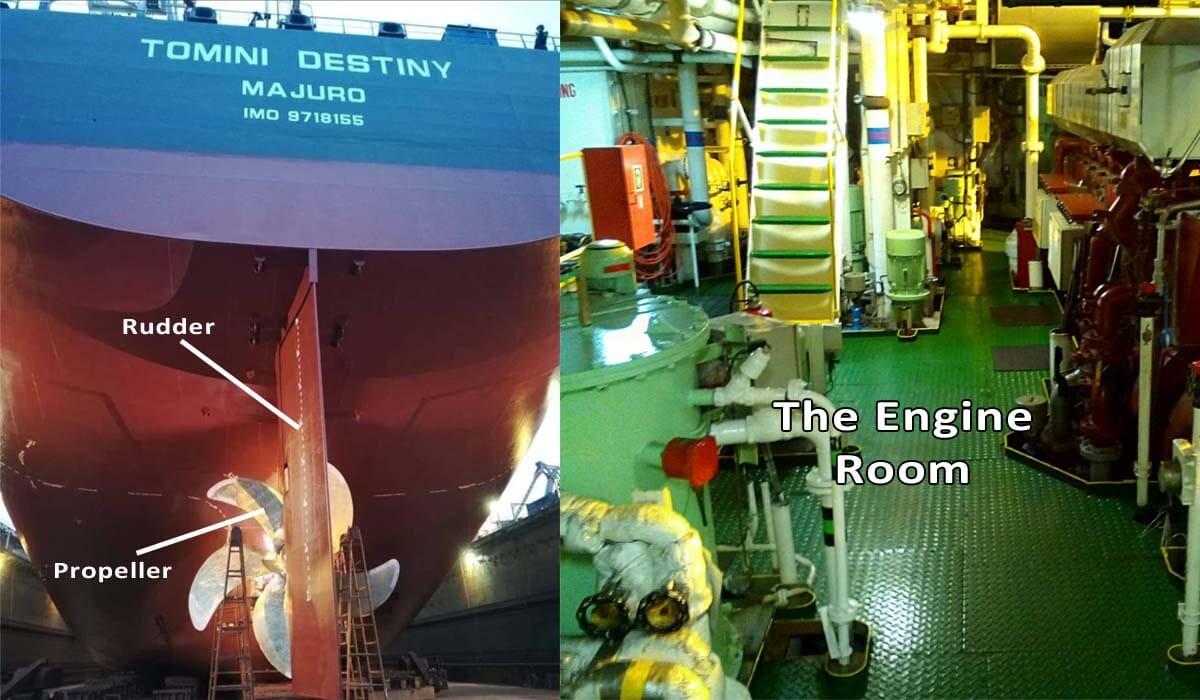
The engine room is the heart of the ship’s mechanical operations.
It’s typically located in the aft section below the accommodation block and houses most of the vessel’s machinery.
Key components found in the engine room:
- Main Engine – Powers the propeller for forward and reverse movement.
- Generators – Supply electricity throughout the vessel. Includes emergency generators.
- Boilers – Provide steam for various systems.
- Pumps – Used for ballast, bilge, fuel, and cooling operations.
- Air Compressors & Purifiers – Support engine start-up and fuel quality control.
⚠️ Access to the engine room is restricted to engine crew. High noise, heat, and mechanical risk zones require full PPE and permit-to-work protocols.
6. 🛏️ Accommodation Block (Living Quarters)
The accommodation block, or simply “accommodation,” is the living space for all personnel onboard.
It includes cabins, dining and recreation areas, sanitary facilities, and offices.
Common facilities:
- Cabins – Sleeping quarters for officers, ratings, and passengers.
- Messroom & Galley – Where food is prepared and served.
- Day Rooms, Gym, Laundry – For rest and leisure.
- Ship Office – For the Master and officers’ administrative tasks.
- Deck Levels – Named by position (e.g., upper deck, boat deck, bridge deck).
📌 Accommodation layout follows SOLAS guidelines for habitability, emergency egress, and fire safety.
7. 🧭 The Bridge and Bridge Wings
The bridge is the navigation and command center of the vessel.
Located at the top of the accommodation block, it provides 360° visibility and houses all navigational instruments and communication systems.
Standard equipment on the bridge:
- Radar and ECDIS
- Gyro and Magnetic Compass
- VHF and GMDSS Communications
- Engine Telegraph & Rudder Angle Indicator
- BNWAS, AIS, Speed Log, and Autopilot
Bridge extensions:
- Bridge Wings – Open-air platforms extending to port and starboard for maneuvering visibility, especially during docking.
- Monkey Island – Located above the bridge, houses critical navigation equipment.
🚨 According to STCW, watchkeeping officers must maintain proper lookout and logkeeping while on the bridge.

8. 🧭 Port Side and Starboard Side
These are fixed directional terms used onboard:
- Port Side – The left side of the ship when facing forward (toward the bow).
- Starboard Side – The right side when facing forward.
🧠 Pro tip for cadets: Port and Starboard never change regardless of the direction you’re facing. These nautical terms are vital for communication, navigation, and emergency response.
9. 🔁 Propeller
The propeller is a rotating, fan-like device that generates thrust to move the ship forward or astern.
It is driven by the main engine through a shaft.
- Most merchant ships use a single screw (propeller).
- Can be fixed-pitch or controllable-pitch.
10. 🧭 Rudder
Installed directly behind the propeller, the rudder controls the ship’s direction by deflecting water flow.
- Steering gear located in the steering flat controls rudder movement.
- Most vessels use a conventional semi-balanced rudder.
📌 The propeller and rudder are visible only when the vessel is in dry dock or operating at very light draft.
11. 🔄 Thrusters
Thrusters are lateral propulsion devices used for low-speed maneuvering:
- Bow Thruster – Located near the bow, allows side-to-side movement.
- Stern Thruster – Located aft (if fitted), supports turning or sideways movement.
🌀 Thrusters do not replace the main propulsion system but assist during berthing, unberthing, and tight maneuvering.
12. 🌫️ Funnel (Exhaust Stack)
The funnel is the vertical structure that vents exhaust gases from the main engine, auxiliary engines, and boilers.
It’s typically located behind the accommodation block and is one of the most visible external features of a ship.
Functions:
- Discharges exhaust safely above crew areas.
- Reduces back pressure on engines.
- Serves as an identifier. Company colors and logos are often painted on the funnel.
📌 Funnel height and design follow MARPOL Annex VI standards to minimize emissions and improve dispersion.
13. 📡 Mast and Navigational Equipment
A mast is a tall vertical structure that supports essential navigational and communication equipment.
Depending on the ship design, you may find:
- Foremast – Located near the bow.
- Main Mast – Near the bridge or on Monkey Island.
- Aft Mast – Found on larger vessels or special types.
Equipment commonly installed on masts:
- Navigational lights (per COLREGs)
- Radar scanners
- VHF and GMDSS antennas
- Anemometers
- Fog horns and signal lights
- Searchlights and CCTV
📏 Mast height is regulated to ensure visibility and electromagnetic performance.
14. 🐒 Monkey Island (Compass Platform)
Monkey Island is the open platform directly above the bridge roof.
It serves both as a backup navigation site and a mounting area for sensitive instruments.
Found here:
- Magnetic Compass – Still required by SOLAS even in the era of gyro systems.
- Radar Masts and Antennas
- VDR (Voyage Data Recorder) Capsule
- GMDSS Aerials
- Signal Flags and Lights
🧠 The name “Monkey Island” dates back to the age of sail when lookouts would climb the highest part of the ship- like monkeys!
15. 🛳️ Decks and Ship Levels
A deck is the horizontal surface on a ship, equivalent to floors in a building.
Decks serve different functions depending on their location:
- Main Deck – Usually the uppermost complete deck.
- Forecastle Deck – Forward raised deck.
- Poop Deck – Aft raised deck (more common on older ships).
- Tank Top – The lowest deck, forming the ceiling of the double bottom tanks.
Decks are named for orientation and function (e.g., bridge deck, upper deck, engine room platform deck).
📌 Seafarers use these names for reporting locations, emergency musters, and maintenance planning.
16. 🏗️ Ship’s Cranes and Lifting Gear
Not all vessels have cranes, but many are equipped with them for cargo operations or storing ship supplies.
Types:
- Provision Cranes – For lifting stores and spares, usually located aft.
- Cargo Cranes – Found on general cargo ships, multipurpose vessels, and tankers.
- Hydraulic Davits – For launching lifeboats and rescue boats.
⚙️ These lifting appliances follow SOLAS and Load Line Convention safety standards and must be load-tested regularly.
17. 🌊 Ballast Tanks and Stability Systems
Ballast tanks are compartments filled with seawater to adjust the ship’s trim, list, and stability.
They’re located along the hull- bottom, sides, and ends.
Functions of ballast:
- Maintains even keel and draft.
- Lowers center of gravity for stability.
- Protects cargo holds from direct hull impact.
Ballasting is managed using:
- Ballast pumps and valves
- Ballast Water Treatment Systems (BWTS) – required by IMO regulations to prevent ecological transfer.
📌 Proper ballasting and de-ballasting is critical during cargo operations, dry-docking, and rough weather navigation.

18. 📦 Cargo Space (The Earning Area)
The cargo space is the area designated for storing goods during transit. It varies depending on vessel types:
- Container Ships – Use container bays, stackable both above and below deck.
- Bulk Carriers – Have large cargo holds with hatch covers.
- Tankers – Use liquid-tight tanks with inert gas systems.
- Ro-Ro Ships – Use deck spaces with ramps for wheeled cargo.
Cargo spaces are designed for maximum capacity, structural integrity, and compliance with IMO and SOLAS rules.
📌 Cargo areas directly affect revenue – they are called the ship’s “earning space.”
📚 FAQ Section
❓ What are the main parts of a merchant ship?
The main parts include the hull, bow, stern, engine room, accommodation block, bridge, propeller, rudder, mast, decks, ballast tanks, and cargo space.
❓ What is the function of the rudder?
The rudder steers the ship by redirecting the flow of water from the propeller. It’s essential for directional control.
❓ Why are ballast tanks important?
Ballast tanks help maintain ship stability, correct trim or list, and ensure safe operations during loading or rough weather.
❓ What is Monkey Island used for?
Monkey Island is the platform above the bridge that holds the magnetic compass, antennas, radar, and signal equipment.
❓ Are all ships equipped with cranes?
No. Cranes are common on multipurpose, general cargo, and tankers. Bulk carriers and container ships often rely on port equipment.
✅ Conclusion: Why Seafarers Must Know Ship Parts
Familiarity with ship components is essential for safe operations, clear communication, and professional growth at sea.
From bridge to engine room, and bow to stern, every part plays a role in vessel performance and crew safety.
Whether you’re preparing for board exams or daily onboard tasks, understanding your ship’s layout is a fundamental seafarer skill.
May the winds be in your favor.
Leave a Reply