

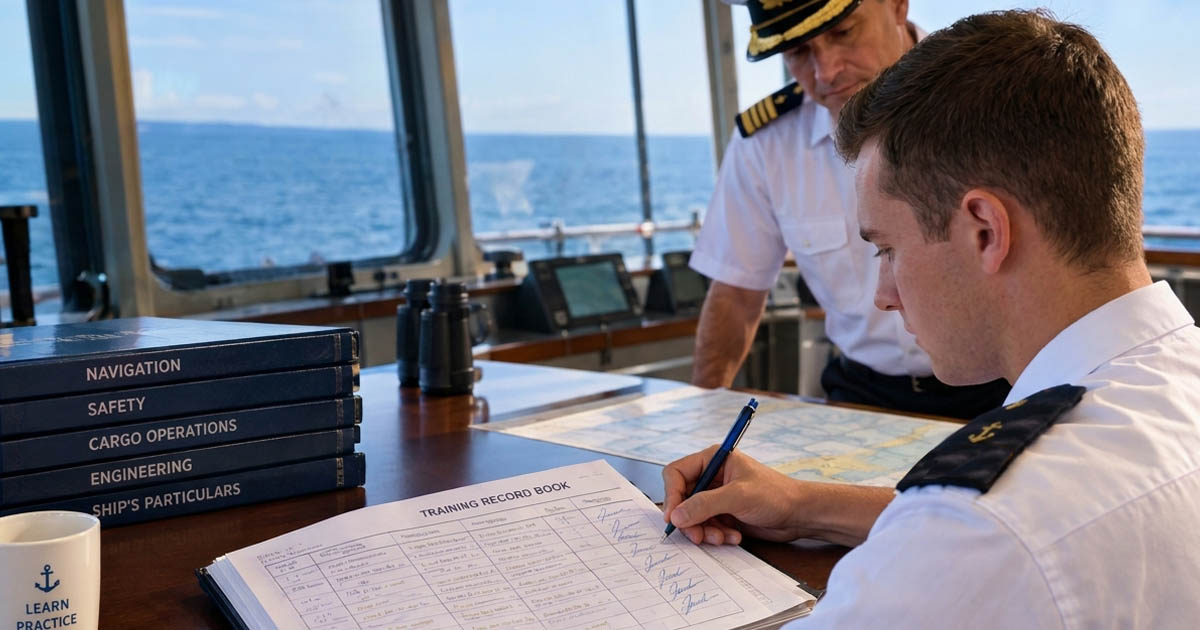
A Training Record Book can end up full of signatures, and that feels like progress. But here’s a better question: if someone took your TRB away and asked you to do the job, could you?
IMO guidance describes the TRB as a record of the practical training and experience you gain at sea, and your progress toward completing it. This is even recognized by the USCG.
A signature says a task was observed, demonstrated, or assessed. It doesn’t necessarily mean you can perform it tomorrow without supervision.
The signatures matter, and you need them. The problem starts when getting the signature becomes the goal.
When the signature comes with questions
When I was a cadet, my Captain was strict about this. Every time I asked him to sign my monthly TRB, I knew he might ask me questions about what I had recorded. He was one of those types of captains.
My Chief Officer was even tougher. He would grin when I handed him my TRB because I knew what was coming: a gruelling interview on a Saturday afternoon.
At the time, it was frustrating. Looking back, I understood the point. The signature was supposed to be tied to what I had actually experienced and learned, not to a page I had filled in.
The day the Captain called us in
Around my third month on board, the Captain called my fellow engine cadet and me in with our TRBs.
He looked at mine first. I had too few signatures, so I got a good lecture. Then he asked for the engine cadet’s book, and he went ballistic. The engine cadet had written his name and the ship’s name.
Nothing else.
This is actually one of the 24 mistakes first-time cadets make on board.
After that, we updated our books every week, and we knew the Captain, Chief Officer, or Second Engineer could ask about anything we had recorded.
How I worked through mine
There were some activities in my TRB that I didn’t understand. So I went to the bridge and asked the officer.
For navigation topics, he would explain the procedure until I understood it, then let me perform it so I could get real exposure.
I kept working at it, and only then did I ask him to sign. It was the same with the third officer for the parts I didn’t understand.
The order was always: ask, understand, do it, then sign. The signature came last.
Where a signature runs out
Say your TRB shows a signed task on a piece of equipment. An officer asks what it’s used for, and you answer.
He asks about the safety precautions, and you answer. He asks what you’d check before using it, and you hesitate. He asks what could go wrong, and you have no idea.
You have a signature, but the questions have exposed a gap.
If you can’t explain something you’ve recorded, don’t hide behind the signature. Go back and ask. That applies even if it’s already signed.
A signature records that training or assessment happened. Your understanding keeps developing through practice and questions.
Not every task fits your ship
The TRB can contain tasks that apply to different ship types, but I was on a tanker. I asked the third officer about cargo lashings, and he told me we didn’t have them.
That section was for container ships. Other sections were for general cargo ships and bulk carriers.
On a tanker, he could only sign the parts that applied. He said it was fine to leave the rest unsigned, and that if I later joined other ship types, I could ask those officers to teach me and sign them.
You may also not complete your required sea service on one ship. Bring the book to the next ship.
You fill in that ship’s particulars and generally only need signatures for the tasks that are still outstanding.
You don’t repeat tasks that have already been properly completed and signed, but you should refresh them and make sure you still understand them.
Check the details with your school or company because requirements differ.
Important: Don’t invent an experience to fill a box. Ask what the requirement means and whether it applies. Learning why a task doesn’t apply to your ship was worth more than a signature.
Tasks you can only do on board
Some TRB tasks can only be completed properly on board.
Mine included drawing the safety plan, cargo system, stripping system, and ballast system. You draw your actual ship, and you can’t do that at home or in school because you don’t have access to those layouts.
Ask the Chief Officer or Chief Engineer.
For the accommodation safety plan, ask the Chief Officer for a copy and draw it by hand. Do the same for the ballast and stripping systems.
Meanwhile, the Chief or Second Engineer can provide you with the bunker arrangements.
A textbook diagram gives you the concept, but your ship shows you where the real valves and pumps are, and that’s what you’ll deal with as an officer.
Who can sign
Your TRB signatures are not only limited to officers you have on board.
If a superintendent or company representative visits your ship, you may be able to ask for their signature too.
Be ready to answer their questions.
A company representative may be pleased to see that a cadet is actively working through the training requirements and learning the job, since the company is investing in cadets to become future officers.
If you’re not getting the exposure
Sometimes the Captain or Chief Officer doesn’t give you time to rotate to the bridge or engine room.
They may never actually tell you that you’ll only work on deck. Sometimes, they simply don’t arrange the rotation.
Start politely, and pick your moment:
“Chief, I still have these training areas outstanding. If there’s a chance during the next operation, could I join you?”
If an officer refuses to sign a task you believe you have properly completed, calmly ask why. If appropriate, remind them of the company’s training requirements for cadets.
If it continues, ask other officers how to handle it, and if you get the chance, talk to your designated person ashore or your marine superintendent so you’re included in the rotation.
A cadet can’t learn what they’re never exposed to, so raise it early. You can also check my content How Deck Cadets Can Learn More From Their First Ship.
A test before you ask for the next signature
- Can I explain this task and why it’s done this way?
- Can I do it under supervision?
- Can I explain the safety considerations and what could go wrong?
- Do I know when this knowledge is needed in a real situation?
- If I had to do it again tomorrow, would I know where to start?
If yes, the signature means something.
If not, you’ve found something you still need to learn.
Chase the skill
Your TRB isn’t a trophy for having every box filled.
When you become responsible for the job, nobody will care how neat your book looked. They will want to know whether you can do it.
So keep it updated, be honest when you don’t understand something, and don’t fear the officer who questions you about what you recorded.
Those questions may be what turns a signature into evidence that you actually learned the job.
May the winds be in your favor.
Leave a Reply